
EU REACH PFAS Rule Adds Export Declaration Requirement
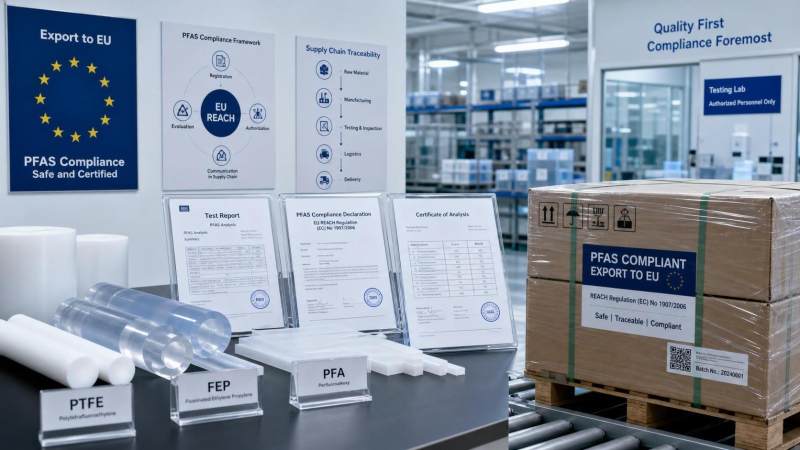
On July 30, 2026, the European Commission formally released the implementation details for the PFAS restriction under Item 77 of REACH Annex XVII, setting a new compliance requirement for exports to the EU from October 1, 2026. For shipments involving PFAS substances, including fluoropolymer materials such as PTFE, FEP, and PFA, exporters will need to provide both a declaration of conformity and a substance concentration test report with the goods. This is worth close attention from PTFE material manufacturers in China, EU importers, and supply chain participants because it affects export documentation, customs timing, and the practical standard for supplier traceability.
What the new requirement clearly sets out
According to the information provided, the European Commission announced on July 30, 2026 the effective implementation details for the PFAS restriction under Item 77 of REACH Annex XVII. The rule specifies that from October 1, 2026, all goods exported to the EU that contain PFAS substances must be accompanied by a declaration of conformity and a substance concentration testing report. The scope described in the provided information includes fluorinated polymer materials such as PTFE, FEP, and PFA.
The same information also states that the requirement directly affects the export process of Chinese PTFE material manufacturers to the EU, including customs clearance timing and compliance costs. It further indicates that importers need to verify in advance whether suppliers have completed REACH-SCIP database registration and whether supply chain traceability capability is in place.
Where the operational pressure is likely to appear
Export shipments may face a stricter document threshold
From an industry perspective, direct trading companies and manufacturers shipping PFAS-related materials to the EU are the first group likely to feel the change. The main reason is straightforward: the requirement is tied to shipment-level accompanying documents. In practical terms, the impact is likely to show up in pre-shipment preparation, document review, and customs-facing submission processes. What deserves closer attention is whether internal export workflows are currently set up to produce compliant declarations and concentration test reports on time for each shipment.
Import-side screening is becoming more front-loaded
EU importers are also directly affected because the provided information makes supplier verification a priority. Their attention is likely to shift further upstream, especially toward checking supplier REACH-SCIP registration status and traceability readiness before goods move. The business impact may therefore appear earlier in the transaction cycle, during supplier qualification, order confirmation, and compliance review, rather than only at the customs stage.
Supply chain coordination may become more document-dependent
For supply chain service providers and procurement teams, the pressure is less about the material itself and more about coordination. Analysis shows that when a rule requires supporting declarations and test reports to travel with the goods, delivery schedules can become more sensitive to documentation readiness. The immediate concern is not only whether documents exist, but whether they are complete, consistent, and traceable across supplier, exporter, and importer records.
What companies should watch before October 1
Check whether affected product lines are already mapped
Companies involved in PTFE, FEP, PFA, or other PFAS-containing materials should first identify which export products fall within the requirement described in the provided information. The key practical issue is whether internal product classification, material records, and shipment files are already linked closely enough to support a conformity declaration and concentration reporting process.
Review documentation readiness against shipment timelines
What deserves closer attention is the gap between a regulatory requirement and day-to-day export execution. Even where companies understand the rule, the operational risk may come from lead times for testing, document issuance, and final shipment release. Businesses should therefore focus on whether compliance files can be prepared in a timeframe that does not disrupt dispatch and customs clearance.
Verify supplier status before orders move downstream
For importers and sourcing teams, the provided information points clearly to advance verification of supplier REACH-SCIP registration status and traceability capability. In practice, this makes supplier screening more important at the front end of procurement. The issue to watch is not only formal registration status, but also whether the supplier can provide supporting records consistently across repeat shipments.
Prepare for customer communication on compliance evidence
Analysis shows that the requirement may also affect commercial communication, especially where buyers expect compliance evidence before shipment or customs filing. Exporters and suppliers should pay attention to how conformity declarations, test reports, and traceability explanations are presented to customers, because document quality and response speed may influence transaction continuity as much as the material qualification itself.
Why this should be read as more than a filing update
Observably, this development is not just a procedural note about one more export document. Based on the information provided, it signals that PFAS-related compliance for EU-bound trade is being pushed deeper into the transactional and supply chain level. That said, it is more appropriate to understand this as a concrete near-term compliance change rather than a basis for broader market conclusions. The confirmed facts establish a new documentation threshold and a clear start date; broader commercial effects will still depend on how companies adjust their verification, testing, and traceability routines in practice.
How the industry may best interpret this stage
At this point, the most reasonable reading is that the rule creates an immediate operational requirement with wider strategic implications still developing. The confirmed impact is on export paperwork, customs efficiency, supplier verification, and compliance cost exposure for PFAS-containing materials shipped to the EU. From an industry perspective, this is best understood as a short-term compliance trigger and a longer-term signal that traceability and document-backed material management are becoming more central in PFAS-related trade.
Basis of this article and what still needs verification
This article is based on the user-provided news title, event date, and event summary concerning the July 30, 2026 announcement of the EU REACH PFAS restriction implementation details. For this type of industry update, relevant source categories would typically include official regulatory notices, company disclosures, industry association updates, authoritative media coverage, and standard or compliance-related documents. No specific official source link was provided in the input, so the exact official publication path still needs to be verified on an ongoing basis. Continued attention should be paid to any subsequent official clarifications, implementation wording, and practical customs or supplier-document expectations tied to the October 1, 2026 effective date.
Recommended News
- 2026.09.14Gel Battery Electrolytes: How Ionic Conductivity and Stability Shape Cell DesignElectrochemistry Fellow
- 2026.09.13Fluoropolymer Extrusion Process: How Melt Control Affects Tube QualityPolymer Synthesis Expert
- 2026.09.12How German Implant Makers Select Medical Polymers for Long-Term BiocompatibilityPolymer Synthesis Expert
The VitalSync Intelligence Brief
Receive daily deep-dives into MedTech innovations and regulatory shifts.