
EU PFAS Rule Extends DoC Duty to Fluoropolymers
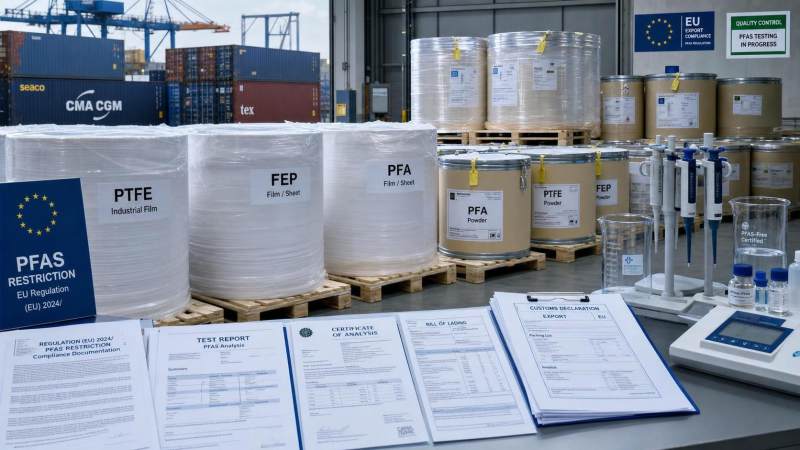
On July 29, 2026, the European Commission formally published the effective text of Regulation (EU) 2026/1422 in the Official Journal, bringing REACH Annex XVII entry 77 on PFAS restrictions into force. From October 1, 2026, PTFE, FEP, PFA and other fluoropolymer-related materials covered by the rule will face a new pre-customs documentation requirement for exports to the EU, including a declaration of conformity (DoC) and a full substance composition file. This matters not only for exporters of fluorinated materials, but also for importers, procurement teams, testing support providers, and delivery planning across the supply chain because compliance preparation now becomes part of shipment readiness.
What the adopted text now requires
According to the information provided, the European Commission published Regulation (EU) 2026/1422 in Official Journal OJ L 2026/187 on July 29, 2026, as the effective text of the PFAS restriction under REACH Annex XVII entry 77. The rule becomes mandatory on October 1, 2026. The published text expressly brings fluoropolymers such as PTFE, FEP, and PFA within scope. It also requires suppliers of fluorinated materials exported to the EU to provide importers, before customs clearance, with a declaration of conformity and a complete substance composition dossier, including reports on monomer residues, degradation products, and trace PFAS impurity testing.
Where the pressure is likely to appear first
Export shipments now depend on document readiness
From an industry perspective, exporters of PTFE and other fluorinated materials are likely to feel the change most directly because the rule links market access to documentation available before customs clearance. The immediate impact is not limited to product classification; it also reaches shipment release timing, file completeness, and coordination with EU-side importers. What deserves closer attention is whether internal export workflows currently treat compliance files as commercial attachments or as mandatory pre-shipment gate documents.
Procurement teams will need deeper upstream material visibility
For raw material buyers and manufacturing companies, the issue is not only whether a finished material contains PTFE, FEP, or PFA, but whether upstream suppliers can support the required composition file. Analysis shows that procurement may need to ask for more than a standard specification sheet, especially where monomer residues, degradation products, and trace PFAS impurity testing reports are required as part of the dossier. This could affect supplier qualification, purchasing lead times, and the timing of order confirmation for EU-bound business.
Import coordination and supply chain service roles become more exposed
EU importers, distributors, and supply chain service providers may also face additional coordination pressure because the rule places practical emphasis on documents being available before customs clearance. Observably, this shifts some risk from a purely technical compliance issue into an execution issue involving customs preparation, file transfer, and document consistency between exporter and importer. Where documentation arrives late or in incomplete form, the effect may surface first in delivery scheduling rather than in product design.
Testing and compliance support may become part of commercial delivery planning
Testing-related and compliance support functions are likely to become more closely tied to shipment planning because the required dossier explicitly refers to monomer residues, degradation products, and trace PFAS impurity testing reports. It is more appropriate to understand this as a documentation-intensive compliance step that may affect handover timing, customer acceptance readiness, and traceability expectations in export transactions.
What companies should review before October 2026
Check whether current product files can support a DoC
Analysis shows that companies shipping fluorinated materials to the EU should first review whether existing technical files are sufficient to support a declaration of conformity under the new rule. Where current records focus mainly on product specifications or routine quality documents, the gap may appear in substance-level composition support rather than in finished-product descriptions.
Map dossier responsibilities across supplier and customer interfaces
What deserves closer attention is who prepares, verifies, and transmits the required composition file. In practice, this affects the interface between upstream suppliers, exporters, and EU importers. Companies may need to confirm early how monomer residue data, degradation product information, and trace PFAS impurity testing reports will be assembled and controlled within transaction documents.
Reassess lead times for EU-bound orders
Observably, the rule introduces a compliance step that sits before customs clearance, so delivery planning may need adjustment even where product formulations remain unchanged. Exporters and procurement teams should pay attention to whether order lead times, booking arrangements, and document cut-off dates still reflect the new compliance sequence.
Watch for execution language in contracts and tender files
Because the provided information does not include further operational guidance, it would be premature to treat implementation outcomes as fully settled. Even so, companies involved in EU-facing sales should monitor whether customer contracts, technical bid documents, purchase terms, or importer onboarding requirements begin to reference the DoC and composition dossier more explicitly as a transaction condition.
Why this looks like an execution signal, not just a policy headline
Analysis shows that this development is better understood as a landed rule change rather than an early policy discussion, because a formal regulation text has been published and a mandatory application date has been stated. At the same time, it remains necessary to keep watching how the requirement is applied in operational terms. Observably, the main industry question now is less about whether the rule exists and more about how consistently documentation expectations will be reflected in customs preparation, importer review, procurement practice, and commercial file management.
How to read the current stage of impact
At this stage, the event is best understood as a concrete compliance and delivery-preparation change for fluorinated material exports to the EU. The confirmed facts already indicate a direct effect on documentation obligations and timing discipline. A rational reading is that companies should treat this as an active implementation signal, while continuing to watch for further clarification in execution practice, document review expectations, and market feedback.
Basis of this article and what still needs verification
This article is based on the user-provided news title, event date, and event summary. For developments of this type, relevant source categories typically include official notices, regulatory publications, customs or trade authority information, industry association updates, standard-setting documents, and reporting by authoritative media. The input identifies the Official Journal publication and the regulation number, but no specific official source link was provided in the input, so the exact source link still needs to be verified on an ongoing basis. Continued observation is also needed on implementing details, compliance interpretation, tender document language, industry feedback, and how companies execute the required documentation in actual export transactions.
Recommended News
- 2026.09.14Gel Battery Electrolytes: How Ionic Conductivity and Stability Shape Cell DesignElectrochemistry Fellow
- 2026.09.13Fluoropolymer Extrusion Process: How Melt Control Affects Tube QualityPolymer Synthesis Expert
- 2026.09.12How German Implant Makers Select Medical Polymers for Long-Term BiocompatibilityPolymer Synthesis Expert
The VitalSync Intelligence Brief
Receive daily deep-dives into MedTech innovations and regulatory shifts.