
ECHA Starts PFAS Limits in Fluoropolymers
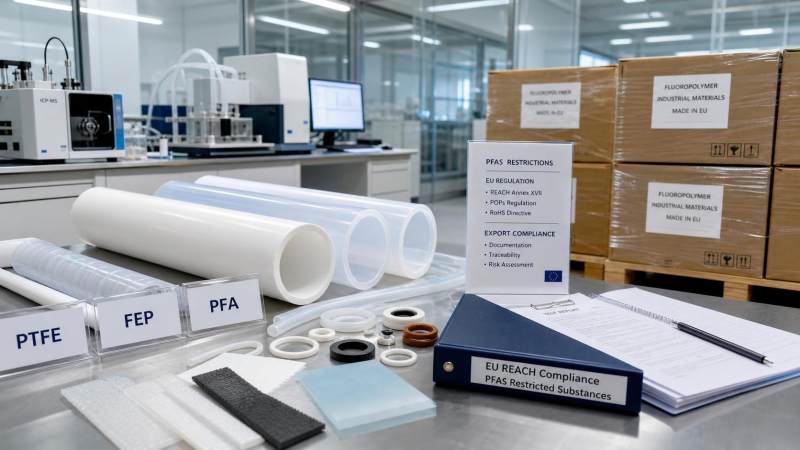
On August 1, 2026, the European Chemicals Agency formally brought into effect the amendment to Item 76 of REACH Annex XVII after announcing it at midnight on July 31. The measure introduces phased restrictions on PFAS, with the first stage targeting non-essential uses of fluoropolymers such as PTFE, FEP, and PFA in applications including seals, coatings, and gaskets. For companies exporting to the EU, the update matters not only as a product compliance issue, but also as a documentation and market access issue that directly affects supplier qualification, buyer review, and shipment readiness.
What the amendment confirms from August 1
Based on the provided information, ECHA officially released the amendment to Item 76 of REACH Annex XVII at midnight on July 31, 2026. From August 1, 2026, PFAS are subject to phased restrictions. In the first stage, fluoropolymers containing PFAS, including PTFE, FEP, and PFA, are prohibited for non-essential uses such as seals, coatings, and gaskets. Exports to the EU must also be accompanied by a declaration of conformity and technical documentation covering alternatives. The amendment is described as having a direct impact on the compliance pathway of Chinese fluoromaterial exporters and on overseas buyers' access assessment.
Where the immediate pressure is likely to appear
Export-facing material suppliers will face a dual review of products and paperwork
From an industry perspective, companies selling fluoropolymer materials into the EU market may be affected first because the amendment is tied both to use restrictions and to supporting submission requirements. The pressure is likely to show up in product screening, customer response, export file preparation, and shipment approval timing.
Processors and manufacturers may need to reassess application scenarios
Analysis shows that processors using PTFE, FEP, or PFA in components such as seals, coatings, and gaskets may need to pay closer attention to whether their end uses fall into the non-essential category referenced in the provided information. The most immediate business impact may appear in material selection, order confirmation, and production planning tied to EU-bound products.
EU buyers and sourcing teams may tighten supplier entry checks
Observably, overseas purchasers are likely to focus not only on whether a supplied material contains PFAS, but also on whether the supplier can provide a declaration of conformity and technical documentation on alternatives. That makes procurement review, supplier onboarding, and continued qualification key points of attention.
Supply chain service providers may see higher document coordination demands
For service providers involved in cross-border delivery, the amendment may create more coordination work around document completeness, communication between seller and buyer, and shipment preparation. The operational issue here is less about interpreting the rule in theory and more about whether files and statements are ready in a form acceptable for trade execution.
What companies should watch now
Separate confirmed restrictions from internal assumptions
What deserves closer attention is the distinction between the confirmed first-stage restriction and broader internal interpretations that companies may adopt too quickly. The provided information confirms the restriction on non-essential uses and the related submission requirements for EU exports, but practical business decisions should remain tied to the exact wording and scope reflected in official materials.
Identify the product lines most exposed to EU review
Companies with PTFE, FEP, PFA, and related fluoropolymer business linked to seals, coatings, gaskets, or similar applications should prioritize checking which shipments, customers, and contracts are most likely to be examined first. This is especially relevant where product acceptance depends on matching material composition with declared end use.
Prepare conformity files and alternative-related technical materials early
The provided information makes clear that exports to the EU must include a declaration of conformity and technical documentation on alternatives. In practical terms, exporters and suppliers should pay attention to whether internal document ownership, approval flow, and customer-facing versions are already aligned with delivery schedules and buyer requests.
Expect closer communication on qualification and delivery timing
Analysis shows that this type of regulatory update can affect not only whether a product may be supplied, but also when a deal can move forward. Supplier qualification, customer clarification, and document resubmission may become part of the delivery timeline, so commercial, compliance, and logistics teams will need a more coordinated response.
Why this looks like more than a one-day compliance update
As an observation, this development is better understood as both an immediate operational change and a longer-term regulatory signal. The immediate change is clear: from August 1, 2026, certain non-essential uses involving PFAS-containing fluoropolymers face restriction, and EU exports require supporting compliance and alternatives documentation. The longer-term signal lies in how market access is increasingly tied to demonstrable documentation rather than product claims alone. Even so, it would be premature to treat every downstream consequence as settled, because the practical interpretation and execution path in business transactions still need continued attention.
How this development is best understood for now
At this stage, the amendment should be read as a confirmed compliance event with direct consequences for EU-facing fluoropolymer trade, especially where PTFE, FEP, and PFA are used in non-essential applications. It is not just a headline about PFAS restrictions; it also points to stricter expectations around export documentation and buyer-side review. A neutral reading is that the rule has already created a concrete threshold for affected business, while the full commercial impact will depend on how companies map products, uses, and files against the new requirements.
Basis of this article and points for continued verification
This article is based on the user-provided news title, event date, and event summary. For this type of development, source categories that are usually relevant include official regulatory notices, company disclosures, industry association updates, authoritative media coverage, and standards-related documents. A specific official source link was not provided in the input, so continued verification against the formal ECHA text and related official materials is still necessary. Follow-up attention should focus on any further official wording, implementation details, and how compliance documentation expectations are applied in actual EU-bound transactions.
Recommended News
- 2026.09.15High-Strength Composite Selection: Matching Fiber, Matrix, and Load ConditionsComposite Materials Scientist
- 2026.09.14Gel Battery Electrolytes: How Ionic Conductivity and Stability Shape Cell DesignElectrochemistry Fellow
- 2026.09.13Fluoropolymer Extrusion Process: How Melt Control Affects Tube QualityPolymer Synthesis Expert
The VitalSync Intelligence Brief
Receive daily deep-dives into MedTech innovations and regulatory shifts.