
Japan Tightens LCP Resin Import Checks From July
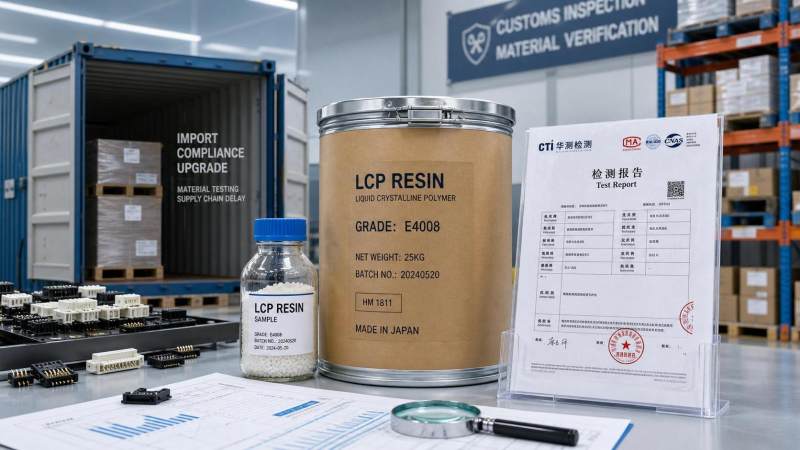
On July 2, 2026, Japan's Ministry of Economy, Trade and Industry (METI) announced a stricter import assessment rule for LCP resins, with enforcement starting July 15. Beyond the existing UL94 V-0 flammability requirement, Chinese exporters will now need to provide dual verification covering ISO 5659-2 smoke density and CO/HCN release rate, along with supporting original test materials from JQA- or JIS-recognized laboratories. For companies supplying Japan's automotive electronics and 5G base station connector chains, the development matters because it shifts compliance from a single pass-fail document check to a more documentation-intensive review that is expected to lengthen customs clearance by 7-10 working days.
What METI Has Formally Added to LCP Resin Import Review
According to the information provided, METI notified the market on July 2, 2026 that it would implement enhanced import evaluation requirements for LCP resins. From July 15, import review will no longer rely only on the existing UL94 V-0 flammability classification. It will also require mandatory verification under ISO 5659-2 for two indicators: smoke density and CO/HCN release rate.
The new requirement applies to Chinese LCP resin exporters shipping to Japan. In addition to the dual reports, exporters must submit original test videos, calibration certificates, and original gas chromatography spectra issued by laboratories recognized by JQA or JIS. Based on the same input, the rule change is expected to extend customs clearance cycles for LCP materials entering Japan by an average of 7 to 10 working days.
Where the Immediate Pressure Is Likely to Appear
Export-side compliance moves from report submission to evidence package preparation
From an industry perspective, the most direct impact falls on Chinese exporters of LCP resins. The issue is not only the addition of ISO 5659-2 indicators, but also the requirement to provide original testing evidence and calibration-related documentation. This may affect pre-shipment preparation, document completeness checks, and communication with recognized laboratories before goods are dispatched.
Japanese buyers may face longer material confirmation and receiving cycles
For procurement teams and import-side buyers in Japan, the stated 7-10 working day extension in customs clearance may affect material arrival planning. What deserves closer attention is whether incoming resin schedules still align with production demand, especially where LCP is tied to time-sensitive connector manufacturing programs.
Connector manufacturing schedules could feel the timing impact first
The information provided specifically points to automotive electronics and 5G base station connector manufacturers. Observably, these companies may be affected less by the testing rule itself and more by its effect on inventory rhythm, incoming material timing, and batch allocation. Any delay at the customs stage can translate into tighter coordination requirements between procurement, warehousing, and production planning.
Supply chain service providers will need tighter document handling discipline
Logistics, customs, and related service providers may also be drawn into the change because the rule expands the volume and sensitivity of compliance documents linked to each shipment. The key issue for these participants is whether paperwork review, handoff timing, and document traceability can keep pace with the stricter evidence standard.
What Companies Should Watch Closely Now
The gap between having a test result and having an acceptable submission set
Analysis shows that the practical challenge may lie not only in obtaining UL94 and ISO 5659-2 results, but in assembling the full submission package required by the new rule. Companies involved in exports to Japan should pay close attention to whether every shipment-linked file includes the original test video, calibration certificate, and gas chromatography source records required in the notice.
Laboratory recognition and document acceptability
Another operational focus is the recognition status of the testing laboratory. Since the input specifies JQA- or JIS-recognized laboratories, exporters and buyers should verify early whether their existing testing arrangements match that requirement and whether the resulting documents are formatted and retained in a way that supports customs review.
Lead-time planning for July shipments and follow-on deliveries
Because the new mechanism starts on July 15 and the reported customs impact is 7-10 working days, shipment timing becomes a practical issue. Companies serving Japanese customers should closely monitor delivery promises, production sequencing, and inventory buffers where LCP material is part of ongoing supply commitments.
Customer communication around clearance risk and delivery cadence
What deserves closer attention is the commercial side of compliance. Exporters, importers, and downstream manufacturers may need to align expectations on possible clearance delays, especially where delivery timing is linked to production windows. The policy signal and the actual customs experience may not be identical in every case, so ongoing communication will matter.
Why This Looks Like More Than a Routine Documentation Update
As an observation, this development is more appropriately understood as a compliance tightening signal rather than a routine paperwork adjustment. The addition of ISO 5659-2 smoke density and toxic gas release metrics, together with the requirement for original testing evidence, indicates that review is moving toward deeper verification of fire-related performance records for imported LCP resins.
At the same time, it would be premature to treat this as a fully settled long-term market outcome. The confirmed facts establish stricter entry requirements and longer expected clearance times, but they do not yet prove how broadly the commercial impact will spread beyond the affected supply chains named in the input. Continued observation is still necessary.
How the Industry May Best Read This Stage
In practical terms, the July rule change matters because it affects both compliance content and supply chain timing. The immediate issue is not only whether a product meets UL94 V-0 and ISO 5659-2 requirements, but whether exporters can present the specific original materials required by Japanese review authorities without slowing shipments further.
Current evidence suggests this should be understood as a near-term operational change with potential longer-term signaling value. For now, the most reasonable reading is that companies tied to Japan-bound LCP trade, automotive electronics, and 5G connector production should treat documentation readiness and delivery planning as the main priorities while continuing to watch how the rule is applied in practice.
Basis of This Article and What Still Needs Verification
This article is based on the user-provided news title, event date, and event summary concerning METI's July 2, 2026 notice on enhanced LCP resin import assessment, including the added UL94 and ISO 5659-2 dual verification requirements and the stated customs clearance impact. No specific official source link was provided in the input, so the exact official publication link remains to be verified on an ongoing basis.
For this type of industry update, source types usually worth checking include official government notices, company compliance disclosures, industry association updates, authoritative media coverage, and relevant standards documentation. Further follow-up should focus on any additional official wording, implementation details in customs practice, and whether document review requirements are clarified or adjusted after the July 15 start date.
Recommended News
- 2026.09.14Gel Battery Electrolytes: How Ionic Conductivity and Stability Shape Cell DesignElectrochemistry Fellow
- 2026.09.13Fluoropolymer Extrusion Process: How Melt Control Affects Tube QualityPolymer Synthesis Expert
- 2026.09.12How German Implant Makers Select Medical Polymers for Long-Term BiocompatibilityPolymer Synthesis Expert
The VitalSync Intelligence Brief
Receive daily deep-dives into MedTech innovations and regulatory shifts.