
METI Tightens LCP Import Traceability Checks
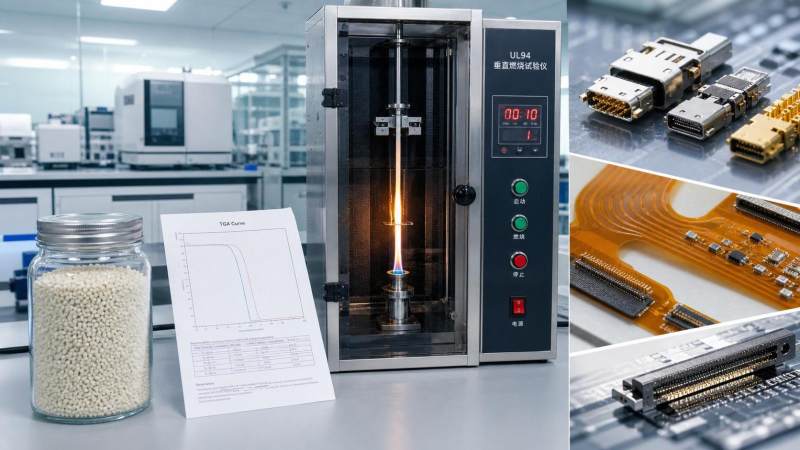
On July 1, 2026, Japan’s Ministry of Economy, Trade and Industry (METI) moved to strengthen import-side safety review for liquid crystal polymer (LCP) resin by introducing a stricter traceability mechanism around flammability performance. The development deserves close attention from Chinese suppliers, Japanese importers, electronics procurement teams, and manufacturers tied to 5G millimeter-wave connectors and automotive high-frequency FPCB, because the new documentation expectation is already affecting supplier qualification and the practical ability to secure orders.
What the new documentation requirement includes
According to the provided event information, METI issued internal guidance on July 1, 2026 to JETRO and major electronic component importers regarding LCP resin imports. Under this flammability traceability management approach, all newly declared LCP batches must now be accompanied by an original UL94 V-0 vertical burning test data package issued by a CNAS/ILAC-MRA accredited laboratory.
The required package includes video records, thermogravimetric curves, char yield data, and logs for test temperature and humidity conditions. The mechanism is described as not legally mandatory, but it has already been adopted by major buyers such as Panasonic and Sumitomo Electric as a precondition for supplier access.
The supplied information also states that this directly affects order execution for LCP used in applications including 5G millimeter-wave connectors and automotive high-frequency FPCB.
Where pressure is likely to appear first
Supplier qualification is becoming more document-driven
From an industry perspective, Chinese LCP suppliers may be affected first at the customer entry stage rather than only at customs clearance. Because leading buyers have reportedly turned the mechanism into a supplier screening condition, the impact is likely to show up in pre-sales qualification, bid participation, and sample-to-mass-production conversion.
Importers and procurement teams face a tighter review interface
For Japanese importers and procurement organizations, the immediate issue is not only whether material meets UL94 V-0, but whether the supporting evidence is complete, original, and traceable to an accredited laboratory. Analysis shows that this can shift workload toward document verification, supplier coordination, and batch-level compliance checks before orders are released or shipments are accepted.
Downstream application programs may feel schedule pressure
Processors and end-use manufacturers involved in 5G millimeter-wave connectors and automotive high-frequency FPCB may need to pay closer attention to material onboarding and supply continuity. Observably, when supplier access depends on a full raw data package rather than a simplified certificate layer, delays can emerge in qualification timing, delivery planning, and approval cycles.
What companies should watch now
Whether internal guidance evolves into broader market practice
What deserves closer attention is the gap between a non-mandatory mechanism and actual commercial enforcement. The current signal matters because leading buyers have already translated it into supplier access criteria. Companies should therefore monitor whether this remains concentrated among major purchasers or spreads more widely across electronics import channels.
The completeness of the raw test package
In practical terms, the key issue is not a single pass/fail statement. The requirement, as provided, calls for original test materials including video, thermogravimetric curves, char yield, and environmental logs. Suppliers and traders should check whether their current documentation process can deliver these items consistently for each newly declared batch.
Accreditation alignment in cross-border supply
Because the required documents must come from CNAS/ILAC-MRA accredited laboratories, supplier-side preparation should focus on whether existing laboratory partners meet that recognition condition and whether test records are ready in a form acceptable to customers and import-side reviewers. This is likely to become a contract execution issue as much as a technical one.
Customer communication around lead time and onboarding
Analysis shows that procurement and sales teams may need earlier customer communication when qualification depends on batch-linked original data. The immediate concern is managing expectations around onboarding, replenishment, and documentary readiness, especially for programs tied to high-frequency electronics applications mentioned in the event summary.
How this signal should be interpreted
Observably, this development is more than a routine documentation update, but it should not yet be overstated as a formal legal barrier based on the provided information. It is more appropriate to understand this as a market-enforced compliance signal: the rule is not described as mandatory by law, yet it is already shaping who can enter approved supply chains.
From an industry perspective, the significance lies in the shift from proving a flammability grade to proving the full traceability of how that grade was established. That changes the operational center of gravity from product specification alone to supporting evidence, batch records, and cross-border documentation discipline.
Why the market will keep watching this
At this stage, the development is best read as a near-term operational change with possible longer-term implications if large buyers continue to adopt it as a standard gatekeeping condition. The confirmed facts do not establish a universal market outcome, but they do indicate that LCP suppliers serving Japan-facing electronics chains may now be judged not only on material performance, but also on the depth and credibility of their test traceability package.
A neutral reading is that this is neither a purely procedural update nor a fully settled regulatory endpoint. It is a concrete business signal that already matters in customer access and order landing, while still requiring continued observation to see how broadly it is applied.
Basis of this article and points for follow-up
This article is based on the user-provided news title, event date, and event summary. For developments of this kind, relevant source categories typically include official notices, company procurement requirements, industry association updates, authoritative media reporting, and standard-related documentation. A specific official source link was not provided in the input, so further verification remains necessary.
For ongoing observation, the most relevant follow-up points are whether METI or related institutions issue additional wording, whether major buyers broaden the requirement across more procurement scenarios, and whether implementation remains focused on LCP batches tied to the application areas identified in the provided summary.
Recommended News
- 2026.09.14Gel Battery Electrolytes: How Ionic Conductivity and Stability Shape Cell DesignElectrochemistry Fellow
- 2026.09.13Fluoropolymer Extrusion Process: How Melt Control Affects Tube QualityPolymer Synthesis Expert
- 2026.09.12How German Implant Makers Select Medical Polymers for Long-Term BiocompatibilityPolymer Synthesis Expert
The VitalSync Intelligence Brief
Receive daily deep-dives into MedTech innovations and regulatory shifts.