
Chemical Synthesis Route Selection and the Cost of Rework
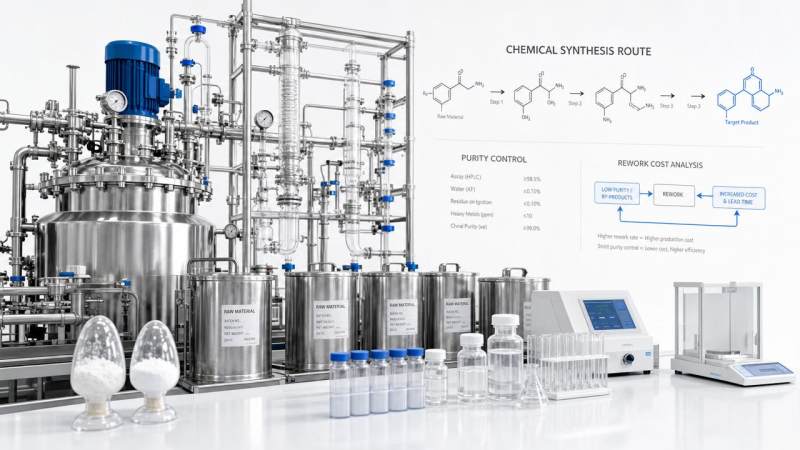
In advanced materials manufacturing, chemical synthesis route selection is never just a laboratory decision—it directly shapes cost, compliance, purity, scalability, and time to market. For business leaders navigating carbon fiber, battery chemicals, electronic gases, and specialty polymers, understanding how chemical synthesis choices trigger or prevent expensive rework is essential to protecting margins, securing supply chains, and sustaining technological advantage.
Why does chemical synthesis route selection become a board-level cost issue?
For enterprise decision-makers, the phrase chemical synthesis often sounds technical, but the commercial consequences are immediate. A route that looks efficient in pilot scale can fail under volume, trigger impurity excursions, increase solvent recovery loads, or create regulatory exposure that forces reformulation.
Rework is rarely limited to one batch. In advanced materials, a flawed chemical synthesis path can cascade into repeated purification, scrap, retesting, delayed customer qualification, and supplier switching. Each round consumes not only cash, but also management attention, engineering bandwidth, and strategic credibility.
This is especially true in sectors where AMCS tracks molecular performance and purity thresholds at extreme levels. In semiconductor electronic chemicals, trace metal contamination can invalidate a wafer process. In battery materials, crystal morphology drift can lower cycle stability. In specialty engineering plastics, route-related residues can undermine thermal or dielectric performance.
- A route decision affects feedstock availability, by-product complexity, and downstream purification intensity.
- It influences whether a plant can meet customer audit expectations on consistency and change control.
- It determines how easily a business can localize production or build dual-source resilience under geopolitical pressure.
The hidden chain from synthesis choice to rework
Many companies underestimate how early decisions lock in later costs. Once a chemical synthesis route is tied to specific catalysts, fluorinated intermediates, hazardous gases, or narrow process windows, every quality deviation becomes harder and more expensive to correct.
That is why route selection should be reviewed not only by R&D, but also by operations, procurement, EHS, regulatory, quality, and commercial teams. AMCS often sees the strongest performers treating synthesis design as a strategic operating model, not a lab exercise.
Where does rework come from in advanced materials chemical synthesis?
Rework appears when the original process route cannot reliably deliver target specifications at commercial cadence. In high-tech materials, the problem is rarely one variable. It is usually the combined effect of purity, yield, reaction selectivity, handling stability, equipment compatibility, and customer qualification requirements.
The table below shows how common route-selection mistakes in chemical synthesis translate into operational and financial consequences across advanced materials manufacturing.
For decision-makers, the key lesson is simple: rework is not only a production symptom. It is often the delayed invoice of poor chemical synthesis route selection. The earlier these risks are mapped, the cheaper they are to avoid.
Sector-specific rework pressure points
- Carbon fiber and composites: precursor consistency, solvent handling, and oxidation/carbonization fit can magnify small synthesis deviations into major mechanical property variation.
- Battery chemicals: precursor route influences particle size distribution, coating quality, and interfacial stability, which directly affects downstream electrochemical performance.
- Electronic chemicals and gases: ultra-high purity requirements mean route-derived contaminants may be economically impossible to remove later.
- PEEK, PTFE, and other specialty polymers: route choice shapes monomer purity, side-product control, processing window, and export compliance risk.
How should executives compare chemical synthesis routes before scale-up?
A practical comparison framework must go beyond lab yield. The best route on paper may still be the wrong route for regulated exports, regionalized supply chains, or high-mix customer portfolios. AMCS emphasizes synthesis decisions that balance thermodynamics, purity architecture, cost structure, and geopolitical resilience.
The comparison matrix below helps leadership teams evaluate chemical synthesis routes with commercial discipline rather than isolated technical preference.
This framework matters because the cheapest route per kilogram may produce the highest cost per approved shipment. For materials serving aerospace, chipmaking, and new energy platforms, approval economics often outweigh nominal process economics.
A useful executive checklist
- Ask what impurities are created by the route, not only what purity is achieved at the end.
- Model requalification cost if a key precursor becomes restricted or unavailable.
- Review whether purification steps scale linearly, or become bottlenecks at commercial volume.
- Estimate the cost of one failed customer audit or one quarter of delayed ramp-up.
What should procurement and technical teams look at together?
Chemical synthesis route selection fails most often when procurement optimizes for short-term price while technical teams optimize for lab performance. In advanced materials, those two views must be integrated early. A slightly higher-cost precursor may reduce downstream purification, improve qualification consistency, and lower total cost of ownership.
Joint evaluation priorities
- Raw material fingerprinting: define acceptable impurity envelopes, lot-to-lot variability limits, moisture sensitivity, and storage stability before contract negotiation.
- Process fit: confirm whether the selected route matches installed reactor metallurgy, filtration capability, gas handling, and waste treatment infrastructure.
- Customer change control: understand how route adjustments will affect customer notification, requalification testing, and document updates.
- Regional compliance: screen exposure to REACH-related restrictions, transport classifications, fluorinated substance scrutiny, and local environmental reporting obligations.
AMCS is particularly relevant here because route intelligence is no longer only scientific. It is strategic. Companies need visibility across material chemistry, purity economics, compliance trajectories, and supply chain capital dynamics at the same time.
Cost of rework: where margins actually disappear
Executives often account for rework as an isolated manufacturing cost. That view is incomplete. The real cost of chemical synthesis rework includes both visible and silent losses across the commercialization chain.
The following cost table can help leadership teams quantify why route design deserves earlier cross-functional review.
The most expensive rework is often the one not booked under manufacturing. When a semiconductor chemical misses purity expectations or a battery precursor fails consistency targets, the lost design-in position can be far more damaging than the batch loss itself.
When a higher initial process cost is the lower total cost
In many chemical synthesis programs, a route with tighter raw material specifications, more controlled intermediate isolation, or cleaner reaction chemistry appears more expensive at first glance. Yet it often lowers analytical burden, raises first-pass yield, and reduces qualification turbulence. For executive teams, this is the difference between unit cost thinking and system cost thinking.
How do compliance and purity requirements reshape route selection?
Advanced materials companies no longer choose synthesis routes in a neutral policy environment. Export exposure, fluorinated chemistry scrutiny, hazardous gas controls, and sustainability expectations increasingly influence route viability. A pathway that works today may become commercially fragile tomorrow.
Three compliance-driven route shifts now affecting the market
- Lower tolerance for persistent fluorinated chemistries in certain applications, especially when alternative materials or reformulation pathways are under active review.
- Tighter scrutiny of impurity traceability in semiconductor and battery supply chains, pushing route design toward cleaner feedstocks and more auditable purification logic.
- Growing preference for local production for local consumption, particularly in wet chemicals and other products where logistics, safety, and customer service responsiveness directly affect switching costs.
This is where AMCS brings unusual value. Its intelligence lens connects molecular synthesis thermodynamics with market access, policy direction, and capital logic. That combination helps business leaders avoid route choices that are chemically elegant but commercially exposed.
FAQ: practical questions about chemical synthesis and rework risk
How should a company choose between a high-yield route and a high-purity route?
Start from customer acceptance criteria, not from lab efficiency alone. If the target market is semiconductor processing, battery materials for premium platforms, or aerospace-grade composites, purity and consistency usually dominate nominal yield. A lower-yield chemical synthesis route may still be superior if it reduces hard-to-remove contaminants and shortens qualification cycles.
What are the earliest warning signs that a synthesis route will cause future rework?
Watch for narrow temperature or residence-time windows, frequent need for manual correction, unstable raw material sources, difficult mother liquor management, heavy dependence on post-purification rescue steps, or repeated divergence between pilot and larger-batch analytical data. These are classic indicators that scale-up rework may become structural rather than occasional.
Does rework matter equally across all advanced material segments?
No. Rework hurts every segment, but the mechanism differs. In electronic chemicals, purity failure can cause immediate rejection. In battery chemicals, it may appear later as inconsistent electrochemical performance. In specialty polymers, route-related residues may compromise processing or compliance. In carbon fiber precursors, inconsistency can surface as unstable mechanical properties after expensive downstream conversion.
How early should procurement join synthesis route evaluation?
Much earlier than many organizations allow. Procurement should be involved before route lock-in, especially when critical inputs have geopolitical concentration, hazardous transport limits, or tight impurity requirements. Early participation helps avoid a technically acceptable route that later becomes commercially fragile or impossible to source competitively.
Why decision-makers use AMCS to reduce chemical synthesis uncertainty
AMCS operates at the intersection of chemistry, purity, compliance, and industrial strategy. That matters because route selection is now shaped by more than reaction success. Leaders need to understand how ultra-high purity targets, patent barriers, regional policy, raw material concentration, and downstream customer validation interact before capital is committed.
What AMCS can help you evaluate
- Chemical synthesis route suitability for carbon fiber, battery chemicals, electronic chemicals, specialty engineering plastics, and synthetic gases.
- Impurity risk mapping, purification burden, and likely rework hotspots before scale-up or supplier transition.
- Compliance exposure related to fluorinated substances, export pathways, hazardous intermediates, and regional regulatory shifts.
- Supply chain resilience analysis covering local-for-local production logic, switching barriers, and sourcing concentration.
If your team is comparing process routes, reviewing a supplier change, planning a new plant, or trying to cut the cost of rework in chemical synthesis, AMCS can support structured discussions around parameter confirmation, route selection, delivery timing, custom intelligence needs, certification expectations, sample evaluation pathways, and quotation communication. The earlier these questions are addressed, the lower the cost of correction later.
Recommended News
- 2026.09.18How to Evaluate a Polymer Compounding Manufacturer for High-Performance ApplicationsMr. Arthur Mercer
- 2026.09.17Chemical Manufacturing Compliance: Building a REACH-Ready Chemical Inventory SystemDr. Felix Sterling
- 2026.09.16Battery Material Purity Control: Critical Tests for Stable Cell PerformanceElectrochemistry Fellow
The VitalSync Intelligence Brief
Receive daily deep-dives into MedTech innovations and regulatory shifts.