
Material Thermodynamics Data Gaps Can Mislead Design Decisions
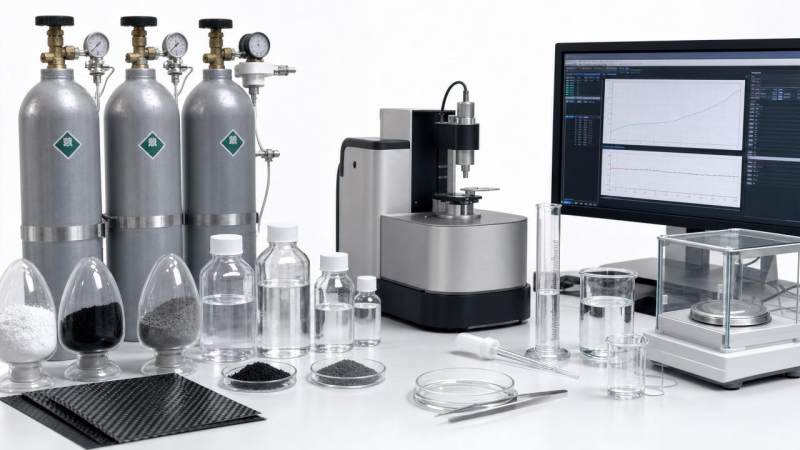
When material thermodynamics data is incomplete, technical evaluation teams can make confident decisions on unstable ground. In advanced materials—from carbon fiber composites and battery chemicals to electronic gases and specialty plastics—small gaps in phase behavior, purity response, or reaction limits can distort performance forecasts, compliance planning, and investment logic. This article examines how these hidden uncertainties mislead design decisions and what evaluators should verify before moving forward.
Why material thermodynamics gaps create high-cost evaluation errors
For technical evaluation personnel, material thermodynamics is not an abstract academic topic. It determines whether a powder remains stable in storage, whether a gas reacts cleanly in a chamber, and whether a polymer survives heat, chemicals, or electrical stress.
The problem is rarely total ignorance. More often, teams work with partial datasets: a DSC curve without long-duration aging, vapor pressure data without contamination sensitivity, or phase diagrams that stop short of the operating boundary.
That gap becomes dangerous in industries where purity ranges from 9N to 12N, where thermal runaway margins are narrow, and where one unstable formulation can damage yield, certification timelines, or customer trust.
- Aerospace teams may overestimate resin or composite stability under cyclic thermal loading.
- Battery teams may underestimate interfacial reactions, gas generation, or phase transitions near charge limits.
- Semiconductor teams may assume gas or wet chemical behavior is stable even when trace impurities alter reaction pathways.
- Engineering plastics evaluators may miss crystallinity shifts that change dimensional stability and dielectric behavior.
Typical signals that data is incomplete
Many procurement and qualification mistakes begin with acceptable-looking technical datasheets. The warning signs appear only when evaluators ask what is missing, not only what is shown.
- Single-point test results without range data across humidity, pressure, or temperature.
- Thermal stability data without decomposition products or reaction kinetics.
- Purity specifications without impurity species distribution and response thresholds.
- Lab-scale equilibrium data with no process-scale validation.
Which design decisions are most vulnerable to weak material thermodynamics data?
Not every design parameter fails equally. Some decisions can tolerate uncertainty. Others cannot. The table below shows where material thermodynamics blind spots most often distort technical evaluation across advanced materials sectors.
The key lesson is practical: material thermodynamics errors rarely stay inside the laboratory. They move directly into qualification delays, redesign cycles, scrap exposure, and misleading total cost calculations.
Why technical evaluators are especially exposed
Evaluation teams often sit between R&D, procurement, compliance, and operations. They must decide quickly, but they inherit fragmented information from suppliers, public literature, and internal tests using different assumptions and boundary conditions.
How the risk changes by application scenario
Material thermodynamics should be judged in context. The same data gap has different consequences in a carbon fiber prepreg line, a lithium battery system, or an ultra-clean semiconductor process.
Carbon fiber composites
For composites, cure kinetics, glass transition behavior, moisture-driven property shifts, and thermal expansion mismatch matter more than a simple room-temperature strength value. Missing this data can make structural reliability look better than it is.
Battery cathodes, anodes, and electrolytes
In batteries, material thermodynamics influences electrolyte decomposition, lithium plating tendency, oxygen release, and interphase growth. A narrow dataset may support a good prototype but fail under fast charge, cold start, or long storage.
Electronic chemicals and gases
Here, trace contamination is not a side note. Adsorption, outgassing, and reaction equilibria at extremely low impurity levels can shift line performance. Teams need more than nominal purity; they need thermodynamic behavior under process reality.
Specialty engineering plastics
PEEK and PTFE may look chemically resistant on paper, but real evaluation depends on crystallization response, creep under heat, sterilization exposure, and media compatibility. Missing those boundaries leads to false substitution confidence.
What should technical evaluators verify before approval?
To reduce decision bias, evaluators need a repeatable screening method. The following checklist helps convert material thermodynamics from a vague concern into a measurable approval workflow.
This verification process is especially important when a supplier presents strong headline performance but limited boundary-condition evidence. In advanced materials, the missing edge conditions often matter more than the average result.
A practical approval sequence
- Define the real operating envelope, not only the nominal specification.
- Map required material thermodynamics data to failure modes, compliance exposure, and process sensitivity.
- Request missing data before pricing comparisons distort the decision.
- Run targeted validation on the most uncertain boundaries, not broad but shallow testing.
- Approve with conditional controls if the data package is still incomplete.
Comparison analysis: incomplete data versus stitched intelligence
Technical teams do not only need more data. They need connected intelligence. That is where AMCS creates value: combining molecular synthesis thermodynamics, ultra-high-purity behavior, compliance pressure, and supply-chain switching barriers into a decision-ready view.
This stitched approach is particularly useful where performance and physical limits are shaped by multiple variables at once: high-nickel cathodes, solid-state interfaces, EUV-adjacent chemistries, high-purity process gases, and export-sensitive specialty polymers.
Procurement and compliance risks that are often underestimated
Material thermodynamics affects buying decisions as much as engineering decisions. A cheaper candidate can become expensive if it requires stricter storage, more frequent requalification, additional purification, or replacement due to regulatory change.
Common hidden cost drivers
- Extra incoming inspection because impurity behavior is not fully characterized.
- Short shelf life caused by moisture or temperature sensitivity during logistics.
- Equipment cleaning or chamber downtime after unstable decomposition.
- Reformulation pressure linked to PFAS restrictions or export compliance shifts.
For evaluators, this is where AMCS insight matters. Thermodynamics should be read together with compliance direction, purity infrastructure, and local-for-local supply constraints. A technically workable material may still be a poor strategic choice.
FAQ: what technical evaluators ask most about material thermodynamics
How much material thermodynamics data is enough for initial qualification?
Enough means the data covers the real operating window and the main failure modes. At minimum, evaluators should verify phase stability, decomposition onset, impurity sensitivity, and storage behavior. If the application is highly sensitive, boundary-condition data is mandatory.
Is nominal purity enough for semiconductor gases and wet chemicals?
No. Nominal purity alone does not explain which impurity species are present, how they behave in plasma or wet processing, or whether they adsorb onto delivery systems. Material thermodynamics and impurity interaction data are both required.
What is the most common mistake in battery material evaluation?
Many teams focus on energy density and cycle results while underweighting reaction thermodynamics at interfaces. This can hide gas evolution, transition-metal dissolution, lithium plating tendency, or thermal instability that appears only outside ideal conditions.
How should teams compare two materials when both datasets are incomplete?
Do not compare only on list price or peak performance. Compare uncertainty. Rank each option by missing thermodynamics variables, likely failure consequences, compliance exposure, and time needed for validation. The lower uncertainty option is often the better commercial decision.
Why informed teams turn to AMCS before final design or sourcing approval
AMCS focuses on the materials domains where thermodynamics gaps cause the biggest strategic mistakes: carbon fiber composites, battery chemicals, semiconductor electronic gases and wet chemicals, specialty engineering plastics, and precision synthetic gases.
Its advantage is not generic market commentary. It is the ability to connect molecular-level stability, ultra-high-purity constraints, process implications, regulatory direction, and supply-chain economics into usable technical intelligence for evaluators.
What you can discuss with us
- Parameter confirmation for phase behavior, purity thresholds, decomposition, and storage limits.
- Material selection support for composites, battery systems, electronic chemicals, gases, PEEK, or PTFE applications.
- Evaluation of delivery cycle risk, localization barriers, and switching feasibility.
- Compliance review related to export scenarios, substitution planning, and evolving chemical restrictions.
- Sample support strategy, test-priority planning, and quote communication based on actual technical risk.
If your team is making a design, sourcing, or qualification decision with incomplete material thermodynamics information, contact AMCS to clarify the missing variables before they become yield loss, certification delay, or expensive redesign. That conversation can start with one focused question: which unknown in your current data package has the greatest commercial consequence?
Recommended News
- 2026.09.18How to Evaluate a Polymer Compounding Manufacturer for High-Performance ApplicationsMr. Arthur Mercer
- 2026.09.17Chemical Manufacturing Compliance: Building a REACH-Ready Chemical Inventory SystemDr. Felix Sterling
- 2026.09.16Battery Material Purity Control: Critical Tests for Stable Cell PerformanceElectrochemistry Fellow
The VitalSync Intelligence Brief
Receive daily deep-dives into MedTech innovations and regulatory shifts.