
EU Tightens Microplastics Exemption Ahead of 2028
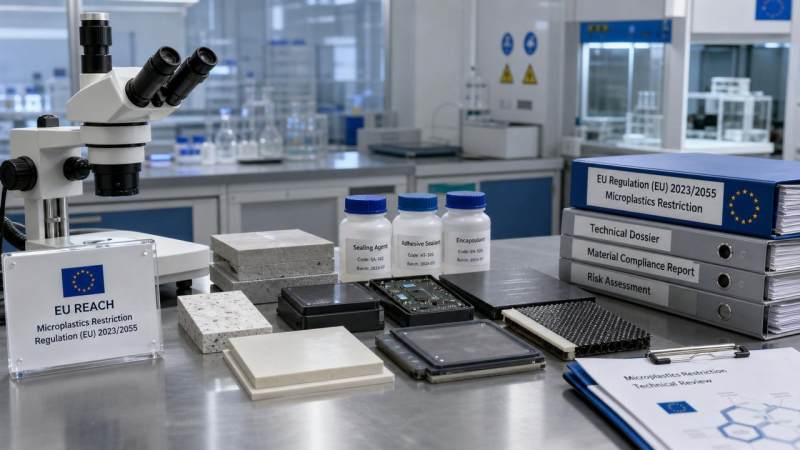
On June 2, 2026, the European Commission issued Regulation (EU) 2026/1168 to amend entry 78 of REACH Annex XVII, narrowing the exemption for microplastics that are considered permanently embedded in a solid matrix. The change is especially relevant for exporters in construction materials, electronic encapsulation adhesives, composites, and coatings, because products with an expected service life of less than one year will no longer fall under that exemption and may require reformulation or technical adjustment before June 22, 2028.
What the amendment changes
The confirmed update is that Regulation (EU) 2026/1168, published by the European Commission on June 2, 2026, revises entry 78 of REACH Annex XVII.
The amendment significantly tightens the conditions for the exemption related to products in which microplastics are permanently embedded in a solid matrix.
Under the revised rule, products with an expected period of use of less than one year are no longer covered by that exemption. The examples provided in the input include temporary coatings, quick-release molds, and short-term curing agents.
The input also states that exporters in building materials, electronic encapsulation adhesives, composite materials, and coatings need to complete formulation substitution or technical upgrades by June 22, 2028.
Where pressure is likely to appear first
Export-facing manufacturers may need to reassess product qualification
From an industry perspective, manufacturers selling into the EU are likely to feel the immediate impact because the revised exemption changes how certain products may be judged for compliance. The main pressure point is not only product composition itself, but also whether the intended service life remains below or above the one-year threshold in practical use.
Procurement teams may need closer upstream verification
Analysis shows that companies sourcing raw materials or semi-finished formulations for EU-bound goods may need to re-check whether existing inputs were previously treated as exempt under the permanent-embedding concept. What deserves closer attention is whether supplier statements, technical descriptions, and product-life assumptions remain aligned with the revised rule.
Processors and converters may face adjustment in application scenarios
For processors using coatings, mold-related materials, curing systems, or encapsulation products, the likely effect is operational rather than purely legal. Observably, the issue sits at the intersection of formulation, intended use, and end-use duration, which means production planning and product specification management may require review.
Supply-chain and customer-facing teams may see higher documentation demands
Distributors, compliance service providers, and customer account teams may also be affected because downstream buyers are likely to ask whether a product still qualifies for the exemption after the amendment. The practical impact may show up in specification sheets, declarations, contract language, delivery commitments, and customer communication around compliance status.
What companies should watch before the 2028 deadline
Check whether short-life products were relying on the exemption
The most immediate task is to identify products with an expected use period of less than one year and determine whether their EU market access assumptions depended on the permanent-embedding exemption. This point is particularly relevant for temporary coatings, quick-release mold applications, and short-term curing uses mentioned in the input.
Separate legal wording from technical implementation
Analysis shows that the policy text and day-to-day technical application may not be identical in practice. Companies should pay attention to how product lifespan is described internally and externally, because the distinction between a regulatory concept and a real-world use scenario may become central in customer review and compliance preparation.
Prepare supplier and customer documentation early
What deserves closer attention is whether supporting documents are strong enough for a transition period leading up to June 22, 2028. Businesses may need to review supplier qualifications, formulation records, technical data, declarations, and communication materials used with EU customers.
Build transition timing into delivery and reformulation plans
Observably, the deadline creates a fixed planning horizon for affected exporters. Companies involved in reformulation or technical upgrades should treat compliance work, validation timing, and customer communication as linked tasks rather than separate functions.
Why this reads as more than a narrow wording change
As an editorial observation, this development is better understood as a targeted compliance signal rather than a routine drafting update. The rule change does not simply restate an existing principle; it narrows an exemption by linking it more clearly to expected product use duration.
Analysis shows that this matters because many affected products sit in technical applications where exemption logic, product design, and customer use conditions can overlap. That makes the amendment important not only for regulatory teams, but also for formulation, sales, procurement, and export operations.
At the same time, it is more appropriate to understand this as a defined regulatory change with ongoing implementation questions, rather than as a complete picture of all downstream outcomes. Continued attention is warranted as companies translate the legal text into product-specific decisions.
How to read the latest move now
The main industry significance of this amendment lies in its narrower treatment of the permanent-embedding exemption for products with shorter expected use periods. For exporters in construction materials, electronic encapsulation adhesives, composites, and coatings, the issue is practical: compliance review, formulation decisions, and technical upgrades now sit on a deadline ending June 22, 2028.
From an industry perspective, the update is best understood as a concrete near-to-mid-term compliance change and also as a longer-term regulatory signal. It does not by itself define every commercial outcome, but it clearly indicates that companies relying on exemption-based assumptions should review those assumptions early.
Basis and follow-up verification
This article is generated based on the user-provided news title, event date, and event summary. Information of this kind is typically cross-checked against official regulatory notices, company disclosures, industry association updates, authoritative media reporting, and standards-related documents.
No specific official source link was provided in the input, so the exact official link still requires continued verification. Follow-up attention should focus on any further official clarification, implementation interpretation, and product-specific compliance reading related to Regulation (EU) 2026/1168 and REACH Annex XVII entry 78.
Recommended News
- 2026.09.18How to Evaluate a Polymer Compounding Manufacturer for High-Performance ApplicationsMr. Arthur Mercer
- 2026.09.17Chemical Manufacturing Compliance: Building a REACH-Ready Chemical Inventory SystemDr. Felix Sterling
- 2026.09.16Battery Material Purity Control: Critical Tests for Stable Cell PerformanceElectrochemistry Fellow
The VitalSync Intelligence Brief
Receive daily deep-dives into MedTech innovations and regulatory shifts.