
How to Select Wear-Resistant Metal Replacement Plastics for High-Friction Parts
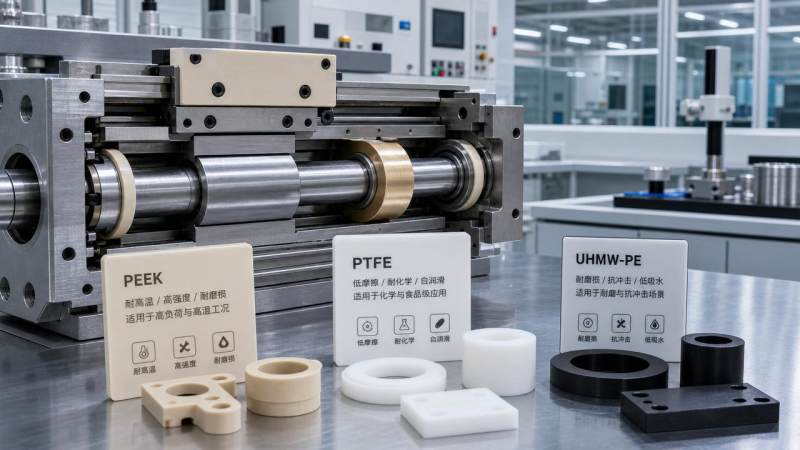
Selecting wear-resistant plastics for sliding, rotating, or abrasive parts is rarely a simple metal-versus-polymer decision. In high-friction systems, metal replacement plastics wear resistance depends on pressure, surface finish, speed, heat build-up, lubrication regime, and chemical contact. That is why the same polymer may perform well in one bearing cage or guide rail, yet fail early in another. For industrial decision-making, the useful question is not whether a plastic is “strong,” but whether it can hold dimensions, resist wear, and control friction under real operating conditions.
Why this choice matters across industrial systems
The push toward lighter, quieter, corrosion-resistant components has expanded the role of engineering plastics in aerospace, electronics, medical devices, EV systems, and automated equipment.
In many of these sectors, replacing metal can reduce part count, simplify machining, and limit lubrication demands. It can also lower noise and protect mating surfaces.
More importantly, metal replacement plastics wear resistance now affects lifecycle cost, uptime, contamination control, and supply strategy. That makes material selection both a technical and commercial issue.
This is also where platforms like AMCS are relevant. Material evaluation no longer stops at datasheet values. It increasingly connects performance, purity, compliance, processing, and supplier reliability.
What wear resistance really means in plastic parts
Wear resistance is not a single property. It is the material’s ability to retain function while friction removes surface material or changes geometry over time.
For high-friction parts, three behaviors matter together: wear rate, coefficient of friction, and creep under load. A low-friction polymer may still deform. A stiff polymer may still abrade quickly.
Heat is often the hidden variable. Frictional heat can soften plastics locally, accelerate oxidation, and change contact pressure. In practice, thermal stability is part of wear performance.
Common material families
PEEK, PTFE compounds, UHMW-PE, PA, POM, PPS, and filled fluoropolymers are typical candidates. Each has a different balance of friction, stiffness, chemical stability, and cost.
Filled grades often improve metal replacement plastics wear resistance. Carbon fiber, glass fiber, graphite, PTFE, and solid lubricants can change sliding behavior significantly.
The main variables that decide performance
Material selection should start with the tribological system, not the polymer name. In other words, evaluate the contact pair, motion type, and environment together.
- Load and pressure: higher contact stress can increase creep, heat, and transfer film instability.
- Speed and PV value: excessive pressure-velocity conditions often cause rapid wear or softening.
- Counterface material: hardened steel, anodized aluminum, ceramic, and coated shafts produce different wear patterns.
- Temperature exposure: continuous service temperature matters more than short peak values.
- Lubrication and contamination: dry running, boundary lubrication, dust, slurry, or chemical splash change the ranking of materials.
Surface finish deserves special attention. A rough metal shaft may destroy an otherwise suitable plastic bushing. An overly polished surface can also prevent stable transfer film formation.
How to compare candidate materials in practice
A useful comparison combines tribology, processing, and operational risk. Looking only at tensile strength or hardness usually leads to false confidence.
When possible, compare application-specific test data instead of generic catalog values. Pin-on-disk results are useful, but they do not fully represent every bearing, seal, or guide application.
Where selection mistakes usually happen
One common mistake is choosing a premium polymer when the failure is actually caused by poor geometry, contamination, or shaft misalignment.
Another is assuming fillers always improve performance. Some filled materials raise stiffness but increase counterface wear or complicate machining.
Moisture uptake is another overlooked issue. Materials such as nylon may change dimensions enough to affect clearance and friction in precision equipment.
In regulated or high-purity environments, selection must also consider extractables, outgassing, and contamination risk. This is especially relevant in semiconductor, medical, and advanced electronics systems.
A practical selection path
A reliable decision process starts by ranking failure modes. Wear may not be the first issue; deformation, chemical attack, or thermal fatigue may dominate.
- Define the contact conditions, duty cycle, and acceptable wear limit.
- Screen candidate polymers by temperature, chemistry, and load capacity.
- Review filled and unfilled grades separately.
- Check process route, tolerance capability, and supply consistency.
- Validate with realistic testing against the actual mating surface.
For teams tracking advanced materials through AMCS, this broader view is increasingly valuable. The strongest material choice is often the one that aligns wear data, processing limits, compliance expectations, and supply chain resilience.
In the end, metal replacement plastics wear resistance should be judged as a system outcome, not a standalone label. The next useful step is to build a short comparison matrix around load, PV, environment, counterface, and service life targets before narrowing to final trials.
The VitalSync Intelligence Brief
Receive daily deep-dives into MedTech innovations and regulatory shifts.