
EU Adds Broad PFAS Restriction Under REACH Annex XVII
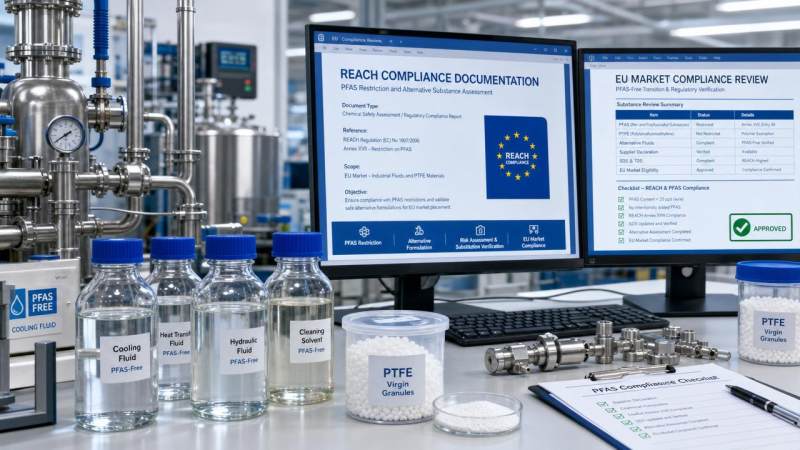
On June 12, 2026, the European Commission formally issued Regulation (EU) 2026/1187, adding PFAS to Entry 79 of REACH Annex XVII and setting a broad market restriction that reaches PTFE processing aids, fluorinated cooling fluids such as Novec 7200, and fluorinated surfactants. For exporters, formulators, procurement teams, and EU-facing compliance functions, the key point is not only the scope of the restriction but also the short 12-month transition period, with a full EU market ban taking effect from June 2027.
What the new restriction formally covers
According to the provided information, the new rule places per- and polyfluoroalkyl substances (PFAS) into REACH Annex XVII Entry 79. The restriction covers organic compounds containing C-F bonds and explicitly includes PTFE emulsion stabilizers, fluorinated cooling fluids such as Novec 7200, and fluorinated surfactants.
The regulation was formally published by the European Commission on June 12, 2026, under Regulation (EU) 2026/1187. The transition period is 12 months, and products covered by the restriction are to be fully banned from being placed on the EU market from June 2027.
The provided information also states that Chinese PTFE material exporters are required to complete substitute formulation validation and ECHA notification by Q3 2026.
Where the immediate pressure is likely to appear
Export-facing PTFE material business
From an industry perspective, companies exporting PTFE-related materials to the EU are likely to face the earliest direct impact because the summary specifically highlights PTFE emulsion stabilizers and sets a clear compliance deadline. The main pressure point is expected to be product formulation review, replacement validation, and the timing of regulatory communication tied to EU market access.
Procurement and raw material screening
Analysis shows that procurement teams may be affected where product systems or auxiliaries include fluorinated processing substances or related additives. The operational impact is likely to center on supplier declarations, material identification, and confirmation of whether affected substances remain present in formulations intended for the EU market.
Manufacturing and process fluid use
Manufacturing functions may also need to reassess process-linked substances because the stated scope includes fluorinated cooling fluids and fluorinated surfactants. What deserves closer attention is whether restricted substances are embedded in production support materials rather than in the final marketed material alone, since that can affect substitution planning and delivery continuity.
EU compliance and customer-facing documentation
For compliance teams, sales operations, and customer service roles serving EU accounts, the issue is likely to move quickly from legal interpretation to document readiness. The short transition window means that customers may ask earlier for status updates on substitute formulations, ECHA-related communication, and product compliance confirmation before June 2027.
What companies should focus on now
Separate confirmed scope from internal assumptions
Analysis shows that companies should first work from the confirmed text provided here: PFAS have been added to REACH Annex XVII Entry 79, the coverage includes organic compounds with C-F bonds, and named examples include PTFE emulsion stabilizers, fluorinated cooling fluids, and fluorinated surfactants. Internal compliance reviews should distinguish these confirmed points from any broader interpretation that has not yet been independently verified.
Prioritize substitution timelines against the Q3 2026 requirement
What deserves closer attention is the timing mismatch between the formal publication date, the 12-month transition period, and the statement that Chinese PTFE material exporters should complete substitute formulation validation and ECHA notification by Q3 2026. In practice, this makes early-stage technical verification and regulatory preparation more urgent than a simple wait-and-see approach.
Check vulnerable product and process categories
Observably, the most sensitive categories are those directly named in the provided summary or closely tied to them in business operations: PTFE processing-related systems, fluorinated cooling fluids, and fluorinated surfactants. Companies serving the EU market should review where these materials sit in formulations, processing steps, and customer specifications, because disruption may arise from hidden dependencies rather than only from finished goods labels.
Prepare external communication before the ban date
From an industry perspective, supplier communication, customer notice, and compliance documentation should be treated as part of the response, not as a final administrative step. Where substitute formulations are being validated, counterparties may need early visibility on transition status, expected qualification timing, and any implications for order execution tied to the June 2027 market deadline.
How this development is best understood at this stage
Analysis shows that this is more than a routine regulatory update because the restriction is described as covering all organic compounds containing C-F bonds and because the transition period is only 12 months. That combination makes the development relevant not only as a policy signal but also as an operational issue for companies already shipping into the EU.
At the same time, it is more appropriate to understand this as both a confirmed compliance event and an evolving implementation topic. The confirmed event is the publication of Regulation (EU) 2026/1187 and the stated market ban timeline; the part that still requires ongoing attention is how each company maps the rule onto specific formulations, process aids, and customer commitments.
What the regulation means for the market conversation
From an industry perspective, the immediate significance of this update lies in its breadth and timing. It signals that PFAS-related compliance is no longer limited to isolated substance checks for some businesses but may now require product-by-product and process-by-process review where EU market placement is involved.
It is more appropriate to understand this development as a near-term compliance change with longer-term strategic implications. The ban timetable is already defined in the provided information, but the full business effect will depend on how quickly affected companies complete substitution, notification, and customer-side alignment.
Basis of this article and points to keep verifying
This article is based on the user-provided news title, event date, and event summary concerning the EU restriction on PFAS under REACH Annex XVII. The specific official source link was not provided in the input, so the exact underlying publication and any subsequent clarifications still need to be continuously verified.
For this type of industry update, commonly relevant source categories include official regulatory notices, company disclosures, industry association information, authoritative media coverage, and standard-setting or regulatory documentation. Further follow-up should focus on official wording updates, implementation details related to ECHA notification, and any practical clarification affecting substitute formulation validation and EU market placement.
Recommended News
- 2026.09.18How to Evaluate a Polymer Compounding Manufacturer for High-Performance ApplicationsMr. Arthur Mercer
- 2026.09.17Chemical Manufacturing Compliance: Building a REACH-Ready Chemical Inventory SystemDr. Felix Sterling
- 2026.09.16Battery Material Purity Control: Critical Tests for Stable Cell PerformanceElectrochemistry Fellow
The VitalSync Intelligence Brief
Receive daily deep-dives into MedTech innovations and regulatory shifts.