
ECHA PFAS Draft Raises Export Filing Bar
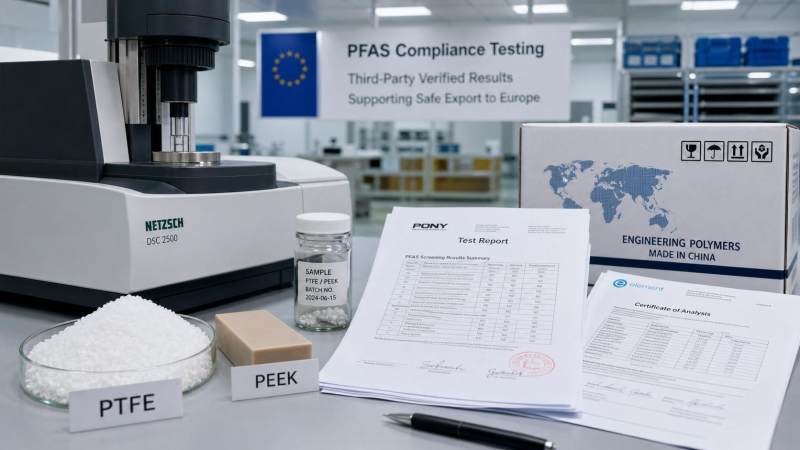
On July 2, 2026, the European Chemicals Agency (ECHA) submitted a PFAS broad restriction proposal to the European Commission as a revision to REACH Annex XVII. For exporters of fluorinated polymers such as PTFE Materials and PEEK Resins, the development is notable because the draft links market access and customs documentation more directly to molecular-level disclosure, including fluorination profile data and TGA-MS release curves. What deserves closer attention is not only the proposal itself, but also the way compliance, shipment preparation, third-party testing, and document readiness may become part of routine export execution from October 2026 onward.
What the draft now requires on record
According to the provided event summary, ECHA submitted a PFAS full-category restriction proposal to the European Commission on July 2, 2026, under a REACH Annex XVII revision. The draft introduces mandatory declaration items that include polymer-level fluorination degree expressed through the F/C atomic ratio, fluorine content in end groups, and the amount of PFAS gases released during thermal decomposition.
The same summary states that the draft directly affects exports to Europe of high-fluorine engineering plastics, including PTFE Materials and PEEK Resins. It also states that from October 2026, all fluorinated polymers must be accompanied in customs filings by a raw data package issued by a third-party laboratory, including a molecular fluorination spectrum and a TGA-MS PFAS release curve.
Where the pressure is likely to appear first
Export shipments may face a documentation-first compliance check
From an industry perspective, exporters are likely to be affected first because the reported requirement is tied to customs documentation submitted together with the shipment. The practical impact may therefore concentrate on pre-export review, file completeness, and whether test records can be matched to the specific polymer being shipped. For companies selling PTFE Materials, PEEK Resins, or other fluorinated polymers into Europe, document readiness may become part of delivery execution rather than a separate downstream compliance task.
Procurement teams may need tighter upstream material traceability
Analysis shows that procurement functions may also be affected where fluorinated polymers are sourced from multiple suppliers or converted across several internal steps before export. If fluorination degree, end-group fluorine content, and thermal release characteristics must be evidenced through third-party raw data, buyers may need to verify earlier whether suppliers can provide the required technical basis, sample consistency, and supporting records in time for shipment planning.
Processors and manufacturers may see added pressure on batch-to-file alignment
Manufacturers and processors using fluorinated polymer feedstocks may need to pay closer attention to the connection between material identity, processing records, and export documents. Observably, the issue is not only whether a product contains fluorinated polymer, but whether the exported material can be supported by the exact forms of laboratory evidence referenced in the summary. That may affect internal release procedures, technical file preparation, and communication between production, quality, and trade compliance teams.
Testing and compliance service providers may become critical to delivery timing
Third-party laboratories and compliance support providers are also likely to become more central in the export chain because the summary explicitly refers to third-party-issued raw data packages. For companies relying on external testing capacity, the key concern may be turnaround time, report format, and whether the laboratory output is suitable for customs submission and customer review. The compliance burden may therefore extend beyond testing itself into file management and delivery scheduling.
What companies should review now
Check whether current technical files can support the new declaration fields
Analysis shows that companies dealing in fluorinated polymers should first compare their current technical documentation against the declaration items named in the summary. Existing product files may not be organized around F/C atomic ratio, end-group fluorine content, or thermal PFAS gas release data, which means the immediate issue may be file structure and evidence availability rather than only product chemistry.
Review laboratory pathways before customs deadlines begin to matter
What deserves closer attention is whether current laboratory arrangements can generate the required molecular fluorination spectrum and TGA-MS PFAS release curve as raw data packages in a usable timeframe. The summary does not provide execution details on review standards or acceptance practice, so companies should treat laboratory readiness as a point for close monitoring rather than assume a settled operating model.
Revisit contracts, specifications, and bid documents involving fluorinated materials
For suppliers and buyers working under formal technical specifications or tender documents, it may be prudent to review whether fluorinated polymer requirements are described only in material-grade terms or whether they can accommodate added evidence obligations. Observably, where exports depend on third-party data packages, specification alignment and document obligations may become part of commercial negotiation, order confirmation, and delivery commitments.
Track official wording and implementation signals carefully
The provided information identifies a draft proposal and states a filing requirement from October 2026, but it does not provide fuller implementation detail, acceptance criteria, or operational guidance. For that reason, companies should pay attention to subsequent official wording, execution practice, and any changes in compliance interpretation before treating all process assumptions as fixed.
Why this reads as more than a technical filing update
From an industry perspective, this development is better understood as a signal that fluorinated polymer oversight is moving closer to molecular-level evidence and shipment-level documentation. That matters because the operational burden may shift from broad material declarations toward data-backed proof that must travel with export paperwork. At the same time, it remains appropriate to view the situation as a rule development that still requires observation, since the provided information does not include the full downstream enforcement framework, customs review practice, or market response.
How to interpret the current stage
Analysis shows that the event should not be read merely as another policy discussion point, because the summary ties the draft directly to export-facing submission requirements and names a concrete documentation package. At the same time, it would be premature to treat every implementation detail as settled. The more balanced reading is that this is a strong execution signal for companies trading fluorinated polymers into Europe, with the greatest immediate value in document preparation, supplier coordination, and close monitoring of how the rule is applied in practice.
Basis of this article and what still needs verification
This article is generated based on the user-provided news title, event date, and event summary. For developments of this kind, source categories typically relevant to later verification include official announcements, releases by regulatory authorities, customs or trade administration notices, industry association updates, standards documentation, and reporting by authoritative media. A specific official source link was not provided in the input, so that point still requires follow-up verification. Observably, the areas that remain worth tracking include detailed policy wording, compliance interpretation, documentation expectations in procurement or tender files, industry feedback, and how companies implement the requirement in actual export workflows.
Recommended News
- 2026.09.14Gel Battery Electrolytes: How Ionic Conductivity and Stability Shape Cell DesignElectrochemistry Fellow
- 2026.09.13Fluoropolymer Extrusion Process: How Melt Control Affects Tube QualityPolymer Synthesis Expert
- 2026.09.12How German Implant Makers Select Medical Polymers for Long-Term BiocompatibilityPolymer Synthesis Expert
The VitalSync Intelligence Brief
Receive daily deep-dives into MedTech innovations and regulatory shifts.