
How Does Thermodynamics Affect Battery Thermal Runaway Prediction?
How Does Thermodynamics Affect Battery Thermal Runaway Prediction?
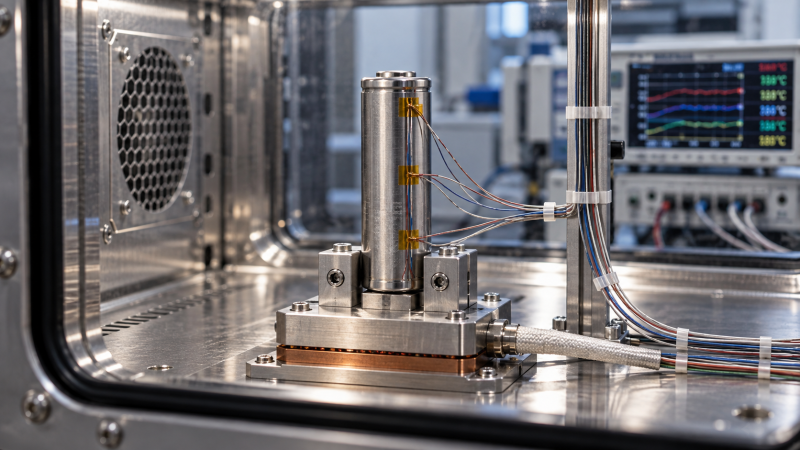
How does chemical thermodynamics affect battery thermal runaway prediction—and where does it fall short? The answer starts with the energy stored in charged electrodes and the reactions they can undergo with electrolytes and other cell components. Thermodynamics helps identify energetically favorable reaction pathways and estimate potential heat release. It does not, by itself, tell an engineer when those reactions will accelerate beyond control.
That distinction matters when selecting a cathode, qualifying an electrolyte, or interpreting a supplier’s thermal stability report. A material can have a substantial reaction energy yet remain kinetically inhibited under normal conditions. Another combination may release less total heat but begin self-heating earlier. Reliable prediction requires thermodynamics, reaction kinetics, and heat transfer to describe the same cell under the same operating conditions.
Thermodynamics defines the energy available—not the countdown
Two quantities are particularly useful: Gibbs free energy and reaction enthalpy. Under specified temperature, pressure, and composition conditions, a negative Gibbs free energy change indicates that a reaction is thermodynamically favorable. Reaction enthalpy describes the associated heat release or absorption at constant pressure. These quantities are related, but they are not interchangeable: a favorable reaction is not necessarily strongly exothermic.
A charged lithium-ion cell is deliberately maintained away from its lowest-energy chemical state. Electrode separation, electrolyte stability windows, and protective interfaces allow that stored energy to be used through an external circuit rather than released through uncontrolled internal reactions. Heating, mechanical damage, or electrical abuse can undermine those barriers.
Thermodynamic calculations can therefore help identify plausible decomposition products, compare reaction energies, and estimate how changes in electrode composition or lithium content alter the available energy. Equilibrium calculations provide useful constraints, but a failing cell may never reach equilibrium. Products formed during rapid heating can differ from those predicted for a fully equilibrated system.
The practical question is not simply “Can this reaction happen?” It is “Can it release heat fast enough, under these conditions, to overwhelm heat removal?”
Why the same chemistry can produce different runaway behavior
Thermal runaway develops through interacting processes rather than one universal decomposition event. Protective interphases can degrade, lithiated anodes can react with electrolyte, separators can lose their ability to prevent electrode contact, and charged cathodes can undergo structural changes. Some cathode compositions can release oxygen that supports further electrolyte reactions. The order and overlap depend on cell design, state of charge, aging, and the initiating fault.
Reaction kinetics supplies the missing time dimension. Many models use Arrhenius-type expressions, in which reaction rates depend strongly on temperature and an activation barrier. However, fitting one apparent activation energy to an entire cell can hide several overlapping reactions. A model that matches one heating experiment may fail under a slower temperature ramp or a localized internal short.
Consider two cells with similar total measured heat release. One begins releasing heat gradually while its cooling system still has capacity. The other retains much of its reaction energy until a sharp acceleration occurs. Their thermodynamic inventories may be comparable, but their detection windows and cooling requirements are not. Selecting solely on total heat release would miss that distinction.
The heat balance turns material properties into a prediction
A simplified cell-level energy balance can be written as:
mCp(dT/dt) = Q̇reaction + Q̇electrical + Q̇external − Q̇removal
Here, mass and heat capacity determine how much energy is needed to raise cell temperature. Reaction heat depends on reaction enthalpies, rates, and the quantities of reactants remaining. Electrical heating can include resistive losses or a fault such as an internal short. External heat may come from a nearby failing cell, while heat removal depends on conduction, convection, radiation, and cooling-system performance.
Self-heating becomes dangerous when rising temperature accelerates heat generation faster than the surrounding system can remove it. That feedback—not merely the presence of an exothermic reaction—is central to runaway prediction. Heat-generation and heat-removal curves help explain instability, although transient, spatially resolved models are often needed for real cells.
A lumped model assumes a representative cell temperature. This can be useful for screening, but it may miss a hot spot near a defect, tab, or damaged electrode region. A surface sensor can still show an apparently manageable temperature while the interior is developing a much more severe condition.
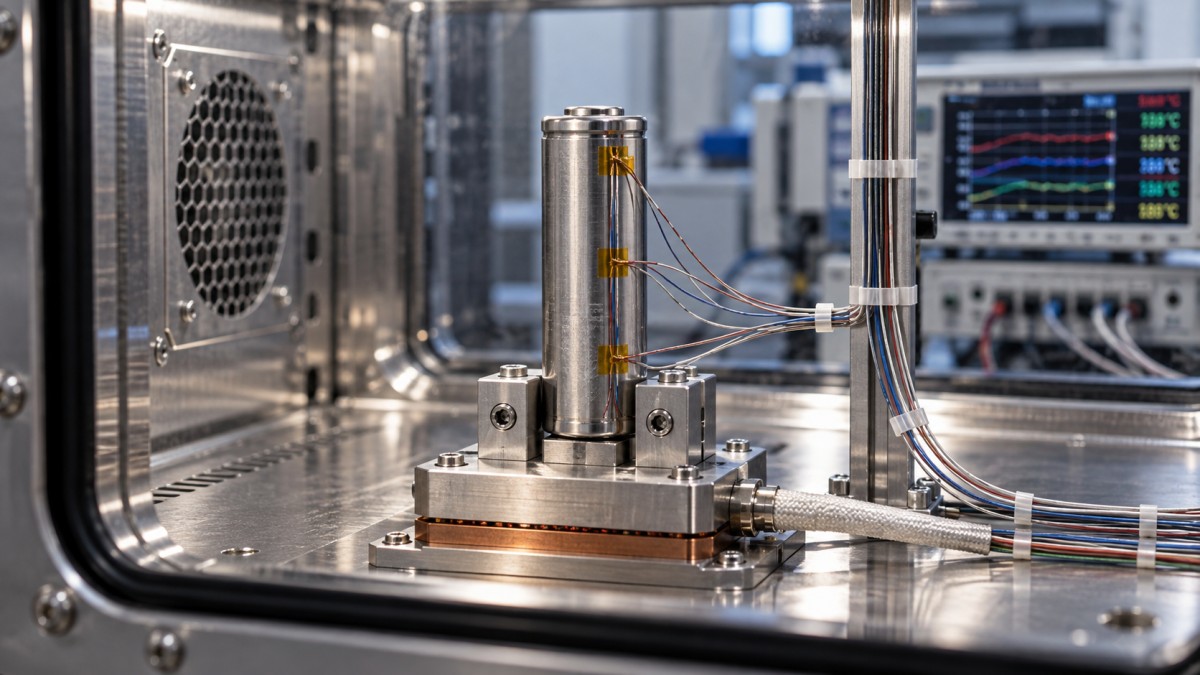
Venting further complicates the balance. Escaping gas and ejected material carry energy away from the cell, but hot vent products can transfer energy to neighboring cells or burn outside the enclosure. Internal reaction heat and external combustion heat need separate treatment; neither a sealed-material test nor a simple cell-temperature trace captures the whole event.
Material comparisons need more than a chemistry label
High-nickel layered oxide cathodes illustrate why composition matters. Their charged-state stability depends on factors including nickel content, degree of delithiation, surface condition, and electrolyte contact. Lithium iron phosphate generally has greater resistance to oxygen release from its phosphate framework, but an LFP cell still contains reactive charged electrodes and usually a combustible electrolyte. Greater cathode stability does not eliminate cell-level runaway or pack propagation risk.
State of charge deserves particular attention. It changes electrode composition and the chemical energy available for side reactions. Comparing thermal reports at different states of charge can produce misleading rankings, even when both laboratories followed their own procedures correctly. Upper cutoff voltage, actual capacity, and conditioning history should accompany the comparison.
Electrolyte changes also involve trade-offs. A formulation that reduces flammability may still react exothermically with a highly charged cathode or lithiated anode. Additives that improve normal cycling can change interphase composition and subsequent decomposition behavior. Likewise, replacing a liquid electrolyte with a solid does not automatically establish safety: electrode–electrolyte compatibility, interfacial reactions, mechanical integrity, and any remaining combustible components still need evaluation.
This is why advanced-materials assessment should connect molecular chemistry with cell construction. A coating, salt, binder, or separator cannot be judged independently of the interfaces it creates. For materials intelligence platforms such as Global Advanced Materials & Chemical Systems (AMCS), that connection is more informative than treating “thermal stability” as a standalone supplier attribute.
What thermal test reports actually tell you
Differential scanning calorimetry, or DSC, measures heat flow associated with thermal events under a defined program. It is useful for screening electrode materials, electrolytes, and deliberately prepared mixtures. However, an electrode powder tested alone does not represent the same chemical system as an electrode wetted with electrolyte. Sample preparation, electrolyte ratio, pan configuration, heating rate, and atmosphere can all affect interpretation.
Accelerating rate calorimetry, or ARC, is commonly used to investigate self-heating under near-adiabatic conditions. It helps characterize how a sample or cell accelerates when heat loss is restricted. Yet the reported self-heating onset depends partly on instrument sensitivity and the selected detection criterion. It should not be treated as a universal temperature below which the battery is safe.
For sourcing and engineering reviews, a useful data request goes beyond the peak temperature:
- Sample definition: electrode state, electrolyte quantity, cell format, state of charge, and aging history.
- Test boundary conditions: heating program, confinement, atmosphere, and whether venting was permitted.
- Measurement basis: whether heat is reported per gram of active material, electrode mixture, or complete cell.
- Event definitions: how self-heating onset, runaway onset, and maximum heating rate were identified.
- Repeatability: individual results and variability, rather than only a representative curve.
These details often explain an apparent supplier disagreement better than a difference in nominal chemistry. A higher reported onset temperature may reflect a different test method rather than a genuinely wider safety margin.
Building a model that survives a change in conditions
A practical workflow starts by defining the prediction target. Screening electrolyte compatibility, estimating time to runaway during external heating, and predicting cell-to-cell propagation are different tasks. They require different levels of detail and different validation experiments.
Thermodynamic information constrains plausible reaction pathways and energy release. Calorimetry then helps estimate reaction rates and their temperature dependence. Cell measurements supply heat capacity, thermal conductivity, electrical behavior, and boundary conditions. The assembled model should be checked against experiments that were not used to fit its parameters.
That last step is easy to undervalue. Matching a single temperature curve does not prove that the underlying reaction mechanism is correct. Several combinations of kinetic parameters and heat-transfer assumptions may reproduce the same trace. Testing across heating rates, charge states, or cooling conditions helps reveal whether the model is transferable or merely well fitted.
Uncertainty should remain visible. Internal short-circuit behavior, manufacturing defects, lithium plating, and aging-related interphase changes may not be captured by nominal material properties. For safety decisions, a prediction interval and sensitivity analysis can be more useful than an apparently precise time-to-runaway value.
From prediction to a defensible decision
Thermodynamics is strongest at explaining the available energy and the chemical reasons one material system may behave differently from another. Kinetics determines how quickly that energy becomes accessible. Heat transfer determines whether it accumulates locally or escapes. None is an adequate substitute for the others.
For material qualification, request comparable thermal data at relevant charge states and with realistic electrode–electrolyte contact. For cell design, check whether the model captures local heating and venting. For pack safety, validate propagation behavior in the intended mechanical and cooling arrangement rather than extrapolating directly from powder-level measurements.
Before accepting a claim of “improved thermal stability,” ask three questions: what reaction was measured, under which conditions, and does that measurement address the failure scenario being designed against? Those answers determine whether thermodynamic data supports a safety prediction—or only a promising material hypothesis.
Recommended News
- 2026.11.06Plasma Process Gases in Korea: Purity and Supply Criteria for ChipmakersIndustrial Gas Strategist
- 2026.11.06Battery Companies Highlight Energy Storage and Solid-State Batteries in Earnings CallsElectrochemistry Fellow
- 2026.11.05Engineering Plastics: Application Examples in Automotive and ElectronicsDr. Felix Sterling
The VitalSync Intelligence Brief
Receive daily deep-dives into MedTech innovations and regulatory shifts.