
Why Biodegradable Plastics Fail in Real Composting Conditions
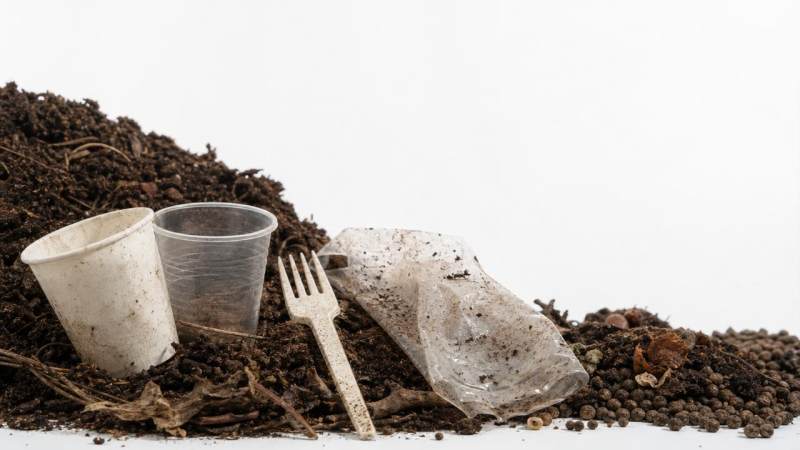
Biodegradable plastics are often promoted as a simple fix for plastic waste. The reality is far more complicated. In real composting conditions, many biodegradable plastics remain intact for months or years.
That gap between marketing claims and disposal reality matters across packaging, consumer goods, food service, and advanced materials strategy. Understanding why biodegradable plastics fail helps improve material choices, waste sorting, and sustainability planning.
What are biodegradable plastics, and why are they misunderstood?
Biodegradable plastics are polymers designed to break down through microbial action. However, that definition says nothing about where, how fast, or under which temperature and moisture conditions decomposition actually happens.
This is the first source of confusion. Many people assume biodegradable plastics will disappear in backyard compost, soil, ocean water, or landfill. Most products do not behave that way.
Some biodegradable plastics need industrial composting systems. These facilities maintain controlled heat, oxygen, humidity, and microbial activity. Without those factors, the material may only fragment or stay mostly unchanged.
Common examples include PLA, PBAT blends, starch-based plastics, and certain compostable packaging films. Their performance depends heavily on formulation, thickness, additives, and end-of-life handling.
The label also gets mixed with other terms. “Biobased” means derived partly from renewable feedstocks. It does not automatically mean compostable. “Compostable” implies specific breakdown standards, not universal degradation.
Why labeling creates false confidence
A cup marked “biodegradable” may still fail in a home compost bin. A compostable fork may not break down in marine conditions. Consumers see one green claim, but disposal systems require much more precision.
This misunderstanding contaminates recycling streams and weakens trust in sustainable materials. For sectors focused on performance, compliance, and environmental credibility, that is a serious risk.
Why do biodegradable plastics fail in real composting conditions?
Most biodegradable plastics fail because real composting conditions are inconsistent. Industrial certification assumes stable operating windows. Real waste systems rarely provide those perfect conditions from collection through final treatment.
Temperature is a major barrier. Many biodegradable plastics require sustained heat above 55°C. Backyard piles often stay much cooler, especially in dry weather, cold seasons, or poorly managed compost heaps.
Moisture also matters. If the compost is too dry, microbial activity slows. If it is too wet and compacted, oxygen falls. In both cases, biodegradable plastics degrade far more slowly than expected.
Material thickness changes results dramatically. Thin films may soften and fragment. Thick cutlery, molded trays, and multilayer items often persist because microbes cannot access the full structure efficiently.
Compost residence time is another issue. Commercial operations optimize throughput. If biodegradable plastics need longer than the facility’s cycle time, they are screened out before complete decomposition.
Contamination worsens the problem. Food residues can help composting, but mixed waste, stickers, inks, barrier coatings, and petroleum-based layers can reduce compostability or prevent acceptance by facilities.
The difference between fragmentation and true biodegradation
A material that breaks into small pieces is not necessarily fully biodegraded. True biodegradation means microorganisms convert the polymer into carbon dioxide, water, biomass, and stable organic matter under defined conditions.
When biodegradable plastics only fragment, they may create persistent microplastic-like residues. That outcome undermines the environmental promise behind the original product claim.
How do industrial composting standards differ from real-world disposal?
Industrial composting standards are useful, but they are often misunderstood as universal proof of environmental performance. In practice, they describe behavior under controlled test protocols, not every disposal environment.
Standards may require specific temperature ranges, particle size reduction, aeration, and time limits. A certified item can pass a lab or pilot test but still fail in a municipal program with different operating conditions.
Some composting sites do not accept biodegradable plastics at all. Operators may worry about contamination, sorting cost, visual residues, or confusion with conventional plastics that look nearly identical.
Landfills are even less favorable. Limited oxygen, lower biological activity, and poor moisture distribution slow degradation. In some cases, biodegradable plastics in landfill perform little better than traditional plastics.
Marine and soil environments are also poor assumptions. Unless a product is specifically tested for those conditions, it should not be expected to degrade safely or quickly there.
Which applications are most at risk of failure?
Not all uses of biodegradable plastics carry the same risk. Failure is most common where collection systems, contamination control, and end-of-life instructions are weak or inconsistent.
Food service items are a major example. Cups, lids, trays, and cutlery may be marketed as compostable, but many venues lack separate organics collection or access to industrial composting facilities.
Flexible packaging creates another challenge. Thin films are hard to sort, often contaminated by food, and frequently mixed into conventional plastic recycling, where they reduce stream quality.
Agricultural mulch films are also debated. If biodegradable plastics do not fully mineralize in soil, residues can accumulate and affect soil quality over time.
Medical, electronics, and engineering uses require even more caution. Performance demands, purity, stability, and regulatory constraints may outweigh any theoretical compostability benefits.
- High-risk: food packaging without composting access
- High-risk: mixed-material pouches and coated paper hybrids
- Moderate-risk: event serviceware with controlled waste collection
- Lower-risk: closed systems with verified composting infrastructure
Why advanced materials sectors need a stricter lens
In high-performance material ecosystems, claims must match process reality. Whether the focus is specialty plastics, battery chemistry, or semiconductor chemicals, material credibility depends on measurable outcomes, not labels alone.
That same discipline applies to biodegradable plastics. Lifecycle fit, purity, additives, waste compatibility, and regulation all matter more than broad sustainability messaging.
How can you judge whether biodegradable plastics are a smart choice?
The key question is not whether a material is called biodegradable. The better question is whether the full disposal pathway supports actual breakdown after use.
Start with certification details. Check whether the product is certified for industrial composting, home composting, soil biodegradation, or marine environments. These are not interchangeable categories.
Then verify local infrastructure. If collection systems and composting facilities do not accept the item, biodegradable plastics may function as conventional waste despite their labeling.
Material design also deserves scrutiny. Ask whether inks, adhesives, barrier layers, and fillers affect compostability. A compostable resin does not guarantee a compostable finished product.
Finally, compare alternatives. In some cases, reusable systems, simplified mono-material packaging, mechanical recycling, or durable engineering plastics with long service life may deliver better environmental results.
What are the biggest myths about biodegradable plastics?
Myth one: biodegradable plastics disappear anywhere. In reality, most need specific processing conditions. Without them, breakdown may be incomplete or extremely slow.
Myth two: biodegradable plastics are always better than recyclable plastics. Not necessarily. If composting infrastructure is absent, a recyclable mono-material design may outperform them environmentally.
Myth three: all plant-based plastics are biodegradable. Some biobased plastics behave like conventional plastics and are designed for durability rather than compostability.
Myth four: compostable packaging solves littering. It does not. Uncollected waste in streets, rivers, or oceans remains a major pollution problem, regardless of green branding.
Myth five: biodegradable plastics remove the need for better system design. In truth, labeling, infrastructure, sorting, and verified material science still determine success.
What should the next step be for smarter material decisions?
Biodegradable plastics can play a role, but only when application, formulation, certification, and disposal systems align. Without that alignment, they often fail in real composting conditions and create new confusion.
A better path starts with evidence-based selection. Match material claims to actual waste pathways. Review local composting acceptance. Compare with reuse, recycling, and longer-life polymer strategies.
For organizations tracking advanced materials, the lesson is clear. Sustainability value must be proven at system level, not assumed from a label. That is especially true for biodegradable plastics.
Use biodegradable plastics only where real composting conditions exist, product design is validated, and end-of-life instructions are unmistakable. Better decisions begin with better material intelligence.
Recommended News
- 2026.09.18How to Evaluate a Polymer Compounding Manufacturer for High-Performance ApplicationsMr. Arthur Mercer
- 2026.09.17Chemical Manufacturing Compliance: Building a REACH-Ready Chemical Inventory SystemDr. Felix Sterling
- 2026.09.16Battery Material Purity Control: Critical Tests for Stable Cell PerformanceElectrochemistry Fellow
The VitalSync Intelligence Brief
Receive daily deep-dives into MedTech innovations and regulatory shifts.