
EU Adopts REACH Revision for PTFE SVHC Filing
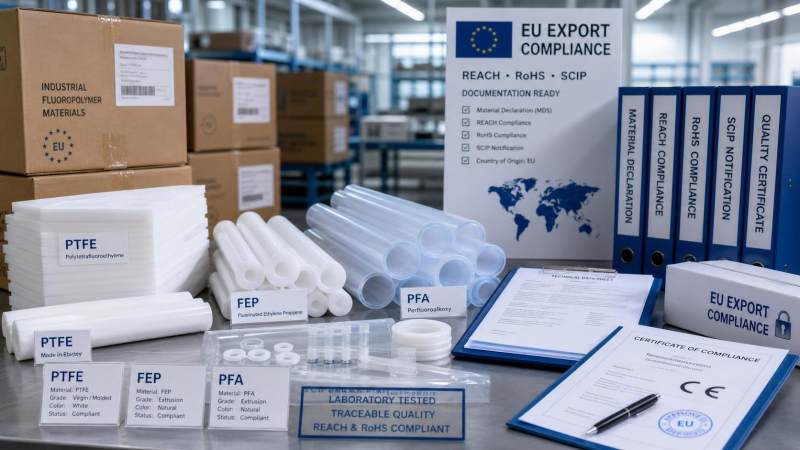
On July 25, 2026, the European Commission formally adopted a REACH amendment published in the Official Journal as OJ L 2026/189 and identified as (EU) 2026/1432. The change brings PFAS polymers including PTFE, FEP, and PFA into mandatory SVHC notification requirements, with filing obligations starting on October 1, 2026 for suppliers exporting PTFE-containing materials to the EU. For exporters, manufacturers, procurement teams, and supply chain service providers, this is not just a regulatory update; it directly affects compliance preparation, document readiness, and the timing of customs clearance.
What Has Formally Changed
The confirmed change is that the European Commission adopted a revision to REACH on July 25, 2026, as published in OJ L 2026/189 under (EU) 2026/1432. Under this revision, PFAS-category polymers, including PTFE, FEP, and PFA, are brought within the scope of mandatory SVHC notification obligations. From October 1, 2026, suppliers exporting PTFE-containing materials to the European Union, including Chinese manufacturers, must submit a complete substance dossier and a use declaration to the ECHA database. The event summary also makes clear that this revision directly affects the compliance path and customs clearance timing for PTFE Materials exports.
Where the Pressure Points Are Emerging
Export transactions now depend more heavily on filing readiness
From an industry perspective, exporters handling PTFE-containing materials are likely to feel the impact first because the rule change is tied directly to SVHC notification and EU-bound shipments. The main business effect is likely to appear in pre-shipment compliance checks, document preparation, and the ability to support customs-related processes with complete filings. What deserves closer attention is whether export documentation and internal product records are aligned with the ECHA submission requirement before goods move.
Manufacturing and material sourcing will need tighter substance documentation
For manufacturers and raw material procurement teams, the change matters because PTFE, FEP, and PFA are specifically named in the event summary. Analysis shows that the practical issue is not only material selection but also the availability of supporting substance information and declared uses needed for dossier preparation. Procurement and production teams may therefore need to pay closer attention to whether upstream material data can support downstream export compliance.
Supply chain coordination may affect delivery timing
Supply chain service providers, distributors, and delivery coordinators may also be affected because the amendment is described as having a direct effect on customs clearance timing. Observably, any missing or incomplete compliance file could become a friction point in shipment planning, document handover, or cross-border coordination. In this context, delivery schedules and order execution may depend more on the completeness of regulatory documentation than before.
EU buyers and sourcing functions may revisit supplier expectations
For buyers and sourcing teams purchasing PTFE-containing materials for the EU market, the revision may translate into stricter supplier documentation requests. Analysis shows that the immediate concern is likely to be whether suppliers can demonstrate that the required substance dossier and use declaration have been prepared and submitted in line with the new obligation. This could influence qualification checks, order confirmation timing, and document review procedures.
What Companies Should Watch Now
Check whether product scope and internal records are consistent
Companies dealing with PTFE-containing materials should first verify whether the products they export to the EU fall within the scope described in the event summary and whether existing internal records can support a complete substance dossier and use declaration. The current issue is document consistency rather than broad policy interpretation.
Review dossier preparation and supporting technical files
Because the requirement refers specifically to submission in the ECHA database, businesses should pay attention to whether technical files, substance-related records, and declared use information are organized well enough for filing. The input does not provide detailed execution rules, so this should be understood as a documentation readiness issue that still requires further verification as implementation approaches.
Reassess shipment schedules tied to the October 1, 2026 date
What deserves closer attention is the transition from regulatory adoption to the effective filing date. Companies with EU-bound PTFE Materials business may need to review shipment timing, order cutoffs, and internal approval steps around October 1, 2026, especially where customs clearance timing is commercially sensitive.
Track how customers and counterparties update compliance requests
Analysis shows that commercial execution may change through customer documentation requests, contract attachments, specification sheets, or tender file wording. Since the input does not include detailed downstream enforcement practice, companies should treat these as areas to monitor rather than as confirmed outcomes.
How This Change Should Be Read at This Stage
Observably, this development is more than a preliminary policy discussion because the amendment has been formally adopted and an effective date has been stated. At the same time, it is not yet appropriate to treat every operational consequence as settled, because the input provides the core obligation but not the full execution detail. It is more appropriate to understand this as a clear compliance signal that has entered the implementation stage, while specific filing practices, document expectations, and market responses still need close observation.
A Practical Reading for the PTFE Trade
For the PTFE Materials trade, the immediate significance of this event lies in the shift from general regulatory awareness to a defined filing obligation with a clear date. The rule change should be read in a measured way: it confirms that SVHC notification will become part of the export compliance path for affected materials, and it also suggests that customs timing and transaction execution could become more sensitive to documentation quality. Current industry discussion is therefore better grounded in compliance preparation and execution readiness than in broad market conclusions.
Basis of This Article
This article is based on the user-provided news title, event date, and event summary. For events of this kind, relevant source categories typically include official notices, publications from regulatory authorities, customs or trade administration information, industry association updates, standard-setting documents, and reporting by authoritative media. The specific official source link was not provided in the input, so it still requires ongoing verification. What also remains worth monitoring are any further implementation details, compliance interpretations, tender document changes, market feedback, and how affected companies carry out the filing requirement in practice.
Recommended News
- 2026.09.14Gel Battery Electrolytes: How Ionic Conductivity and Stability Shape Cell DesignElectrochemistry Fellow
- 2026.09.13Fluoropolymer Extrusion Process: How Melt Control Affects Tube QualityPolymer Synthesis Expert
- 2026.09.12How German Implant Makers Select Medical Polymers for Long-Term BiocompatibilityPolymer Synthesis Expert
The VitalSync Intelligence Brief
Receive daily deep-dives into MedTech innovations and regulatory shifts.