
EU Adopts REACH PFAS Rule for Fluoropolymers
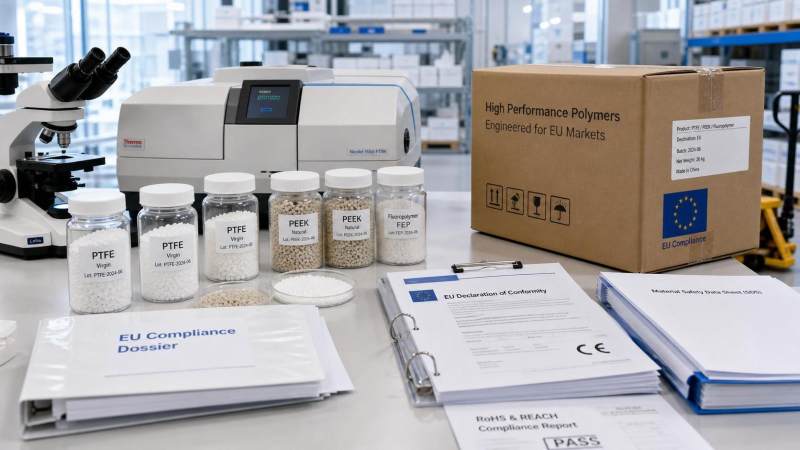
On July 16, 2026, the European Commission formally adopted an amendment to Article 77 of Annex XVII to REACH Regulation (EC) No 1907/2006, based on an ECHA proposal, extending PFAS restrictions to all fluoropolymers, including PTFE, PEEK, and certain fluorinated resins. For exporters serving the EU market, the immediate point of attention is the new requirement to submit a technical alternative verification report to ECHA within six months after the rule takes effect, as this directly affects compliance planning, shipment scheduling, and market access continuity.
What the adopted amendment confirms
The confirmed facts are limited but commercially significant. The amendment broadens the scope of PFAS restrictions under REACH to cover all fluoropolymers, expressly including PTFE, PEEK, and some fluorinated resins. It was formally adopted by the European Commission on July 16, 2026, following an ECHA proposal. Exporters must file a technical alternative verification report with ECHA within six months after the amendment enters into force. If they fail to do so, they face suspension of market access. The information provided also states that this revision directly affects the compliance pathway and delivery cycle for China's exports of PTFE and PEEK materials to Europe.
Where the pressure is likely to appear first
Export-facing material suppliers
From an industry perspective, companies exporting PTFE, PEEK, and related fluoropolymer materials to the EU are the first group exposed to operational pressure. The reason is straightforward: the rule links continued market access to a document-based compliance step within a defined timeframe. The main impact is likely to appear in export compliance preparation, product file review, and shipment timing.
Manufacturing and processing companies in the supply chain
Processors and manufacturers using these materials may also be affected because upstream compliance timing can influence downstream delivery commitments. Observably, the core issue is not only whether material can be supplied, but whether supply can continue without interruption once the six-month reporting window starts to matter in practice.
Procurement and EU-facing customers
Buyers and procurement teams sourcing fluoropolymer materials for EU-linked business need to watch whether suppliers can support the required verification process. The likely impact is concentrated in supplier qualification, order confirmation, and contract execution cycles, especially where delivery dates depend on uninterrupted EU market access.
Logistics and supply chain service providers
Service providers involved in cross-border fulfillment may not be the regulated party in the same way as exporters, but they still face execution risk if customer shipments are delayed or paused by compliance gaps. What deserves closer attention is the possibility that documentation readiness becomes part of shipment planning rather than a separate regulatory matter handled after orders are booked.
What companies should be tracking now
The six-month compliance window
Analysis shows that the timing requirement is one of the most practical parts of this development. Companies should focus on how quickly they can prepare and organize the technical alternative verification report required by ECHA after the amendment takes effect, because the consequence described in the provided information is a possible suspension of market access.
Product scope and internal classification
Businesses dealing in PTFE, PEEK, and certain fluorinated resins should review which products fall within the expanded restriction scope described in the adopted amendment. The immediate concern is whether internal product mapping, export documentation, and customer-facing material descriptions are aligned with the revised regulatory framing.
Delivery planning and customer communication
For companies already supplying the EU market, the practical issue is not limited to legal interpretation. It also concerns delivery commitments and customer expectations. Where orders depend on continuous EU access, supplier communication, lead-time planning, and documentation readiness need to be discussed together rather than handled in separate workflows.
Further official wording and implementation detail
Observably, there is a difference between a policy signal and day-to-day execution. Based on the information provided, the amendment has been formally adopted and the reporting obligation is clear in principle. What companies should continue to watch is how official wording, implementation detail, and related compliance expectations are presented in follow-up materials tied to the rule's entry into force and reporting process.
Why this reads as more than a routine filing change
This section is analysis rather than confirmed fact. It is more appropriate to understand this development as both an immediate compliance change and a longer-term policy signal. The immediate change is the reporting obligation tied to continued EU market access. The longer-term signal is that fluoropolymers such as PTFE and PEEK are now being drawn more directly into the PFAS restriction framework described in the provided information. For the industry, that makes this more than a paperwork update: it affects how regulatory risk, order timing, and supplier readiness are assessed in EU-facing business.
How the market may need to frame this development
A neutral reading is that the amendment already creates a concrete near-term requirement, while its broader commercial effects may still unfold through implementation and company response. Current attention should therefore stay on compliance timing, documentation capability, and continuity of supply to Europe. It is more appropriate to understand this as a live regulatory development with immediate operational relevance, rather than as a completed market outcome.
Basis of this article and points for continued verification
This article is based on the user-provided news title, event date, and event summary concerning the European Commission's formal adoption of the REACH amendment on July 16, 2026. For this type of industry update, source categories commonly associated with verification include official notices, regulator publications, company disclosures, industry association updates, authoritative media reporting, and standard or regulatory documents. No specific official source link was provided in the input, so the exact official reference still needs to be continuously verified. The main follow-up areas to monitor are any further official wording related to entry into force, reporting expectations, and how affected companies translate the amendment into export compliance and delivery arrangements.
Recommended News
- 2026.09.14Gel Battery Electrolytes: How Ionic Conductivity and Stability Shape Cell DesignElectrochemistry Fellow
- 2026.09.13Fluoropolymer Extrusion Process: How Melt Control Affects Tube QualityPolymer Synthesis Expert
- 2026.09.12How German Implant Makers Select Medical Polymers for Long-Term BiocompatibilityPolymer Synthesis Expert
The VitalSync Intelligence Brief
Receive daily deep-dives into MedTech innovations and regulatory shifts.