
ECHA PFAS Export Guide Adds PTFE Roadmap Rule
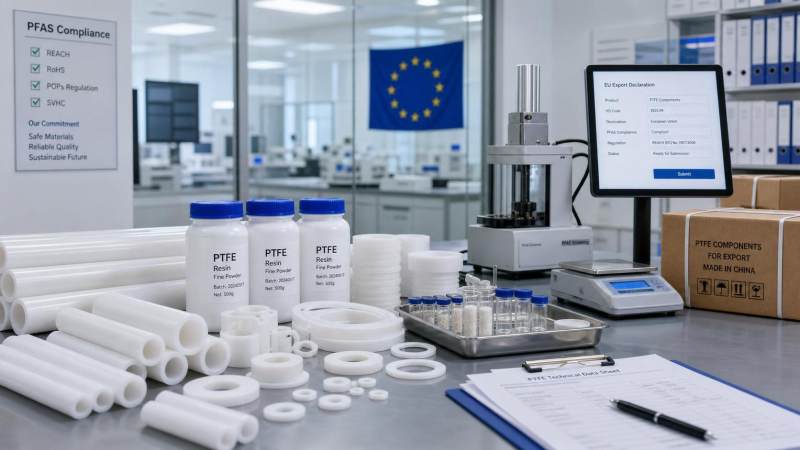
On June 29, 2026, the European Chemicals Agency (ECHA) published version 2.1 of its operational guidance for PFAS restriction export compliance, setting a new documentation requirement for exporters of all fluoropolymer-containing products, including PTFE. From an industry perspective, the immediate point of attention is not only the July 15, 2026 filing timeline, but also the fact that customs clearance and distribution access in the EU market may now depend on whether technical substitution documentation and supporting disclosure items are prepared to the required standard.
What the New ECHA Guidance Confirms
According to the information provided, ECHA released the PFAS Restriction Regulation Export Compliance Operational Guidance V2.1 on June 29, 2026. The guidance requires exporters of all fluoropolymers, including PTFE, to provide importers with a certified technical feasibility substitution roadmap starting July 15, 2026, and to embed that submission within the REACH-IT system.
The same guidance also newly makes three PTFE-related disclosure items mandatory: thermal stability data, degradation product spectrum information, and compatibility testing for non-PFAS alternative resins. The disclosed impact described in the source information is direct relevance to customs clearance and distribution market access for PTFE materials in the European Union.
Where the Pressure Will Be Felt Across the Chain
Export-facing suppliers will face a documentation threshold
Analysis shows that direct trading companies and exporters handling fluoropolymer materials are the first group likely to feel the change. The reason is straightforward: the requirement is tied to export notification, importer-facing documentation, and REACH-IT filing. In practice, the affected business steps are likely to include document preparation, importer coordination, submission timing, and shipment readiness for EU-bound business.
PTFE producers and processors may need deeper technical disclosure
For PTFE material manufacturers and processors, the operational issue is that the guidance does not stop at a general declaration. It specifically names thermal stability data, degradation product spectrum information, and compatibility testing for non-PFAS alternative resins as mandatory disclosure items. What deserves closer attention is whether internal technical files, test records, and product communication materials are already structured in a way that can support export documentation without delays.
Importers and distribution channels may tighten acceptance checks
EU importers and downstream distribution participants may also be affected because the guidance connects compliance disclosure to market entry conditions. Observably, that can shift the practical burden onto order acceptance, inbound compliance review, and distributor onboarding checks. The key change to watch is whether customers and channel partners begin asking for earlier submission of substitution roadmaps and supporting technical materials before confirming purchase or delivery schedules.
Supply chain service providers may see more compliance coordination work
From an industry perspective, service providers involved in compliance support, filing coordination, and cross-border supply execution may need to adapt workflow timing. The likely impact area is not product formulation itself, but document completeness, filing sequence, and communication between exporter and importer. Businesses working around delivery windows should pay attention to whether missing disclosure materials become a shipment gating issue.
What Companies Should Focus on Now
Check whether current files can support the new mandatory disclosures
The practical starting point is to review whether PTFE-related product files already contain the three disclosure elements identified in the guidance and whether those materials are suitable for formal submission. This is a narrower and more immediate question than a broad compliance review, because the guidance names specific technical content rather than only general obligations.
Separate policy wording from operational readiness
Analysis shows that one of the main execution risks is treating the guidance as a high-level regulatory signal rather than a filing and customer-document requirement with a near-term start date. Companies involved in EU exports should distinguish between understanding the policy direction and being operationally ready to submit a certified substitution roadmap through the required system and to support importer-side review.
Review lead times with importers and customers
Because the requirement involves providing documentation to importers and embedding the information in REACH-IT, companies should pay close attention to communication timing with EU counterparts. What deserves closer attention is whether commercial commitments, shipping schedules, and document handover timelines still align once additional certification and technical disclosure steps are included.
Monitor whether product scope and supporting expectations evolve further
Observably, the current guidance already broadens disclosure expectations for fluoropolymer exports by naming PTFE-specific technical items. Companies should therefore keep watch on subsequent official wording, implementation clarifications, or procedural adjustments that may affect how substitution roadmaps and technical evidence are reviewed in practice.
Why This Looks Like More Than a Short-Term Filing Update
Analysis shows that this development is better understood as both an immediate compliance change and a longer-term regulatory signal. The immediate part is clear from the filing date and the newly specified disclosure items. The longer-term signal lies in the type of information now being required: not only product presence, but technical feasibility of substitution and data connected to PTFE performance and degradation characteristics.
At the same time, it would be premature to treat this as a fully settled end-state for all affected businesses. Observably, the information provided establishes the rule change and its direct relevance to EU customs clearance and distribution access, but market practice, customer screening intensity, and documentation workflows may still require continued observation.
How This Update Is Best Understood at This Stage
At this stage, the ECHA guidance is most appropriately understood as a concrete compliance trigger with broader strategic implications for fluoropolymer and PTFE trade into the EU. It is not merely a routine administrative notice, because the requirement reaches into technical disclosure, importer coordination, and REACH-IT submission. A neutral reading is that the rule has already created a defined short-term action point, while its full commercial effect across procurement, distribution, and supply execution still warrants close tracking.
Basis of This Article
This article is based on the user-provided news title, event date, and event summary regarding ECHA's June 29, 2026 release of the PFAS export compliance operational guidance V2.1. In coverage of this type, commonly relevant source categories may include official agency notices, company statements, industry association updates, authoritative media reports, and standards-related documents. The specific official source link was not provided in the input, so continued verification against the original official publication remains necessary. Follow-up attention should focus on any subsequent official clarifications, filing practice details within REACH-IT, and further implementation signals affecting PTFE and other fluoropolymer exports.
Recommended News
- 2026.09.14Gel Battery Electrolytes: How Ionic Conductivity and Stability Shape Cell DesignElectrochemistry Fellow
- 2026.09.13Fluoropolymer Extrusion Process: How Melt Control Affects Tube QualityPolymer Synthesis Expert
- 2026.09.12How German Implant Makers Select Medical Polymers for Long-Term BiocompatibilityPolymer Synthesis Expert
The VitalSync Intelligence Brief
Receive daily deep-dives into MedTech innovations and regulatory shifts.