
ECHA Draft Rule Tightens PFAS Exemption Filings
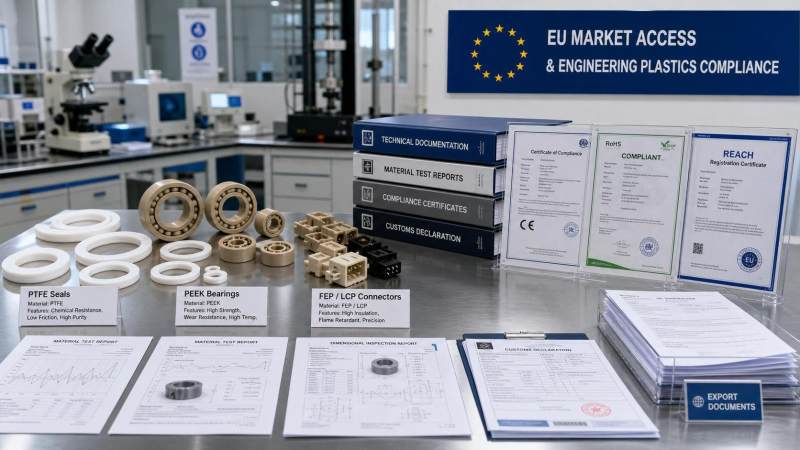
On June 17, 2026, the European Chemicals Agency (ECHA) issued a draft amendment to REACH Annex XVII that changes how exporters must support claims that PFAS substances are permanently embedded in polymer matrices and cannot be released. For products containing PFAS substances, including fluoropolymer-based materials such as PEEK, PTFE, and FEP, the issue is no longer only technical classification but also whether a technical exemption application is filed and assigned an acceptance number before the stated deadline. This matters directly to exporters, component manufacturers, buyers, compliance teams, and supply chain coordinators involved in high-value engineering plastics entering the EU customs territory.
What the draft amendment requires
According to the provided event summary, ECHA published a draft amendment to REACH Annex XVII on June 17, 2026. The draft requires exported products containing PFAS substances that claim the substances are permanently embedded in a polymer matrix and cannot be released to submit a technical exemption application to ECHA by October 31, 2026 and obtain an acceptance number.
The same summary states that products without an acceptance number will be prohibited from entering the EU customs territory from January 2027. The stated scope of impact includes high-value engineering plastic products such as PTFE seals, PEEK bearings, and LCP connectors.
Where the pressure appears along the supply chain
Export transactions now depend on filing status
From an industry perspective, exporters and traders may be affected first because market access is tied to whether the claimed exemption has been submitted and accepted for numbering. The practical impact is likely to appear in shipment readiness, customer declarations, contract review, and pre-export document checks rather than only in material selection.
Component makers face a documentation threshold
Manufacturers of parts such as seals, bearings, and connectors may need to pay closer attention to how PFAS-related material claims are described in technical files. Analysis shows that the issue is not simply whether PFAS is present, but whether the "permanently embedded" claim can be supported in a form suitable for a technical exemption filing and downstream customer use.
Buyers and procurement teams may revisit supplier conditions
For purchasing functions, the rule change may affect supplier onboarding, order confirmation, and delivery risk review. What deserves closer attention is whether suppliers can provide the documents needed to support exemption-related claims and whether procurement specifications, tender materials, or delivery conditions need to reference an acceptance number before EU-bound shipments proceed.
Testing and compliance support functions may see earlier involvement
Compliance teams, certification-related service providers, and testing support functions may be drawn into the process earlier because technical applications typically depend on internal material statements, supporting technical records, and consistent communication across the supply chain. Observably, this turns PFAS handling from a back-end compliance issue into a front-end trade and delivery checkpoint.
What companies should watch now
Review which product claims rely on the embedded-use argument
Companies should first identify which EU-bound products containing PFAS substances are being positioned on the basis that the PFAS content is permanently embedded in the polymer matrix and cannot be released. This is the most direct trigger described in the event summary and should shape internal screening priorities.
Check whether existing technical files can support an exemption submission
Analysis shows that technical documentation may become a commercial gating item. Businesses should examine whether product files, material declarations, specifications, and customer-facing statements are consistent with a technical exemption application, while avoiding assumptions that an existing internal description automatically satisfies the draft requirement.
Track acceptance-number requirements in orders and delivery planning
What deserves closer attention is the transition between the application deadline of October 31, 2026 and the stated January 2027 entry restriction for products without an acceptance number. Companies involved in export scheduling, customs preparation, and customer delivery commitments should monitor whether commercial documents and shipment release steps need to reflect that status.
Follow later wording and enforcement signals carefully
Because the provided information describes a draft amendment, it is more appropriate to understand the current stage as a rule development signal with immediate compliance planning relevance, rather than as a fully detailed enforcement framework. Businesses should therefore keep watching for later official wording, interpretive practice, and changes in how customers or procurement documents refer to the requirement.
How this development is best understood at this stage
Observably, this update signals that PFAS compliance for engineering plastics may be moving beyond substance identification toward a more formal market-access screening model tied to application handling. It is also a sign that claims about non-release in polymer matrices may face a higher documentary threshold in trade practice.
At the same time, analysis shows that the current information is still bounded by the draft nature of the amendment and the limited details provided in the input. For that reason, the development is better understood as a concrete compliance warning and execution signal, while some aspects of practical interpretation still require continued observation.
A practical reading for the market
The immediate significance of this event lies in timing and process. For affected PFAS-containing engineering plastic products, access to the EU market may depend not only on product composition but also on whether a technical exemption application is filed on time and receives an acceptance number. That makes the issue relevant to trade execution, procurement controls, document readiness, and delivery planning.
In neutral terms, this is best read as an emerging operational requirement with potential market-entry consequences, rather than as a broad policy narrative. The most reasonable response for industry participants is to map affected products, verify document readiness, and continue monitoring how the rule is expressed and applied in subsequent official materials and business practice.
Basis of this article and items still to verify
This article is generated from the user-provided news title, event date, and event summary. For developments of this type, relevant source categories typically include official notices, releases by regulatory authorities, customs or trade administration information, industry association updates, standard-setting documents, and reporting by authoritative media.
A specific official source link was not provided in the input, so the exact official text and subsequent updates still need to be verified on an ongoing basis. Continued attention should be given to later policy details, compliance interpretation, procurement document changes, tender wording, market feedback, and how affected companies implement the requirement in practice.
Recommended News
- 2026.09.18How to Evaluate a Polymer Compounding Manufacturer for High-Performance ApplicationsMr. Arthur Mercer
- 2026.09.17Chemical Manufacturing Compliance: Building a REACH-Ready Chemical Inventory SystemDr. Felix Sterling
- 2026.09.16Battery Material Purity Control: Critical Tests for Stable Cell PerformanceElectrochemistry Fellow
The VitalSync Intelligence Brief
Receive daily deep-dives into MedTech innovations and regulatory shifts.