
Japan Tightens LCP Import Filing From Sept. 2026
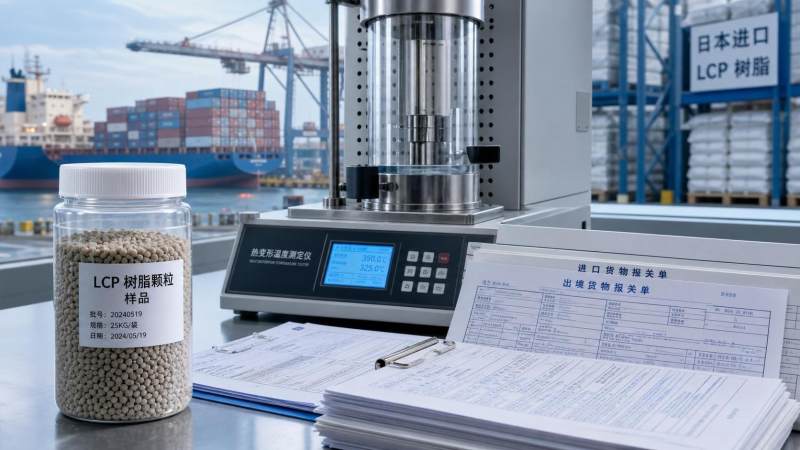
On June 27, 2026, Japan's Ministry of Economy, Trade and Industry announced a revision to the schedule of the Chemical Substances Control Law that adds liquid crystal polymer (LCP) resin to the Class II designated chemical substances category. From September 1, 2026, importers will need to submit heat stability-related technical data to METI before customs clearance. For companies involved in LCP trade, procurement, processing, compliance, and local delivery in Japan, the change deserves attention because it affects document readiness, customs timing, and delivery planning for downstream applications such as 5G millimeter-wave RF modules and automotive connectors.
What the notice changes from September 2026
The confirmed facts are limited but clear. METI issued the notice on June 27, 2026. Under that notice, LCP resin is newly added to the Class II designated chemical substances list under the Chemical Substances Control Law. Beginning on September 1, 2026, all importers must submit three items to METI before customs clearance: heat deflection temperature (HDT), the rate of change in dielectric constant after long-term thermal aging, and a review report for UL94 V-0 certification.
The notice also indicates that this requirement is expected to extend customs clearance time for LCP materials imported into Japan by an average of 7 to 10 working days. At the same time, the technical documentation threshold will rise, with direct implications for local delivery schedules tied to end customers using these materials.
Where the operational pressure is likely to appear
Importers will face a pre-clearance documentation burden
From an operational standpoint, direct importers are the first group affected because the filing requirement applies before customs clearance. Their immediate exposure is not only the added submission step, but also the need to ensure that HDT data, long-term thermal aging dielectric performance data, and UL94 V-0 review materials are complete and usable in the required compliance flow. What deserves closer attention is that the rule change turns technical material readiness into a customs timing issue.
Procurement and planning teams may need to adjust lead-time assumptions
For raw material buyers and sourcing teams, the confirmed 7 to 10 working day extension in clearance time changes planning assumptions around replenishment and scheduled delivery. The impact is likely to be felt in order timing, inbound scheduling, and buffer planning for Japan-bound LCP resin. Analysis shows that procurement teams should treat the new filing requirement as a supply continuity variable rather than a narrow compliance formality.
Processors and component manufacturers may see delivery coordination risks
Manufacturers using LCP in downstream production, especially for 5G millimeter-wave RF modules and automotive connectors mentioned in the event summary, may be affected through local delivery rhythm rather than through the rule text alone. If imported resin arrives later because pre-clearance filing takes longer, production sequencing, customer commitments, and handoff timing inside the local supply chain may all come under pressure. The key issue for this group is alignment between material arrival and committed delivery windows.
Testing, certification, and compliance support functions become more relevant
The required submission items are technical in nature, so compliance teams and external support functions involved in testing or certification review may become more important in transaction execution. Observably, the change raises the practical value of document consistency and traceable technical evidence. Even where no new commercial requirement has yet been described beyond the filing obligation, document quality may become a gating factor for smooth import handling.
What companies should watch before the rule takes effect
Check whether technical files are ready for pre-clearance use
Companies shipping LCP resin into Japan should review whether existing technical files can support pre-clearance submission to METI, specifically around HDT, dielectric constant change after long-term thermal aging, and the UL94 V-0 review report. This is not simply a records issue; it affects whether customs processing can start on time.
Revisit delivery promises tied to Japan-bound orders
Because the event summary states that customs clearance may be extended by 7 to 10 working days on average, businesses should recheck lead-time commitments linked to Japan deliveries. The practical point is to compare current quotation, scheduling, and fulfillment assumptions against the new customs timeline rather than waiting for shipment-by-shipment disruption.
Watch how document expectations are applied in practice
The notice identifies the required submission items, but the input does not provide fuller execution detail on review standards, document format, or case-handling practice. It is therefore more appropriate to monitor how the filing expectation is implemented in actual transactions, including whether customers, brokers, or supply-chain partners begin requesting additional supporting materials to reduce clearance uncertainty.
Pay attention to downstream specification and bid document changes
For suppliers serving customers in RF and automotive connector applications, one practical area to watch is whether procurement specifications, compliance checklists, or bid documents begin to reflect the new filing requirement. The event summary does not confirm such changes yet, so this remains a point for ongoing observation rather than an established outcome.
Why this looks like an execution signal, not just a policy headline
Analysis shows that the significance of this development lies less in policy symbolism and more in its direct effect on import execution. The requirement is tied to a defined effective date, a defined product category, named technical submission items, and an identified customs timing impact. That makes it more than a general regulatory direction.
At the same time, Observably, it should not yet be treated as a fully settled operating framework in every detail, because the provided information does not include the full implementation language, document handling standards, or market response. For that reason, the event is best understood as a concrete compliance change with immediate planning relevance, while some aspects of day-to-day execution still require close monitoring.
How the market should read this development now
The immediate meaning of the June 27 notice is that LCP resin imports into Japan are moving into a more documentation-intensive and time-sensitive compliance path from September 1, 2026. For market participants, the issue is not only whether the rule exists, but whether supply, procurement, and delivery processes are prepared for the extra filing layer before customs clearance.
From an industry perspective, this should currently be understood as an implemented rule change with clear operational consequences, while the finer points of execution still need to be watched through official practice and market feedback. A measured reading is more useful than a dramatic one: the change does not by itself define the full market outcome, but it does materially alter the compliance and delivery assumptions around Japan-bound LCP trade.
Basis of this article and what still needs verification
This article is generated based on the user-provided news title, event date, and event summary. For developments of this kind, commonly relevant source types include official notices, releases from regulatory authorities, customs or trade administration information, industry association updates, standard-related documents, and reporting by authoritative media.
No specific official source link was provided in the input, so the exact official publication path still needs to be verified on an ongoing basis. What also requires continued attention are any later clarifications on implementation details, certification review expectations, changes in procurement or bid documentation, market feedback from affected industries, and how companies ultimately execute against the new filing requirement in practice.
Recommended News
- 2026.09.14Gel Battery Electrolytes: How Ionic Conductivity and Stability Shape Cell DesignElectrochemistry Fellow
- 2026.09.13Fluoropolymer Extrusion Process: How Melt Control Affects Tube QualityPolymer Synthesis Expert
- 2026.09.12How German Implant Makers Select Medical Polymers for Long-Term BiocompatibilityPolymer Synthesis Expert
The VitalSync Intelligence Brief
Receive daily deep-dives into MedTech innovations and regulatory shifts.