
WF6 Spot Prices Surge as Supply Tightens
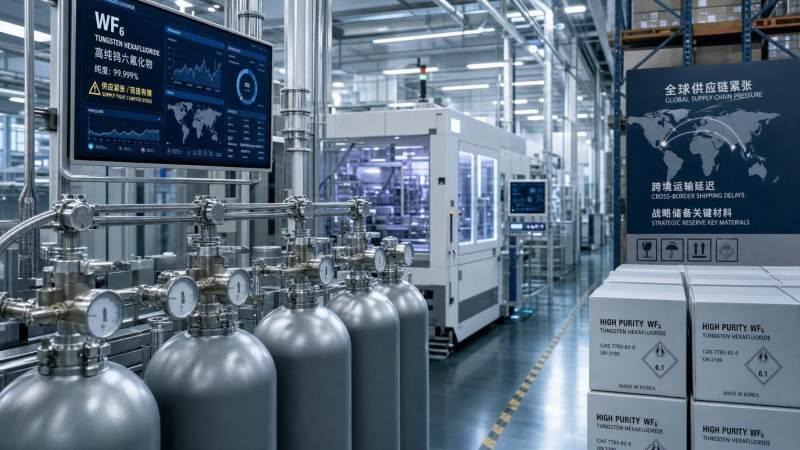
The timing of the underlying event is not clearly specified in the provided information, but as of June 11, 2026, urgent-order pricing for 7N-grade (99.99999%) tungsten hexafluoride had risen to RMB 3.3-3.6 million per metric ton, with some spot offers exceeding RMB 5 million per metric ton. For semiconductor gas buyers, wafer fabs, specialty gas suppliers, and cross-border procurement teams, this development matters because it combines a visible price shock with supply-side concentration and tighter export review conditions around a process material used in EUV lithography and 3D NAND etching.
What has been confirmed so far
According to the provided information, 7N-grade tungsten hexafluoride reached urgent-order prices of RMB 3.3-3.6 million per metric ton as of June 11, 2026, and some spot quotations moved above RMB 5 million per metric ton.
The stated drivers are twofold. First, Kanto Denka and Central Glass in Japan will permanently shut down all electronic specialty gas production lines starting July 1. Second, China has implemented the Tungsten-Related Items Export Control List since January 2026, under which exports of high-purity tungsten powder and related derivatives require case-by-case approval.
The material is identified in the provided summary as a core process gas for EUV lithography and 3D NAND etching. It also states that only a limited number of Chinese companies, including CSSC Special Gas, Haohua Technology, and Huate Gas, currently have 7N mass-production capability. Overseas wafer manufacturers are described as accelerating long-term capacity lock-ins while increasing their review of Chinese suppliers' ISO 8573-1 Class 1 cleanliness certification.
Why different parts of the chain are paying attention
Wafer fabs face a combined pricing and qualification issue
From an industry perspective, wafer fabs may be affected not only by higher urgent-order prices, but also by the interaction between procurement timing and supplier qualification. Where this matters most is in sourcing continuity for processes tied to EUV lithography and 3D NAND etching. What deserves closer attention is whether supply can be secured under longer-term arrangements rather than through spot purchases alone.
Specialty gas suppliers are under pressure on output and compliance
Analysis shows that suppliers with 7N mass-production capability are likely to face heavier scrutiny on both available capacity and documentation readiness. The business impact is not limited to manufacturing itself; it also extends to customer audits, cleanliness certification review, and delivery planning. For suppliers serving overseas customers, the distinction between production capability and export execution may become increasingly important.
Cross-border procurement teams need to track approval-related friction
Observably, companies involved in international sourcing and trade may see greater uncertainty in lead times because high-purity tungsten powder and related derivatives are subject to case-by-case approval under the export control list cited in the input. The practical concern is not only price, but also whether shipment scheduling, contract timing, and internal approval workflows remain aligned with customer demand.
Supply-chain service providers may see more verification work
Logistics coordinators, compliance teams, and commercial intermediaries may be affected through a rise in document checks and customer communication requirements. In this case, the key issue is less about broad transport capacity and more about whether each transaction can move forward with the required supporting materials and supplier credentials.
What companies should watch now
Separate price movement from deliverability
Analysis shows that a high spot quotation does not automatically mean stable deliverability. Buyers and sellers should distinguish between quoted emergency pricing, confirmed allocation, and actual shipment feasibility, especially where case-by-case export review may affect execution.
Prepare for deeper supplier qualification review
The provided information indicates that overseas wafer fabs are increasing review of ISO 8573-1 Class 1 cleanliness certification for Chinese suppliers. What deserves closer attention is whether qualification files, audit responses, and supporting technical materials are current and consistent across customer-facing processes.
Focus on long-term contracts versus spot dependence
Observably, overseas fabs are accelerating efforts to lock in long-term capacity. For market participants, this suggests that commercial discussions may increasingly center on allocation priority, contract duration, and delivery assurance rather than price alone.
Track policy wording and operational implementation separately
From an industry perspective, companies should avoid treating policy language and transaction-level execution as the same issue. The export control framework is a confirmed fact in the provided summary, but its effect on specific orders depends on how approvals, documentation, and counterpart communication are handled in practice.
Why this matters beyond a single price spike
As an editorial observation, this development is more meaningful than a short-lived spot-market fluctuation because it links three issues at once: upstream policy control, loss of named overseas production lines, and concentration of qualified 7N production capacity. That said, it would be premature to treat the current pricing level alone as a definitive long-term market baseline.
It is more appropriate to understand this as a strong supply-chain stress signal within a highly specialized semiconductor materials segment. The reason the industry should keep watching is that qualification cycles, contract conversions, and transaction approvals may shape actual market impact just as much as headline quotations do.
How this development is best understood at this stage
At this stage, the most balanced reading is that the tungsten hexafluoride market is showing both immediate tightness and a deeper structural sensitivity around qualified supply. The confirmed facts point to a narrower pool of available 7N producers and a more complex export environment, but the full business impact still depends on how procurement, qualification, and approval processes evolve in ongoing transactions. For now, this is best understood as an industry development with both short-term pricing consequences and longer-term strategic implications that still require close monitoring.
Basis of this article and what still needs verification
This article is based on the user-provided news title, event timing note, and event summary. No specific official source links were provided in the input, so any related official notices, company announcements, industry association releases, authoritative media reporting, and relevant standards documentation still need to be continuously verified against primary materials. Areas that warrant further follow-up include any subsequent official clarification, supplier-side implementation details, customer qualification progress, and order-level effects on delivery cycles.
Recommended News
- 2026.09.18How to Evaluate a Polymer Compounding Manufacturer for High-Performance ApplicationsMr. Arthur Mercer
- 2026.09.17Chemical Manufacturing Compliance: Building a REACH-Ready Chemical Inventory SystemDr. Felix Sterling
- 2026.09.16Battery Material Purity Control: Critical Tests for Stable Cell PerformanceElectrochemistry Fellow
The VitalSync Intelligence Brief
Receive daily deep-dives into MedTech innovations and regulatory shifts.