
Samsung Approval Lifts Chinese WF₆ Supply Credibility
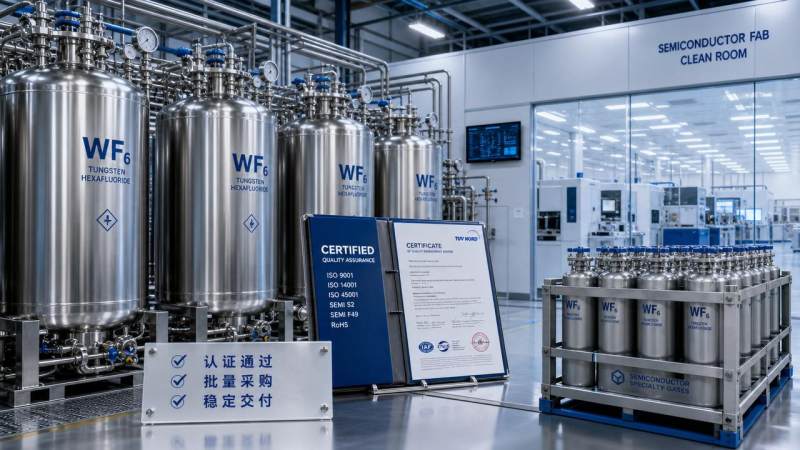
The timing of this development is not specified in the source input, but the signal to the electronics gas market is clear: a customer-side certification threshold has been crossed. CSSC Special Gas says its 7N ultra-high-purity tungsten hexafluoride (WF₆) has completed full-process validation at Samsung Electronics and has received bulk purchase orders. For semiconductor materials suppliers, procurement teams, certification-related service providers, and cross-border supply chain operators, the key issue is not only a new order, but the fact that a domestically produced electronic specialty gas has moved further into a recognized, qualification-based supply position for high-end manufacturing.
What Has Been Confirmed So Far
According to the provided information, CSSC Special Gas announced that its 7N-grade ultra-high-purity WF₆ product completed Samsung Electronics' full-process verification and then obtained bulk procurement orders. The company’s existing capacity of 2,000 tons per year is running at full load, and an additional 1,000 tons per year project is expected to start production in 2027. The same source frames this as a move in China’s high-end electronic specialty gas capability from being merely usable to being trusted, while also indicating that overseas wafer fabs may gain an authenticated second source of supply.
Why This Matters for Qualification, Sourcing, and Delivery
For fab procurement teams, supplier screening may become more documentation-driven
From an industry perspective, the most immediate implication is in procurement qualification rather than headline capacity alone. When a product has passed full-process validation and moved into bulk ordering, purchasing teams may pay closer attention to certification status, technical file completeness, batch consistency evidence, and supplier traceability materials. The practical change is that sourcing decisions may increasingly distinguish between products that are technically available and products that have already cleared customer-side validation requirements.
For specialty gas producers, the entry threshold is increasingly tied to verification results
Analysis shows that for manufacturers of electronic specialty gases, the relevant rule change is less about a published regulation and more about the rising weight of customer qualification standards in real market access. A supplier that can demonstrate completed process verification may be treated differently in bidding, vendor onboarding, and delivery planning from one that is still at the sample or testing stage. This means certification language, quality records, and technical consistency may become more influential in commercial discussions.
For supply chain and trade operators, second-source status can affect execution risk
Observably, logistics providers, distributors, and export-facing supply chain participants may need to watch whether buyer requirements begin to reference approved-source status more explicitly. If overseas wafer fabs are considering an authenticated second source, the operational impact may appear in purchase scheduling, qualification document review, shipment planning, and after-delivery traceability. What deserves closer attention is not just volume, but whether contract execution increasingly depends on auditable product qualification and stable delivery records.
What Companies Should Watch Next
Track how certification is described in procurement materials
Companies involved in electronic materials supply should closely review how customer procurement documents, technical specifications, and supplier access requirements describe validation, approved-source status, and quality proof. The provided information confirms Samsung-related verification and order progress, but it does not define a wider market rule. Businesses should therefore watch whether similar wording begins appearing more broadly in sourcing and tender practice.
Prepare technical and compliance files for deeper review
Where certified supply becomes a stronger commercial filter, supporting materials may matter more in day-to-day execution. Suppliers and service partners should pay attention to product specifications, testing records, quality documentation, traceability files, and delivery-linked technical records that customers may request during onboarding or repeat ordering. This is especially relevant when qualification status is being used as a practical gate for supply continuity.
Align purchasing plans with current and future capacity signals
The confirmed facts show full-load operation at 2,000 tons per year and an additional 1,000 tons per year project expected in 2027. Analysis shows that buyers and intermediaries may need to compare near-term ordering needs with current available supply and future expansion timing, particularly where procurement plans depend on stable multi-period delivery. This should be understood as a planning consideration rather than a confirmed market outcome.
Keep an eye on post-sale accountability and traceability expectations
If customer-side qualification increasingly shapes supplier selection, after-sales response, batch traceability, and quality issue handling may draw more attention. The input does not provide detailed execution rules on these points, so it is more appropriate to treat them as areas for continued monitoring rather than settled requirements. Even so, companies participating in high-end electronic gas supply should be prepared for more rigorous recordkeeping expectations.
How to Read the Signal at This Stage
Analysis shows that this development is best understood as an execution signal from the market rather than a standalone policy announcement. The notable shift is that certification and validation appear to be functioning as real supply access rules in practice. At the same time, it would be premature to treat one confirmed customer-side approval as evidence of a fully generalized market transition. Continued observation is needed on how qualification standards are applied in procurement, how buyers define second-source acceptance, and whether similar recognition appears in other commercial settings.
A Practical Reading of the Development
At this stage, the event is more appropriately understood as a concrete sign that high-end electronic specialty gas supply is being judged not only on product availability, but on verified acceptability within demanding manufacturing processes. For industry participants, the real significance lies in sourcing rules, qualification credibility, and delivery execution standards. It does not by itself prove a broad market reshaping, but it does indicate that certification-backed supply status is becoming more commercially meaningful.
Basis and Ongoing Verification
This article is generated from the user-provided news title, event timing note, and event summary. For developments of this kind, commonly relevant source categories may include company announcements, regulator releases, customs or trade authority information, industry association updates, standards organization materials, and reporting by established business or industry media. No specific official source link was provided in the input, so further verification remains necessary. What still deserves continued monitoring includes any later clarification of certification scope, procurement wording, execution standards, tender document changes, market feedback, and how companies implement related supply and compliance practices.
Recommended News
- 2026.09.18How to Evaluate a Polymer Compounding Manufacturer for High-Performance ApplicationsMr. Arthur Mercer
- 2026.09.17Chemical Manufacturing Compliance: Building a REACH-Ready Chemical Inventory SystemDr. Felix Sterling
- 2026.09.16Battery Material Purity Control: Critical Tests for Stable Cell PerformanceElectrochemistry Fellow
The VitalSync Intelligence Brief
Receive daily deep-dives into MedTech innovations and regulatory shifts.