Japan WF6 Curbs Push AI Chipmakers Toward China
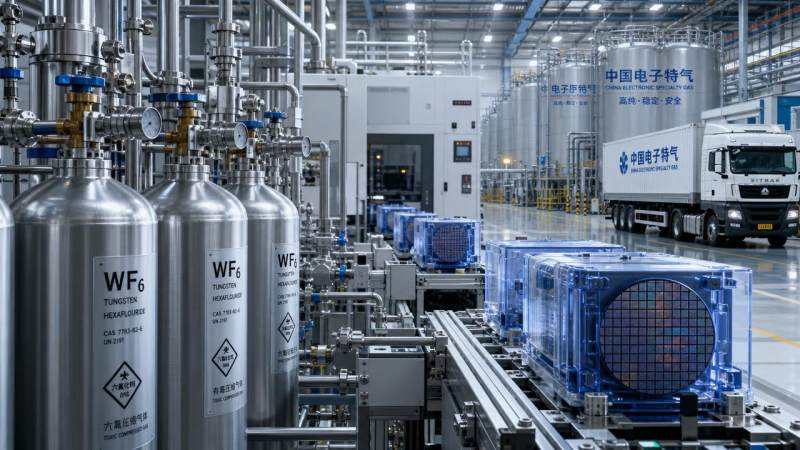
On June 15, 2026, the restriction on Japanese exports of tungsten hexafluoride (WF6) became a practical supply-chain issue rather than a distant policy signal. Following a June 12 notice from Japan’s Ministry of Economy, Trade and Industry tied to upgraded tungsten metal export controls, three major Japanese WF6 suppliers suspended delivery of new orders to non-allied countries from June 15. For chipmakers, foundries, procurement teams, and specialty gas suppliers, the development matters because WF6 is a key precursor in 3D NAND and logic chip etching, linking trade controls directly to sourcing, qualification, and delivery execution.
What Has Been Confirmed So Far
According to the provided event summary, Japan’s Ministry of Economy, Trade and Industry issued a notice on June 12, 2026, and from June 15 three major Japanese WF6 producers—Shin-Etsu Chemical, Showa Denko, and a SUMCO-affiliated enterprise—stopped delivering new orders to non-allied countries because of upgraded export controls affecting tungsten metal.
The same summary states that the resulting supply gap is expected to reach 28% of global supply. It also confirms that WF6 is a critical precursor for etching in 3D NAND and logic chips, with direct effects on the foundry progress of TSMC, SK hynix, and manufacturing tied to Nvidia’s Blackwell platform. In parallel, leading Chinese electronic specialty gas companies have obtained ISO 14644-1 Class 1 cleanroom certification and are taking urgent substitute orders.
Where the Rule Change Reaches First
For chip manufacturers and foundry programs
From an industry perspective, the immediate pressure falls on fabrication schedules that depend on stable WF6 input. The impact is not limited to raw material availability; it can extend to procurement timing, supplier switching, and qualification review for process-critical gases. What deserves closer attention is whether purchasing and engineering teams must now align technical documents, incoming quality requirements, and delivery plans more tightly when replacing a restricted source.
For procurement and sourcing teams
Analysis shows that buyers are likely to feel the rule change first through order acceptance and delivery constraints rather than through abstract policy language. Where new Japanese deliveries are suspended for the affected destinations, procurement teams may need to review existing supply commitments, substitution readiness, supplier credentials, and the document set required for onboarding an alternative source, especially when the gas is tied to advanced chip production steps.
For specialty gas suppliers and supply-chain service providers
For replacement suppliers, the relevant issue is no longer only production capacity but also whether certification, cleanliness control, and shipment execution can support urgent transition demand. The confirmed reference to ISO 14644-1 Class 1 cleanroom certification suggests that qualification-related signals may carry more weight in commercial decisions, while logistics and supply-chain service providers may need to respond to shorter lead-time expectations and tighter traceability requirements.
What Companies Should Track Now
Qualification files and certification evidence
Observably, one practical focus is whether substitute suppliers can present the certification and technical records needed by customers for process-critical gas use. The event summary confirms ISO 14644-1 Class 1 cleanroom certification for leading Chinese suppliers, but companies still need to watch how customers interpret qualification thresholds in actual procurement and delivery decisions.
Official wording and execution scope
Another point to monitor is how the export-control upgrade is described and applied in practice. The confirmed information shows a suspension of new order deliveries to non-allied countries from June 15, but businesses should continue to track whether later official statements, trade guidance, or customer notices clarify the operational scope relevant to contracting, scheduling, and order fulfillment.
Procurement planning and delivery risk
Analysis shows that companies exposed to WF6 should reassess purchase sequencing, delivery buffers, and substitution timing. This should be understood as a practical compliance-and-execution issue: once a restricted source stops accepting or delivering new orders for certain destinations, procurement risk can shift quickly from price and availability to continuity of qualified supply.
Traceability and after-delivery controls
Where urgent replacement orders are involved, quality traceability and supporting documentation become more important. It is more appropriate to understand this as a reminder that supplier qualification is only one part of the transition; document consistency, batch traceability, and post-delivery accountability may also become key checkpoints for affected buyers and supply partners.
How to Read This Signal at This Stage
Observation rather than certainty is important here. This development already looks like an implemented trade-control signal because the suspension date and affected supply behavior are specified in the provided summary. At the same time, it is not yet something the industry should read as a fully settled long-term market outcome. What deserves closer attention is how procurement documents, customer qualification standards, and execution practices respond once substitute orders move from emergency placement to routine delivery.
From an industry perspective, the most meaningful point is that a policy-linked export restriction on an upstream material is now interacting directly with advanced semiconductor production schedules. That makes the issue relevant not only to exporters and regulators, but also to fabs, sourcing managers, technical qualification teams, and service providers involved in specialty gas delivery.
A Practical Reading of the Event
The current event is best understood as a concrete execution signal with immediate supply-chain relevance, while still requiring further observation on how the rule is implemented across procurement and delivery workflows. The confirmed facts show a regulatory trigger, a defined start date, affected suppliers, and an identified substitute pathway through certified Chinese producers. The broader commercial and compliance effects, however, still need to be judged through subsequent customer actions, procurement adjustments, and market feedback rather than assumption.
Basis and Ongoing Verification
This article is generated from the user-provided news title, event date, and event summary. For events of this kind, commonly relevant source categories include official notices, releases from regulatory authorities, customs or trade administration information, industry association updates, standard or certification documents, and reporting by authoritative media. A specific official source link was not provided in the input, so further verification remains necessary. It is also necessary to keep monitoring later policy detail, execution guidance, certification interpretation, tender or procurement document changes, industry feedback, and how affected companies carry out supply substitution in practice.
Recommended News
- 2026.09.18How to Evaluate a Polymer Compounding Manufacturer for High-Performance ApplicationsMr. Arthur Mercer
- 2026.09.17Chemical Manufacturing Compliance: Building a REACH-Ready Chemical Inventory SystemDr. Felix Sterling
- 2026.09.16Battery Material Purity Control: Critical Tests for Stable Cell PerformanceElectrochemistry Fellow
The VitalSync Intelligence Brief
Receive daily deep-dives into MedTech innovations and regulatory shifts.