
Thermal Runaway Chemistry: Why Exothermic Reactions Overwhelm Reactor Cooling
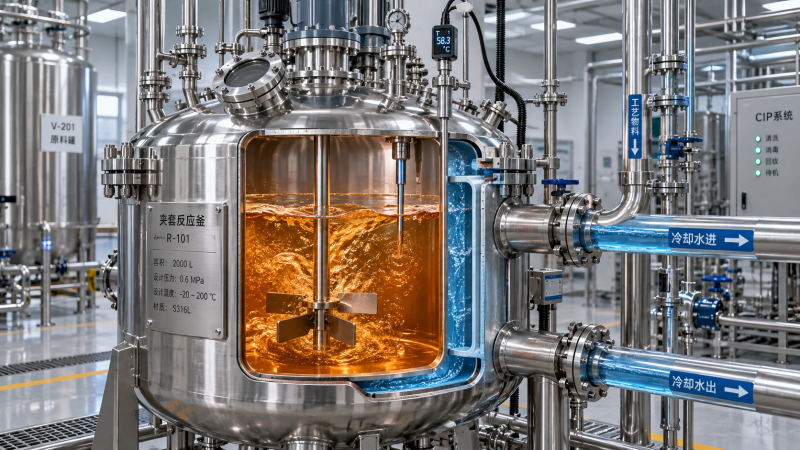
Thermal Runaway Chemistry: Why Exothermic Reactions Overwhelm Reactor Cooling
A reactor can have adequate cooling during normal operation and still lose temperature control during an upset. The difference is often not total reaction heat, but how quickly that heat becomes available. Understanding thermal runaway chemistry means examining temperature-dependent kinetics, accumulated reactants, and secondary decomposition together—not treating the cooling jacket as an unlimited heat sink.
In specialty chemical synthesis, resin production, and battery-material processing, a stable temperature trend can be misleading. Cooling may be compensating for increasing heat generation, or unreacted material may be accumulating without an obvious temperature rise. The useful question is: what happens to this particular reaction mixture if cooling, agitation, or feed control fails?
Reaction heat and cooling do not increase at the same rate
For a simplified, well-mixed batch reactor, the temperature balance can be written as:
mCp(dT/dt) = Qgeneration − UA(T − Tcoolant)
Here, mCp represents thermal capacity, U the overall heat-transfer coefficient, and A the effective heat-transfer area. Feed enthalpy, evaporation, and other heat flows require additional terms where relevant. The equation is useful because it separates chemical heat generation from equipment heat removal.
Many reaction rate constants follow Arrhenius-type temperature dependence over their relevant operating range. As temperature rises, reaction heat generation can accelerate much faster than jacket heat removal, which increases approximately with the temperature difference if U and coolant conditions remain unchanged. More heat raises the temperature; higher temperature releases heat faster. That feedback drives runaway.
An instantaneous heat balance is not necessarily stable. If a small temperature increase raises heat generation more than heat removal, the reactor can move away from its operating point. Reactant depletion may eventually limit the primary reaction, but it may not do so before boiling, pressure escalation, or decomposition begins.
The hidden inventory in a controlled feed
Consider a semi-batch polymerization or resin synthesis in which one reactant is metered into the vessel. The intended strategy is straightforward: restrict the feed so the cooling system can remove the resulting heat. That strategy works only when consumption keeps pace with addition.
A lower-than-expected reaction temperature, inadequate catalyst activity, or poor mixing can allow reactant accumulation. If the reaction subsequently accelerates, the vessel contains more reactive inventory than the feed rate alone suggests. Stopping addition prevents further accumulation, but does not eliminate material already present.
This is why feed-interruption experiments matter. Reaction calorimetry can show whether heat release falls promptly after dosing stops or persists because accumulated reactants continue reacting. A dosing limit derived only from average batch heat release misses this distinction.
Raw-material changes also deserve attention. Water content, inhibitor concentration, catalyst residues, and impurities can alter induction periods or reaction pathways. For high-purity specialty chemicals, purity specifications support product performance, but they do not replace a process-specific thermal hazard assessment.
Why laboratory cooling performance does not scale directly
For geometrically similar vessels, volume grows faster than surface area. A larger reactor therefore generally has less external cooling area per unit of reacting material. Matching laboratory temperature and feed time does not establish equivalent thermal control at production scale.
The heat-transfer coefficient is not fixed either. In polymer and resin processing, increasing viscosity can weaken circulation and wall heat transfer. Fouling adds resistance. Loss of agitation can reduce cooling effectiveness and create temperature gradients, meaning a bulk temperature probe may not capture the hottest region.
Cooling capacity should therefore be evaluated at the least favorable credible combination of viscosity, fill level, coolant temperature, utility availability, and surface condition. A clean-vessel commissioning test is useful, but it does not establish capacity late in a viscous batch or during a shared-utility disturbance.
The calorimetry data that change the decision
No single thermal test answers every process-safety question. A practical evaluation connects several measurements:
- Reaction calorimetry: measures process heat release and its rate under representative dosing, mixing, and temperature conditions; supports assessment of accumulation and cooling demand.
- Differential scanning calorimetry: screens raw materials, intermediates, products, and residues for exothermic behavior. A scan onset is method-dependent, not a universal safe operating temperature.
- Adiabatic calorimetry: investigates self-heating, pressure development, and decomposition kinetics under conditions relevant to loss of heat removal. Interpretation must account for apparatus thermal inertia and test sensitivity.
The adiabatic temperature rise estimates the temperature increase if available reaction heat remains in the system. For a semi-batch process, the maximum temperature of the synthesis reaction, commonly called MTSR, estimates the excursion following cooling failure with the relevant accumulated inventory. Neither value should be calculated using the recipe alone when conversion and accumulation are uncertain.
Compare the predicted excursion with boiling behavior, equipment temperature limits, and decomposition kinetics. Time to maximum rate under adiabatic conditions can help judge whether detection and intervention are fast enough. Such comparisons need qualified interpretation; a simple gap between operating temperature and a DSC onset is not a defensible safety margin.
Cooling protection and pressure protection are different jobs
Once secondary decomposition starts, gas generation may continue even after the intended synthesis reaction has stopped. Boiling can absorb heat, but also creates vapor load. Pressure relief must address the credible runaway scenario, including two-phase discharge where applicable—not merely routine solvent evaporation.
The UK Health and Safety Executive’s guidance, Chemical reaction hazards and the risk of thermal runaway, provides a useful starting framework. Detailed safeguards still require process-specific hazard assessment, applicable pressure-equipment requirements, and appropriate relief-design methods. Emergency quench is likewise not an assumed remedy: compatibility, mixing, added volume, and possible gas evolution need validation.
For AMCS coverage of advanced materials and specialty chemical supply chains, the meaningful distinction is between a supplier reporting thermal stability and demonstrating control of the manufacturing reaction. Before accepting a scale-up, request the upset basis, accumulation evidence, cooling assumptions, and emergency-response timing. If those are missing, a successful laboratory batch is evidence of synthesis feasibility—not proof of production safety.
Recommended News
- 2026.10.29Sourcing Wet Electronic Chemicals in Taiwan: Purity and Supply ReliabilitySemiconductor Chemistry Architect
- 2026.10.29China SAE Names 400 Wh/kg Solid-State Batteries Among Its Top 10 Trends for 2027Electrochemistry Fellow
- 2026.10.28Sourcing Battery Cathode Materials: How to Assess Supplier Quality and CapacityMr. Arthur Mercer
The VitalSync Intelligence Brief
Receive daily deep-dives into MedTech innovations and regulatory shifts.