
Quantum Materials Stability: What Affects Phase Reliability and Measurement Results?
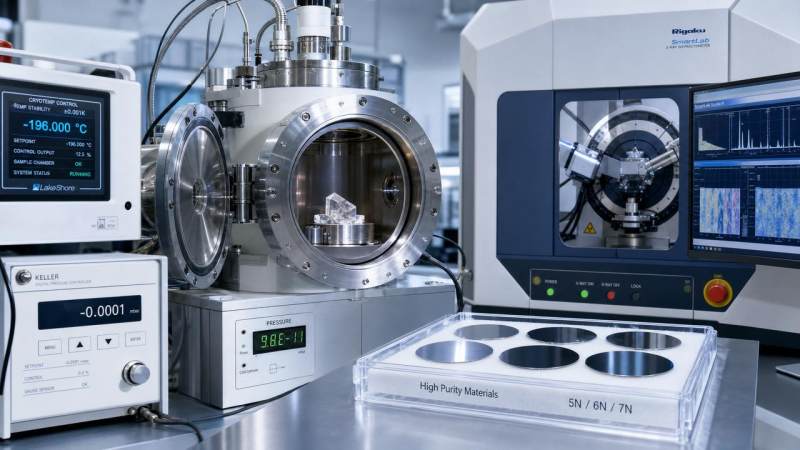
Quantum Materials Stability: What Affects Phase Reliability and Measurement Results?
Quantum materials stability decides whether phase transitions, transport data, and electronic behavior are truly meaningful.
A sample may look fine on paper, yet still produce unstable or conflicting results.
That usually happens when temperature drift, pressure variation, contamination, or handling damage changes the phase state.
For technical teams, quantum materials stability is not just a research topic.
It directly affects measurement reliability, qualification decisions, and process confidence.
The practical question is simple: which factors most often shift the phase and distort the data?
Why Phase Reliability Fails So Easily
Many quantum systems sit close to a phase boundary.
That means a very small external change can push the material into another electronic or structural state.
In practice, quantum materials stability weakens when the sample is highly sensitive to its environment.
This is common in correlated oxides, topological materials, superconductors, and low-dimensional crystals.
One lab may report a clean transition.
Another sees broadened peaks or missing signatures, simply because preparation or test conditions were slightly different.
The Main Factors Behind Quantum Materials Stability
1. Temperature Control
Temperature is often the strongest trigger.
Even minor fluctuations can move transition points, change resistance curves, or blur magnetic and optical responses.
If thermal equilibration is rushed, the data may reflect transient behavior instead of the true phase.
2. Pressure and Mechanical Stress
Pressure can stabilize or suppress a quantum phase.
But unplanned stress matters too, especially from clamping, polishing, bonding, or thermal mismatch.
A strained sample may no longer represent the original material design.
3. Purity and Chemical Composition
Quantum materials stability depends heavily on stoichiometry and impurity control.
Trace contamination can alter carrier density, defect populations, and interfacial chemistry.
This is especially important when synthesis uses high-purity gases, wet chemicals, or reactive precursors.
4. Defects and Microstructure
Not all defects are harmful, but uncontrolled defects create uncertainty.
Vacancies, dislocations, grain boundaries, and phase segregation can shift electronic behavior in unexpected ways.
So when people discuss phase reliability, microstructure is often the hidden variable.
How Measurement Results Become Misleading
Weak quantum materials stability does not always show up as obvious sample failure.
More often, it appears as confusing data.
- Transition temperatures vary between runs.
- Conductivity or magnetization curves show hysteresis that should not be there.
- Spectroscopy peaks broaden, split, or disappear.
- Surface-sensitive methods disagree with bulk measurements.
- Repeated tests on similar samples give inconsistent conclusions.
When this pattern appears, the issue is often not the instrument alone, but the phase sensitivity of the material itself.
Practical Steps to Improve Reliability
The good news is that phase reliability can be improved with disciplined controls.
- Lock down thermal history before each measurement.
- Record cooling rate, soak time, and stabilization delay.
- Minimize unintended stress during mounting and contact formation.
- Verify purity, stoichiometry, and batch consistency before testing.
- Use complementary methods, such as transport plus diffraction or spectroscopy.
- Compare surface and bulk results instead of trusting one signal alone.
In industrial settings, this also supports better supplier qualification and stronger technical documentation.
That matters when advanced materials move from lab evaluation to process integration.
Why This Matters Across Advanced Materials Supply Chains
From recent industry shifts, a clearer signal is emerging.
Buyers and engineers increasingly want proof that measured performance is repeatable, not just impressive on a single test sheet.
For AMCS-related sectors, that links quantum materials stability with purity control, crystallography, compliance, and supply reliability.
The same logic already applies in battery materials, semiconductor chemicals, electronic gases, and high-performance polymers.
Reliable phase behavior is becoming part of commercial credibility, not just technical curiosity.
Final Takeaway
Quantum materials stability is shaped by temperature, pressure, purity, defects, and handling discipline.
If any of these drift, phase reliability and measurement results can quickly lose value.
The most effective approach is straightforward: control the environment, document the sample history, and verify results with more than one method.
That is how quantum materials stability becomes a usable engineering standard rather than an uncertain lab observation.
Recommended News
- 2026.09.18How to Evaluate a Polymer Compounding Manufacturer for High-Performance ApplicationsMr. Arthur Mercer
- 2026.09.17Chemical Manufacturing Compliance: Building a REACH-Ready Chemical Inventory SystemDr. Felix Sterling
- 2026.09.16Battery Material Purity Control: Critical Tests for Stable Cell PerformanceElectrochemistry Fellow
The VitalSync Intelligence Brief
Receive daily deep-dives into MedTech innovations and regulatory shifts.