
Chemical Thermodynamics Software Supplier Comparison: Data Models, Licensing, and Validation
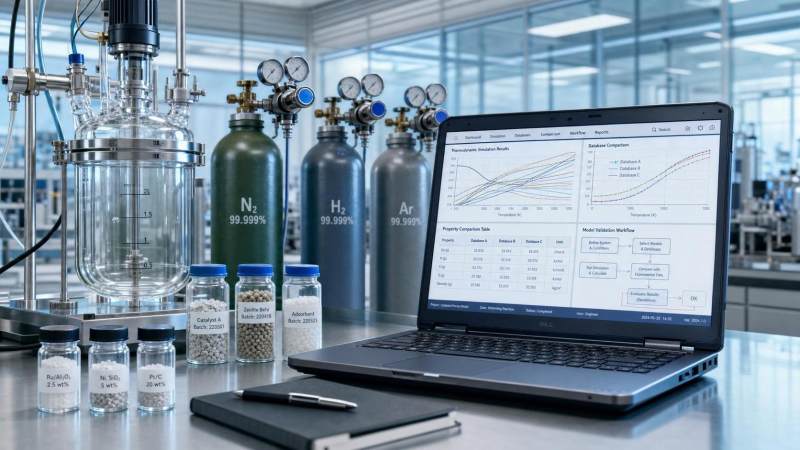
Selecting a chemical thermodynamics software supplier is no longer a narrow modeling decision. In advanced materials and specialty chemicals, it influences data traceability, licensing exposure, validation workload, and how well simulation results support commercial choices.
That matters across battery materials, semiconductor chemicals, engineering plastics, electronic gases, and high-purity processing. Where formulation windows are tight and compliance pressure is rising, software quality affects both technical confidence and procurement discipline.
Why supplier comparison matters now
A decade ago, many teams bought thermodynamics tools mainly for equilibrium calculations. Today, the same platforms are expected to support digital workflows, auditability, and cross-site collaboration.
In sectors tracked by AMCS, the pressure is practical. Cathode precursor optimization, fluoropolymer processing, wet chemical purity control, and gas-phase reaction modeling all require defensible property predictions.
As a result, a chemical thermodynamics software supplier is evaluated not only on scientific depth, but also on data governance, deployment flexibility, and long-term maintainability.
Data models define the real capability
The strongest difference between suppliers often sits below the interface. It is the data model: how thermodynamic parameters are structured, updated, linked, and validated.
Some vendors focus on CALPHAD-style databases for alloy and phase-equilibria work. Others are stronger in electrolyte chemistry, polymer systems, or vapor-liquid equilibrium for process engineering.
For complex chemical systems, buyers should check whether the platform handles:
- multicomponent phase behavior across wide temperature and pressure ranges;
- impurity-sensitive calculations relevant to ultra-high-purity materials;
- electrochemical or ionic species models for battery and wet process chemistry;
- custom parameter import, internal datasets, and version-controlled updates.
A chemical thermodynamics software supplier with a broad database is not automatically the best fit. Coverage matters less than fitness for the intended chemistry and the transparency of parameter sources.
What to verify in database design
Database architecture shapes daily usability. If internal scientists cannot understand model provenance, software adoption usually stalls after early trials.
Licensing models can change total cost quickly
Licensing is where many comparisons become commercially misleading. A low entry price may hide expensive database modules, compute restrictions, or user-type segmentation.
Common structures include named-user licenses, floating licenses, token-based access, and enterprise agreements. Each has different implications for multi-site teams and external collaboration.
For a chemical thermodynamics software supplier, licensing should be tested against actual workflow patterns rather than list pricing alone. Pilot users, occasional reviewers, and central database administrators do not need the same access model.
Cloud deployment adds another layer. Some suppliers include web access and API integration. Others still depend on desktop installation, local license servers, or controlled on-premise environments.
Licensing questions worth asking early
- Are critical databases sold separately from the core engine?
- How are test, training, and backup environments licensed?
- Are APIs, scripting, or external workflow connectors extra-cost features?
- What happens when user count expands after a pilot?
- Can historical results be preserved if the contract changes?
Validation is the point where software becomes usable
Validation is often treated as a technical afterthought. In practice, it is where a chemical thermodynamics software supplier either earns trust or creates recurring uncertainty.
Robust suppliers usually provide benchmark cases, published model assumptions, error boundaries, and comparison methods against experimental data. That is especially relevant for regulated or customer-audited development programs.
In semiconductor chemicals or high-purity gas applications, even small modeling errors can distort impurity management decisions. In battery systems, weak validation can mislead material screening and scale-up priorities.
Validation also includes organizational fit. Can internal teams reproduce the same result on different systems? Can model settings be documented clearly enough for handover and review?
How comparison looks in real industrial settings
Different sectors emphasize different capabilities. That is why the best chemical thermodynamics software supplier for one materials program may be inefficient for another.
Battery material work often needs electrolyte modeling, phase stability prediction, and compatibility with experimental iteration. Semiconductor process chemistry may place more value on gas-phase reactions, purity sensitivity, and strict traceability.
Polymer and fluorochemical applications may prioritize activity models, thermal stability, and process condition mapping. Composite or resin systems may need links to cure behavior or downstream formulation databases.
This is where AMCS-style market intelligence becomes useful. Supplier comparison works better when software capability is read alongside material trends, compliance changes, and regional supply chain realities.
A practical shortlist framework
A disciplined review usually starts with chemistry scope, then moves to database quality, licensing logic, integration requirements, and validation evidence.
- Map the material systems that matter over the next three to five years.
- Request sample workflows using real internal use cases.
- Compare database provenance, not just database size.
- Model total license cost under pilot and scaled deployment scenarios.
- Review validation documents before final commercial negotiation.
That approach usually reveals whether a chemical thermodynamics software supplier can support both near-term projects and broader digital materials strategy.
The next step is straightforward: define the target chemistry, identify the validation burden, and compare suppliers using the same operating assumptions. That creates a cleaner decision than buying on feature lists alone.
- specialty chemicals
- chemical thermodynamics
- battery materials
- semiconductor chemicals
- resin systems
- semiconductor process chemistry
- Wet chemical purity
- chemical purity control
- fluoropolymer processing
- wet chemical purity control
- engineering plastics
- thermal stability
- chemical thermodynamics software
- chemical thermodynamics software supplier
Recommended News
- 2026.09.14Gel Battery Electrolytes: How Ionic Conductivity and Stability Shape Cell DesignElectrochemistry Fellow
- 2026.09.13Fluoropolymer Extrusion Process: How Melt Control Affects Tube QualityPolymer Synthesis Expert
- 2026.09.12How German Implant Makers Select Medical Polymers for Long-Term BiocompatibilityPolymer Synthesis Expert
The VitalSync Intelligence Brief
Receive daily deep-dives into MedTech innovations and regulatory shifts.