
Chemical Thermodynamics Basics: How Gibbs Free Energy Predicts Reaction Direction
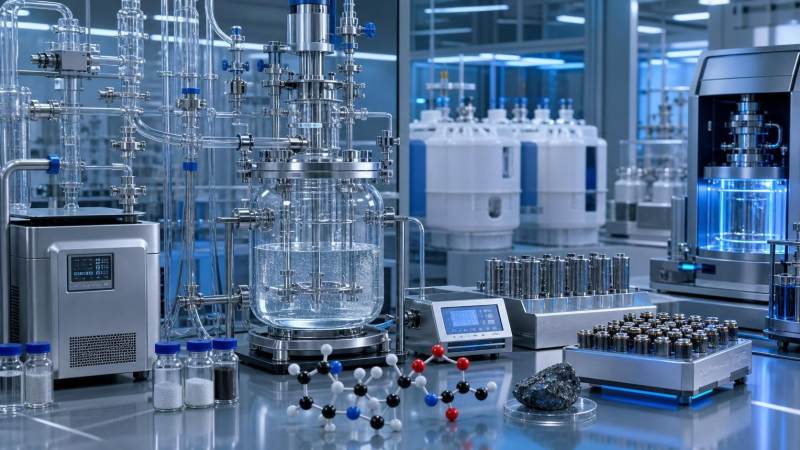
Chemical thermodynamics basics sit behind one of the most practical questions in chemistry: will a reaction move forward, stay balanced, or shift backward under given conditions?
That question matters far beyond the laboratory. It shapes battery stability, semiconductor wet processing, polymer synthesis, gas handling, purification strategy, and material performance across advanced manufacturing.
At the center is Gibbs free energy, a concept that links heat effects, disorder, and temperature to reaction direction. For technical evaluation, it turns chemical thermodynamics basics into a usable decision tool.
Why Gibbs Free Energy Matters
A reaction may look favorable on paper and still fail in practice. The missing step is usually thermodynamic direction under actual operating conditions.
Gibbs free energy, written as ΔG, helps answer that. When ΔG is negative, the forward reaction is thermodynamically favorable. When it is positive, the reverse direction is favored.
If ΔG is close to zero, the system approaches equilibrium. In real production environments, that often means sensitivity to temperature, pressure, composition, or impurity levels.
This is why chemical thermodynamics basics remain relevant in commercial settings. Reaction direction influences yield, energy demand, safety margin, and process consistency.
The Core Relationship Behind Reaction Direction
The standard expression is simple: ΔG = ΔH - TΔS.
ΔH represents enthalpy change, often understood as heat released or absorbed. ΔS represents entropy change, or how system disorder changes during reaction.
T is absolute temperature. That term matters because temperature can amplify the entropy contribution and shift the preferred reaction direction.
A reaction with favorable enthalpy may still become unfavorable at some temperatures. The opposite is also true. This is one reason chemical thermodynamics basics cannot stop at heat of reaction alone.
A practical reading of the equation
- Negative ΔH and positive ΔS usually support spontaneity.
- Positive ΔH and negative ΔS usually oppose it.
- Mixed cases depend strongly on temperature.
- Actual mixtures may differ from standard-state predictions.
Where Industry Pays Attention
In advanced materials and specialty chemicals, reaction direction is rarely an academic detail. It affects formulation windows, purity management, and downstream reliability.
Battery materials are a clear example. Cathode synthesis, electrolyte stability, and interfacial reactions all depend on whether chemical change is thermodynamically favored.
Semiconductor chemicals present another case. Etchants, cleaning agents, photoresist developers, and electronic gases operate under tight control, where small shifts in ΔG can alter selectivity or contamination behavior.
Engineering plastics and fluoropolymers also depend on thermodynamic judgment. Thermal stability, degradation resistance, and processing windows are influenced by free energy changes in reaction and decomposition pathways.
This broader context explains why AMCS tracks chemistry alongside purity, compliance, thermal behavior, and supply chain intelligence. Chemical thermodynamics basics help connect technical data with business consequences.
Typical Situations Where ΔG Guides Decisions
In each case, the useful question is not only whether a reaction can occur. The better question is under which conditions it becomes favorable enough to matter.
How to Apply Chemical Thermodynamics Basics in Practice
Start by separating thermodynamics from kinetics. A negative ΔG suggests a favorable direction, but it does not guarantee fast reaction speed.
Then check the real operating environment. Temperature, pressure, concentration, and phase state can shift free energy away from standard reference values.
Impurity control should not be treated as a side issue. In high-purity chemical systems, trace contaminants may open competing pathways or destabilize an intended equilibrium.
It also helps to read thermodynamic data alongside material structure. Crystallography, morphology, and interface chemistry often explain why similar formulas behave differently in production.
Useful checkpoints
- Compare ΔG across the expected temperature range.
- Review whether equilibrium limits reduce practical conversion.
- Check side reactions in multi-component systems.
- Link thermodynamic predictions to purity specifications and process controls.
What to Evaluate Next
For deeper assessment, chemical thermodynamics basics should be paired with reaction kinetics, transport behavior, and materials characterization.
That combination is especially useful in sectors tracked by AMCS, where performance depends on more than composition alone. Purity thresholds, thermal limits, interface behavior, and compliance pressure all matter.
A sound next step is to map key reactions in the target system, identify where ΔG becomes sensitive, and compare those points against operating temperature, feed quality, and required performance margins.
Used this way, Gibbs free energy does more than explain theory. It becomes a practical filter for judging process direction, material risk, and technology readiness across advanced chemical value chains.
Recommended News
- 2026.09.14Gel Battery Electrolytes: How Ionic Conductivity and Stability Shape Cell DesignElectrochemistry Fellow
- 2026.09.13Fluoropolymer Extrusion Process: How Melt Control Affects Tube QualityPolymer Synthesis Expert
- 2026.09.12How German Implant Makers Select Medical Polymers for Long-Term BiocompatibilityPolymer Synthesis Expert
The VitalSync Intelligence Brief
Receive daily deep-dives into MedTech innovations and regulatory shifts.