
Materials Science Trends 2026: Advances Reshaping Industrial Supply Chains
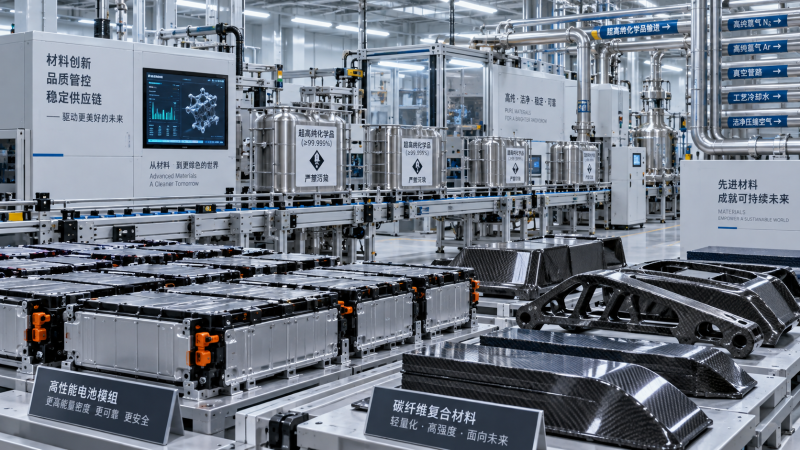
Materials science trends 2026 are reshaping how industrial leaders secure performance, compliance, and supply-chain resilience. From battery materials and semiconductor chemicals to carbon-fiber composites and high-performance polymers, innovation is moving beyond the laboratory and into sourcing decisions, factory qualification plans, and long-term capital strategy. For decision-makers, the central question is no longer simply which material performs best. It is which material system can be manufactured consistently, approved across markets, and supplied without exposing the business to unacceptable risk.
The coming year will reward organizations that treat materials as a strategic operating issue rather than a technical purchasing category. Purity, processability, traceability, environmental profile, and regional availability are becoming as important as a data sheet’s headline strength or conductivity value.
Performance materials are becoming system-level decisions
A major theme among materials science trends 2026 is the move from single-material optimization to system-level engineering. In electric vehicles, for example, a higher-energy cathode has limited commercial value if it accelerates degradation, complicates recycling, or requires an electrolyte that is difficult to qualify at scale. In semiconductor production, a high-purity chemical is only as reliable as its packaging, filtration, delivery system, and contamination-control protocol.
This changes the conversation between material suppliers and buyers. Procurement teams increasingly need to assess how a material behaves in the customer’s process, not only whether it meets a specification at the supplier’s gate. Compatibility with binders, resins, deposition equipment, curing cycles, thermal management systems, and downstream recycling routes will carry more weight in supplier selection.
For executives, this means technical due diligence should involve R&D, manufacturing, quality, sustainability, and supply-chain teams earlier. A cheaper formulation that causes yield loss or introduces lengthy requalification work can become the more expensive choice very quickly.
Battery chemistry shifts from “more energy” to balanced performance
Battery materials will remain one of the most closely watched areas in 2026. High-nickel cathodes, lithium iron phosphate variants, manganese-rich compositions, silicon-enhanced anodes, and solid-state electrolyte development are all progressing, but no single chemistry will dominate every application. The market is becoming more segmented by use case.
Long-range passenger vehicles may continue to prioritize energy density, while commercial fleets, stationary storage, and cost-sensitive mobility applications may favor safety, cycle life, and supply predictability. This is encouraging more nuanced material portfolios rather than a one-chemistry strategy.
Silicon anodes illustrate the opportunity and the challenge. They can support higher capacity, yet volume expansion and interfacial stability remain practical concerns. Similarly, solid-state battery materials offer a compelling safety narrative, but manufacturability, interface resistance, and scalable processing still determine whether technical promise becomes industrial adoption.
Decision-makers should look beyond cell-level claims. Ask whether precursor sources are diversified, whether impurity control is understood, how the material performs after repeated cycling, and whether recycling or recovery pathways are developing alongside demand.
Semiconductor chemicals face a higher bar for purity and continuity
As device architectures become smaller and more complex, semiconductor fabs are placing greater pressure on photoresists, wet electronic chemicals, deposition precursors, and ultra-high-purity electronic gases. Parts-per-trillion impurity control is no longer an abstract technical benchmark; it is directly linked to yield, reliability, and production uptime.
In 2026, buyers will scrutinize the full chain behind materials such as silane, phosphine, specialty etching gases, acids, solvents, and cleaning chemicals. A supplier’s analytical capability matters, but so do cylinder management, bulk delivery, container cleanliness, logistics discipline, and contingency inventory. A chemically compliant product can still become a production problem if transport, repackaging, or local storage compromises its quality.
Regionalization will continue, although it should not be confused with simple reshoring. Local or near-market supply can reduce lead times and improve incident response, but fabs still need access to globally validated chemistries and specialized purification expertise. The strongest sourcing models are likely to combine qualified local capacity with diversified international supply routes.
Composites and engineering plastics gain ground where metal is no longer enough
Aerospace, advanced mobility, electronics, industrial equipment, and medical-device manufacturers are seeking materials that reduce weight without sacrificing durability. Carbon-fiber composites, prepregs, tailored resin systems, PEEK, PTFE, and other specialty engineering plastics are therefore central to the 2026 outlook.
The shift is not merely about lightweighting. Designers are using these materials to manage corrosion, electrical insulation, chemical exposure, vibration, and high-temperature service conditions. In a battery enclosure or aircraft structure, the value may come from integrating functions that would otherwise require several metal components and additional assembly steps.
Yet material substitution deserves caution. A polymer that performs well in a short laboratory test may behave differently after years of thermal cycling, fluid exposure, ultraviolet exposure, or repeated mechanical stress. Processing windows also matter: fiber orientation, void content, cure profile, moisture handling, and machining methods can alter final performance. Business leaders should require application-specific validation rather than relying on generic comparisons between “plastic” and metal.
Regulation is influencing material design earlier
Chemical compliance is becoming a product-development input, not a final documentation exercise. PFAS restrictions, evolving chemical reporting rules, carbon-accounting expectations, and customer demands for substance transparency are affecting fluoropolymers, solvents, additives, coatings, and process chemicals. The impact will vary by geography and application, but uncertainty itself is now a planning risk.
Companies that wait until a restriction becomes imminent may face costly redesigns or abrupt supplier changes. A more resilient approach is to map regulated substances across formulations, identify technically credible alternatives, and understand where alternatives may introduce different performance or processing trade-offs. “PFAS-free,” for instance, is not a sufficient procurement criterion without examining thermal stability, chemical resistance, lifespan, and end-use requirements.
Low-carbon synthesis and recycled feedstocks will also attract attention, especially where customers need more defensible Scope 3 reporting. However, sustainability claims require the same discipline as purity claims: clear system boundaries, documented inputs, and realistic recognition of trade-offs.
What industrial leaders should do now
The most practical response to materials science trends 2026 is to build a material intelligence process that connects technology signals with commercial exposure. Start by identifying the materials that are truly critical to product performance or production continuity. For each one, assess qualification complexity, geographic concentration, regulatory sensitivity, purity requirements, and realistic substitution options.
Next, move supplier discussions beyond price and nominal specification. Request evidence of lot-to-lot consistency, change-notification practices, analytical methods, capacity plans, and the supplier’s own upstream dependency profile. For highly sensitive materials, dual sourcing may not mean two interchangeable vendors; it may mean developing a staged qualification plan before disruption occurs.
Finally, keep R&D and procurement in the same conversation. The material selected today can determine tomorrow’s compliance burden, manufacturing yield, repairability, and market access. Platforms such as Global Advanced Materials & Chemical Systems help teams follow these interlocking developments across battery materials, semiconductor chemicals, composites, and high-performance polymers—turning fragmented technical information into better-timed industrial decisions.
- specialty engineering plastics
- high-nickel cathodes
- silicon anodes
- materials science
- material intelligence
- low-carbon synthesis
- battery materials
- semiconductor chemicals
- solid-state battery materials
- photoresists
- wet electronic chemicals
- fluoropolymers
- resin systems
- prepregs
- engineering plastics
- etching gases
- solid-state battery
- thermal stability
- high-performance polymers
- materials science trends 2026
Recommended News
- 2026.09.26Materials Science Trends 2026: Advances Reshaping Industrial Supply ChainsMr. Arthur Mercer
- 2026.09.25Battery Recycling: How to Assess Recovery Rates, Compliance, and Supply RiskMr. Arthur Mercer
- 2026.09.24Why High-Purity Chemicals Matter in Battery Manufacturing: Contamination Risks and ControlsElectrochemistry Fellow
The VitalSync Intelligence Brief
Receive daily deep-dives into MedTech innovations and regulatory shifts.