
How package reliability testing reveals field failure risk
How Package Reliability Testing Reveals Field Failure Risk
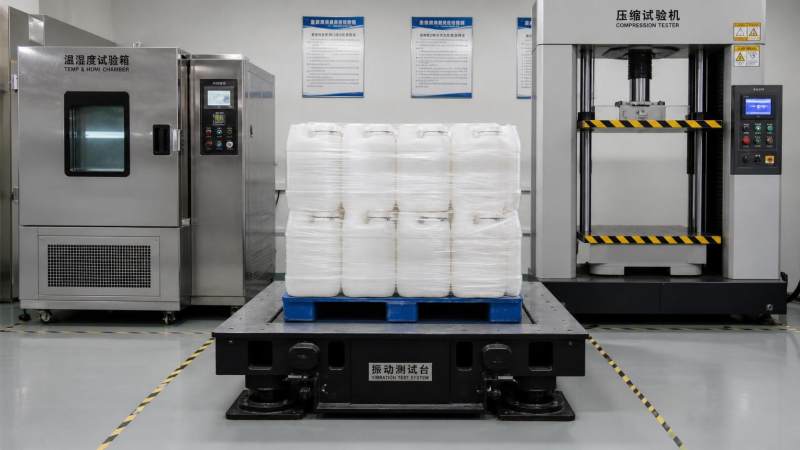
A package can look sound at the end of a production line and still fail long before the material reaches its point of use. That gap between “passed final inspection” and “arrived fit for use” is where package reliability testing earns its place. It does not merely test whether a box survives a drop or whether a closure remains tight in a laboratory. Done properly, it investigates how a packaging system responds to the combined stresses of transport, warehousing, climate variation, repeated handling, and interaction with the product inside.
For quality control and safety teams handling advanced materials, specialty chemicals, semiconductor process chemicals, battery materials, electronic gases, or high-performance polymers, package failure is rarely just a logistics problem. A minor seal defect can allow moisture into a hygroscopic powder. Abrasion inside a drum can generate particles that matter to a high-purity application. A container that creeps under heat may not leak immediately, but it can compromise stacking stability, closure torque, labeling, or secondary containment. The field consequence may appear weeks later, far from the original packing operation.
The practical value of package reliability testing is that it turns these possible failure paths into observable evidence. It helps teams move from broad assumptions—“this drum is robust,” “the pallet is secure,” “the liner is compatible”—to a more defensible judgment about where a packaging design may fail and under what conditions.
Laboratory Damage Is Not the Same as Field Failure
A common mistake is to treat a single test result as a direct prediction of real-world performance. Packaging rarely experiences one clean, isolated event. A shipment may be dropped during loading, exposed to truck vibration for hours, held in a warm warehouse, transferred through several distribution points, and then stacked under an uneven load. Each event may be survivable on its own. The combined sequence can create the failure.
This is especially relevant where the package is part of the product-control system. A moisture-barrier bag for cathode material, a fluoropolymer bottle for a corrosive wet chemical, or a high-purity gas cylinder valve assembly is selected not only for containment. It may also protect purity, chemical stability, traceability, handling safety, and compliance status. A package that remains visually intact can still be operationally unacceptable if it admits humidity, sheds particles, loses closure integrity, or exposes the product to incompatible contact materials.
Field failure risk is therefore better understood as a chain: distribution stress + package design + product sensitivity + handling variation. Reliability testing examines parts of that chain under controlled conditions. Its conclusions are strongest when the test sequence resembles the actual supply route rather than an idealized shipping scenario.
What Reliability Tests Actually Reveal
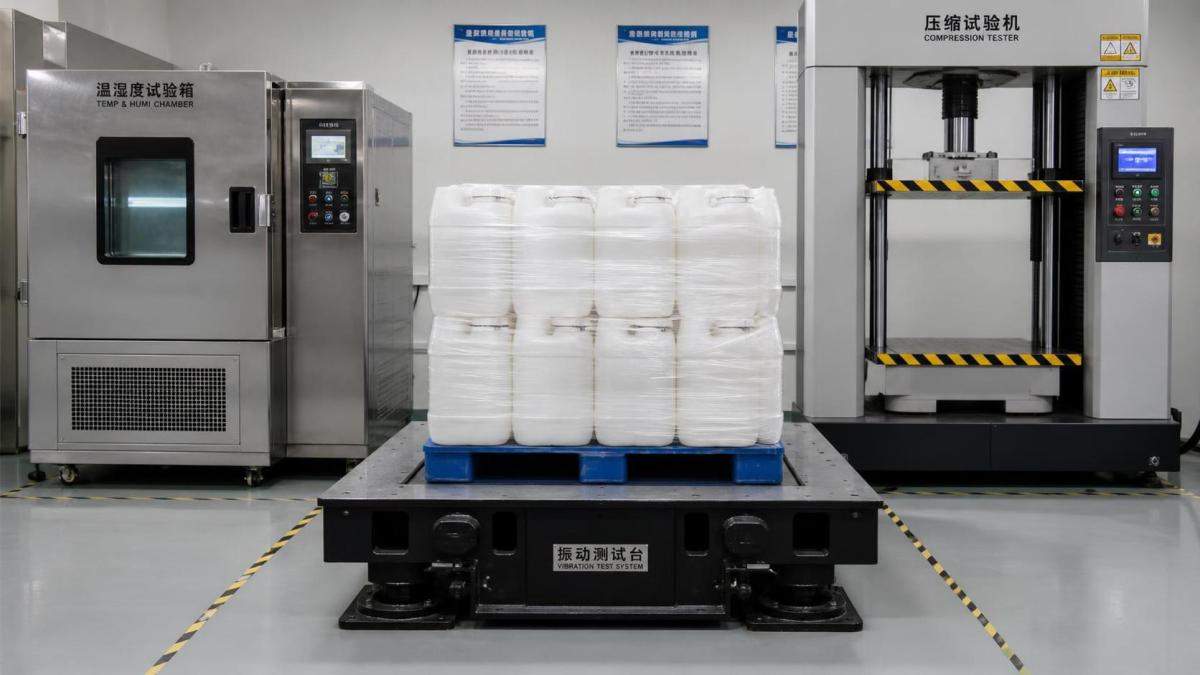
Different tests reveal different weaknesses. A compression test may expose a corrugated shipper that loses stacking strength after humidity conditioning. Vibration testing can show whether a bottle cap gradually loosens, whether an internal component rubs through a liner, or whether palletized loads shift enough to create fork-entry hazards. Drop and impact tests reveal more obvious structural vulnerabilities: fractured corners, punctured containers, deformed pails, broken closures, and inadequate cushioning.
However, the most useful observations are often not dramatic. A shallow scuff near a seam, slight powder migration at a closure, a change in torque after conditioning, or a small displacement in a pallet pattern can be an early warning. In the field, those small signs can become leakage, contamination, or a handling incident after repeated exposure to stress.
Methods from organizations such as ASTM International, ISTA, and ISO are often used to structure these evaluations. The appropriate method depends on the product, package format, shipment mode, market requirements, and internal risk level. A test method should not be selected simply because it is familiar or easy to procure. For regulated dangerous goods, medical applications, or exceptionally sensitive high-purity materials, additional packaging, transport, and product-specific requirements may apply and should be checked against the relevant current regulations and specifications.
The Product Changes the Meaning of a “Pass”
The same packaging damage can have very different consequences depending on what is inside. A dent in an outer carton may be acceptable for a durable engineering plastic part but unacceptable if that carton protects sealed semiconductor chemical containers whose cleanliness controls are strict. A slight increase in oxygen or water-vapor transmission may not affect many industrial products, yet it can be significant for moisture-sensitive powders, reactive formulations, or materials whose electrochemical performance depends on controlled storage conditions.
That is why package reliability testing should include product-sensitive acceptance criteria, not only package appearance. For some products, post-test inspection may need to consider mass loss, seal integrity, closure condition, particle generation, headspace condition, moisture exposure indicators, or chemical compatibility. In other cases, the relevant question is whether the package remains safe to handle after a foreseeable impact event.
Consider a specialty chemical supplied in a plastic bottle with a lined closure. Mechanical testing may show no leakage after a drop sequence. That result is useful, but incomplete. If the material is solvent-rich, oxidizing, corrosive, or otherwise chemically active, the quality team may also need to understand whether the closure liner, bottle resin, label adhesive, and secondary containment remain suitable after storage and temperature exposure. Mechanical robustness and chemical compatibility are related, but they are not interchangeable.
For advanced material supply chains, this distinction is often overlooked during supplier qualification. Procurement may compare pack sizes and shipping cost, while R&D focuses on material specifications. The package can fall between those responsibilities until a rejected delivery or incident exposes the gap. A more reliable review brings quality, EHS, logistics, production, and product engineering into the same discussion before commercialization.
Build Test Sequences Around the Actual Distribution Route
A sound test plan begins with a distribution map. It should identify where the package is filled, whether it is palletized, how it is loaded, how many transfers occur, which transport modes are used, expected storage duration, climate exposure, and how the receiving site handles it. Export packaging designed for a long multimodal route should not be qualified solely on the basis of a short domestic truck journey.
The most informative test programs are often sequential. Conditioning a package before vibration or compression may reveal a vulnerability that an unconditioned sample hides. Likewise, a package that survives a drop test may require further leak or closure inspection afterward; “no visible damage” is not always an adequate endpoint.
This does not mean every shipment needs an elaborate laboratory program. The level of testing should match the consequence of failure. A low-value, nonhazardous item with stable physical properties may justify a relatively simple distribution assessment. A high-purity precursor, reactive chemical, high-value composite prepreg, or tightly controlled battery material typically deserves a more deliberate approach because the cost of a compromised shipment includes more than replacement packaging.
Watch the interfaces, not just the container wall
Many packaging failures begin at interfaces: cap-to-neck, liner-to-closure, bag-to-seal, bottle-to-carton, drum-to-pallet, strap-to-edge protector, or label-to-container. These are the points where material stiffness changes, tolerances accumulate, and repeated motion concentrates stress. During package reliability testing, inspecting these interfaces often yields more insight than looking only for a dramatic rupture.
Pallet design deserves the same attention. Overhang, insufficient corner protection, poor stretch-wrap containment, or an unsuitable load pattern can transfer force into packages that would otherwise perform well. In practice, a robust primary container can still fail because the unit load allows it to strike adjacent packages or pallet hardware during transport.
How to Interpret a “Pass” Without Creating False Confidence
A passed test is evidence of performance under defined conditions, not a blanket guarantee. Quality teams should retain the exact configuration tested: package revision, closure, liner, fill level, headspace, pallet pattern, dunnage, conditioning state, and test sequence. A seemingly small change—such as switching resin suppliers, changing a cap mold, reducing corrugated board grade, or altering pallet wrap—can change the result.
This is where change control matters. If packaging is treated as a commodity component, substitutions may be made without fully considering their effect on product protection. That is particularly risky for high-purity chemicals, electronic gases, and sensitive functional materials, where the packaging specification may be connected directly to contamination control or safe transport performance.
It is also worth separating a test failure from a program failure. A failed sample does not necessarily mean the product cannot be shipped safely. It may point to an adjustable issue: better closure control, revised cushioning, improved pallet stabilization, a more suitable liner, or a distribution route with fewer uncontrolled transfers. The useful question is not “did it fail?” but “what mechanism produced the failure, and can it recur in the field?”
A More Useful Reliability Mindset
In advanced materials and chemical systems, packaging should be reviewed as part of the product’s technical envelope. Purity targets, thermal sensitivity, chemical stability, worker exposure controls, regulatory classification, and export routes all influence what reliable containment means. A package that is adequate for one formulation, region, or transport profile may be unsuitable for another.
For teams comparing suppliers or reviewing a new material launch, the most useful records are rarely limited to a test certificate. Ask what distribution scenario was represented, whether the tested configuration matches the commercial configuration, what post-test inspections were performed, and how changes will be controlled. These questions are as relevant to composite resins and engineering plastics as they are to semiconductor chemicals, battery powders, and specialty gases.
Package reliability testing cannot remove every field uncertainty. It can, however, reveal whether the packaging system has been challenged in ways that resemble its real working life. That is the difference between a package that merely looks acceptable at dispatch and one that is more likely to preserve safety, material integrity, and usability when it reaches the customer.
Recommended News
- 2026.09.14Gel Battery Electrolytes: How Ionic Conductivity and Stability Shape Cell DesignElectrochemistry Fellow
- 2026.09.13Fluoropolymer Extrusion Process: How Melt Control Affects Tube QualityPolymer Synthesis Expert
- 2026.09.12How German Implant Makers Select Medical Polymers for Long-Term BiocompatibilityPolymer Synthesis Expert
The VitalSync Intelligence Brief
Receive daily deep-dives into MedTech innovations and regulatory shifts.