
Are thermoplastic wind turbine composites easier to recycle?
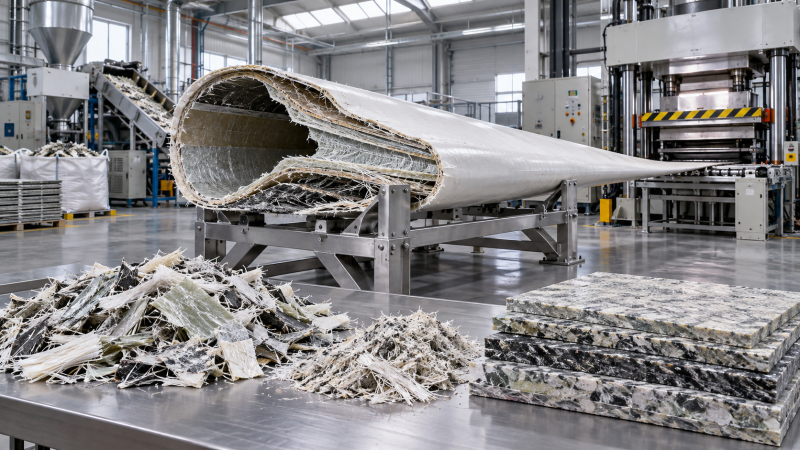
Thermoplastic wind turbine composites can be easier to recycle than conventional thermoset composites because their resin chemistry allows additional recovery routes. Some can be softened and reshaped; others can be dissolved or chemically broken down under suitable conditions. However, those possibilities do not automatically make a finished blade economical to recycle.
The useful distinction is between a material that can be recycled and a blade that has a workable recycling route. Fiber quality, blade construction, transport costs, processing capacity, and demand for recovered materials all influence the result. A thermoplastic system deserves preference when its recovery advantages survive those practical constraints while meeting the blade’s structural and manufacturing requirements.
What changes when the blade resin is thermoplastic?
Conventional wind turbine blades commonly use glass fiber, sometimes combined with carbon fiber, held together by a thermoset resin such as epoxy or polyester. During curing, the resin forms a permanent crosslinked network. Heating it again does not return it to a moldable liquid; sufficient heat eventually degrades it.
Thermoplastic polymers generally lack that permanent crosslinked network. They can soften when heated, although their useful processing window depends on the particular chemistry. This creates opportunities to reshape recovered composite material or separate and recover its constituents through other processes.
There is an important manufacturing distinction within this category. Some thermoplastic systems require heat and pressure to impregnate fibers with molten polymer. Reactive systems instead introduce lower-viscosity ingredients that polymerize within the reinforcement. Certain acrylic thermoplastic systems follow this approach, making them relevant to large composite structures where resin flow through thick fiber assemblies matters.
These differences affect both production and recycling. A recycling route demonstrated for one acrylic formulation cannot automatically be applied to every thermoplastic resin. Likewise, a successful process for a small, clean laminate does not establish that a complete blade can enter the same process without extensive preparation.
Which recycling routes become more practical?
Thermoplastic chemistry broadens the available options, but each route produces a different material. Selection should begin with the required output: a moldable compound, separated reinforcement, recovered polymer, or chemical feedstock.
Conventional thermoset blades also have recovery options, including mechanical processing, thermal treatment, and chemical processes. Some mineral-rich blade waste can enter cement production, where organic material contributes energy and mineral constituents become feedstock. That route does not preserve fibers or recover resin for another composite application.
The thermoplastic advantage is therefore broader access to potentially useful material recovery. It should be assessed against an actual alternative available in the project’s region, with attention to what each process produces.
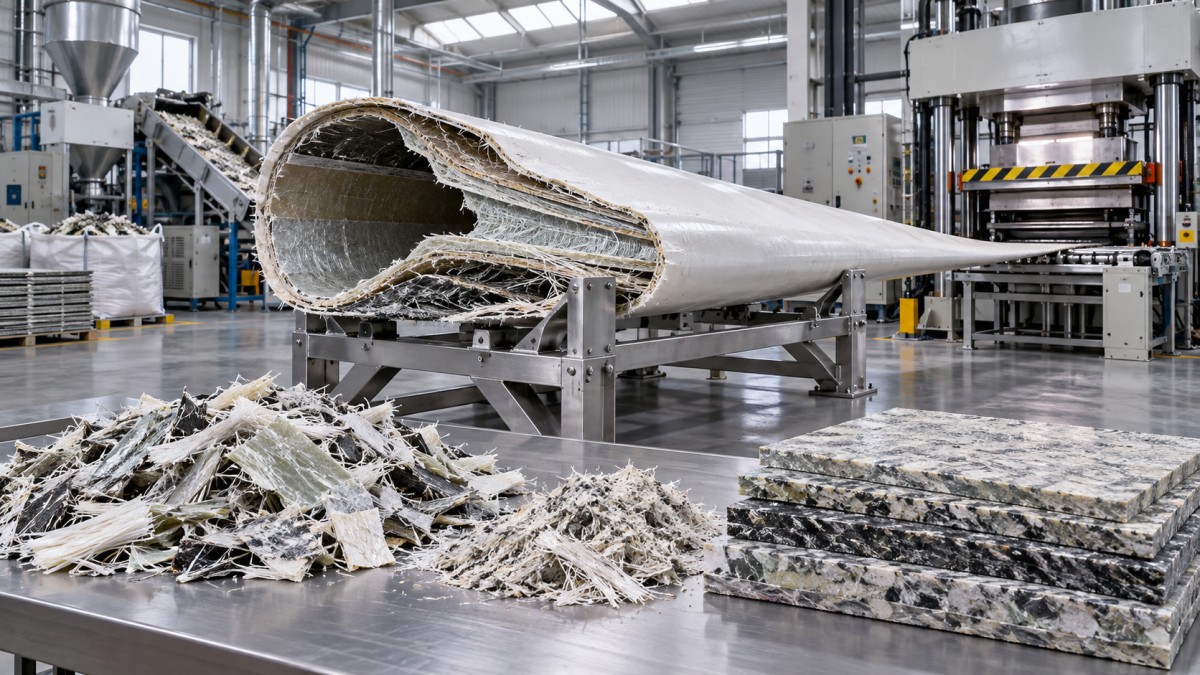
Recovering fibers is different from retaining their value
A blade obtains its strength from more than its ingredients. Fiber length, orientation, placement, adhesion to the resin, and laminate quality determine how loads move through the structure. Recycling can recover the ingredients while losing much of that engineered arrangement.
Consider a continuous glass-fiber laminate reduced to small pieces for molding. The recovered fibers may still reinforce another product, but shorter lengths and changed orientation limit what that product can do. The material may suit covers, housings, or other components after qualification. Its suitability for a highly loaded blade spar is a separate question.
Separation processes can preserve longer fibers, but length alone is insufficient. Fiber surfaces may retain resin residues or lose the sizing that helps them bond to a new matrix. Cleaning, handling, and exposure to heat or chemicals can also affect performance. Recovered reinforcement needs assessment in its intended new resin system.
Carbon fiber and glass fiber present different economics. Carbon fiber’s higher material value can support more elaborate recovery in some applications. Glass fiber offers a smaller value margin, so transport, separation, and finishing costs can more easily outweigh the recovered material’s selling price.
A credible recovery claim identifies both the recovered material and its next application. “Fibers recovered” provides less decision value than evidence of consistent fiber condition, an agreed product specification, and a customer able to use the output.
The whole blade can undermine a recyclable resin
A wind turbine blade is an assembly containing more than fiber and matrix. Depending on its design, it may include core materials, structural adhesives, protective coatings, fillers, metallic components, and different reinforcement types. These materials may require separate treatment even when the main laminate is thermoplastic.
For example, using a thermoplastic matrix in the blade shell does not make a thermoset adhesive joint melt-processable. A coating that causes little difficulty during operation may become contamination during polymer recovery. Mixed core materials can change the composition of shredded feedstock and narrow its possible uses.
Design choices can reduce these problems. Compatible material combinations, accessible separation points, identifiable components, and documented resin formulations can make later processing more predictable. Welding may replace some adhesive connections where the thermoplastic system and joint design permit it, but joint strength, fatigue performance, inspection, and repair still need qualification.
This makes the bill of materials part of the recycling assessment. Procurement should establish which blade components enter the proposed process, which require removal, and which remain as residues. A high recovery claim for a clean laminate coupon should not be interpreted as a recovery figure for the complete blade.
Where the economics can still fail
Even an effective separation process can struggle with irregular feedstock, long transport distances, or an output that needs expensive finishing. Four conditions deserve particular attention.
Collection and transport must fit the process
Blades are bulky, and moving them intact can be difficult. Cutting near the wind farm may reduce transport requirements, but it adds equipment, labor, dust control, and handling costs. It can also destroy the long sections that a reuse or reconsolidation process needs. The proposed recycling route should therefore determine the cutting plan.
The facility needs suitable material at a workable scale
A process built around clean production offcuts faces a different challenge from one accepting weathered blades with coatings, repairs, and mixed components. Manufacturing scrap is a useful starting point because its composition and supply are easier to control. It provides limited evidence of readiness for retired blades unless those additional variables are addressed.
Facility utilization also matters. A technically capable plant may struggle if suitable waste arrives intermittently or comes from widely dispersed sites. Collection agreements and aggregation arrangements can be as consequential as the reactor or processing equipment.
Recovered materials need repeatable specifications
A buyer needs consistency in properties such as fiber length distribution, contamination, moisture, and processing behavior. For recovered polymer or monomer, purity and formulation compatibility become central. A process that produces usable material once must still demonstrate that it can supply an acceptable product repeatedly.
Potential outlets should be evaluated for their capacity as well as their technical fit. A small specialty application may accept recovered material at a useful price yet absorb only a limited volume.
Processing burdens can offset recovery benefits
Heating, grinding, solvent circulation, purification, and drying consume resources. Their significance depends on process efficiency, energy supply, recovery yields, and the material displaced by the output. Environmental comparisons should cover collection through usable recovered product and account for residues. Resin recovery alone does not establish the result for that complete system.
Recycling benefits must fit blade performance and production
A thermoplastic blade material still has to meet demanding service requirements. Fatigue resistance, stiffness, creep behavior, environmental durability, and the performance of bonded or welded joints all affect suitability. These properties depend on the complete composite design and manufacturing process, rather than the polymer category alone.
Creep deserves attention because sustained loading and temperature can influence polymer deformation over time. That does not disqualify thermoplastics; it makes resin selection, operating conditions, and structural design part of the assessment. Moisture exposure, processing defects, and fiber–matrix adhesion also require evaluation.
Manufacturing compatibility may determine whether a promising resin is commercially attractive. A system that requires substantial changes to tooling, heating, consolidation, or quality control creates a different investment case from one that fits an established infusion process. Training, process stability, cycle time, and repair procedures belong in that comparison.
Some thermoplastic systems also offer joining or reshaping opportunities that may support repair and component recovery. Those benefits should be credited only where there is a defined procedure and an acceptable structural outcome. A polymer’s ability to soften does not make an assembled blade straightforward to repair.
What to require before choosing a thermoplastic system
A useful evaluation connects material selection to manufacturing, service performance, and a named recovery pathway. The following evidence helps distinguish a practical proposal from a broad recyclability claim:
- A precise material description: resin chemistry, reinforcement, additives, core materials, coatings, and joining methods.
- Relevant recovery demonstrations: representative blade construction, including contamination and aged material where applicable, with the tested scale clearly described.
- A complete material balance: outputs suitable for sale, process losses, and residues requiring treatment.
- Recovered-product specifications: properties that match an intended application and its qualification requirements.
- An operational plan: collection, cutting, transport, preparation, processing location, and capacity.
- Commercial responsibilities: ownership of waste and recovered products, acceptance conditions, processing charges, and responsibility if the planned outlet becomes unavailable.
Compare candidate systems on a consistent basis, such as blades delivering the required structural performance over the intended service life. A comparison per kilogram of resin can obscure changes in reinforcement content, manufacturing losses, maintenance, or blade mass.
Because retirement may occur long after procurement, preserve material records and avoid dependence on a single recovery assumption. Composition data, repair history, and dismantling instructions can make future processing easier even if the eventual recycling provider changes.
Thermoplastic wind turbine composites are a stronger choice when suitable blade performance, repeatable manufacturing, and a credible recovery market come together. Where collection infrastructure or recovered-material demand remains weak, the chemistry still offers potential, but that potential should not be counted as guaranteed end-of-life savings. Before paying a premium for recyclability, establish what the complete blade will become, who can process it, and what gives the recovered output lasting commercial value.
Recommended News
- 2026.10.29Sourcing Wet Electronic Chemicals in Taiwan: Purity and Supply ReliabilitySemiconductor Chemistry Architect
- 2026.10.29China SAE Names 400 Wh/kg Solid-State Batteries Among Its Top 10 Trends for 2027Electrochemistry Fellow
- 2026.10.28Sourcing Battery Cathode Materials: How to Assess Supplier Quality and CapacityMr. Arthur Mercer
The VitalSync Intelligence Brief
Receive daily deep-dives into MedTech innovations and regulatory shifts.