
Are Biodegradable Materials Strong Enough for Automotive Structures?
Are Biodegradable Materials Strong Enough for Automotive Structures?
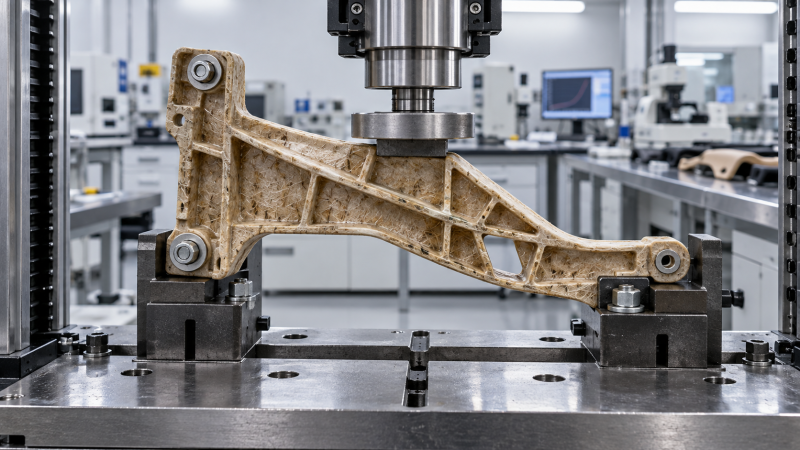
For automakers seeking lighter, lower-impact vehicles, one question demands more than a tensile-strength figure: are biodegradable materials strong enough for structural automotive parts? Some reinforced biodegradable polymers offer promising mechanical properties, but crash performance, creep resistance, moisture sensitivity, and thermal aging determine whether they can move beyond nonstructural applications.
The practical answer is conditional. Certain formulations deserve evaluation for lightly loaded components with controlled operating conditions. That does not make them established substitutes for steel, aluminum, or conventional structural composites in crash-critical load paths. The distinction matters: a material can carry a substantial load during a short laboratory test and still lose bolt preload, distort under sustained stress, or become brittle after aging.
There is also a terminology problem. Bio-based does not necessarily mean biodegradable, and natural-fiber reinforcement does not make an entire composite compostable. Before discussing strength, engineers need to establish exactly what material is being proposed—and what “structural” means in the application.
A door trim carrier and a crash rail are different propositions
Automotive components occupy very different positions on the risk spectrum. A cabin trim substrate may mainly need to retain its shape, resist handling damage, and support attachments. A secondary bracket may carry sustained loads and experience vibration. A crash rail must manage impact energy through a controlled deformation sequence while interacting with the rest of the vehicle.
Calling all three “structural applications” hides the engineering challenge. Even apparently modest parts can have safety-relevant functions: a mounting feature that releases during impact may create a hazard, while a panel near an airbag must behave predictably during deployment.
A sensible screening question is therefore not simply, “Can this polymer replace metal?” It is, “What happens if this component loses stiffness, cracks, or separates from its joint?” If the consequence compromises occupant protection, steering, suspension, or battery retention, the evidence threshold rises sharply. Promising coupon data alone cannot close that gap.
Separate renewable content from biodegradability
Three material categories frequently become mixed together in sustainability discussions:
- Bio-based, durable polymers: some polyamides use renewable feedstocks but are designed for long service life, not biodegradation.
- Natural-fiber composites: flax, hemp, or other plant fibers can reinforce a conventional polymer. A polypropylene matrix does not become biodegradable because it contains plant fibers.
- Biodegradable polymer systems: PLA and some PHA formulations can biodegrade under specified conditions, but their behavior depends on chemistry, geometry, additives, and environment.
Biodegradability is not an unconditional promise that a part will disappear outdoors. Industrial composting, soil exposure, and aquatic environments are different conditions. For example, ISO 14855 addresses ultimate aerobic biodegradation under controlled composting conditions; it does not demonstrate automotive durability or validate disposal in the natural environment.
The full formulation matters. Impact modifiers, coupling agents, coatings, adhesives, and reinforcement can change both performance and end-of-life behavior. A claim supported for the neat resin should not automatically be transferred to the finished composite assembly.
Where promising strength figures run into vehicle conditions
Fiber reinforcement can raise stiffness and strength, making a biodegradable matrix look attractive on a material comparison sheet. But a vehicle does not operate at one temperature, one humidity level, or one loading rate. The most revealing comparison is often between properties before and after representative conditioning—not between two suppliers’ headline values.
Heat, moisture, and sustained loading
PLA illustrates the trade-off. It can offer useful stiffness, yet its response to elevated temperature depends strongly on grade, crystallinity, reinforcement, and processing. Heat-deflection temperature is also measured under specified test conditions; it is not a universal continuous-use temperature rating.
For hydrolysis-sensitive matrices, heat and moisture together can reduce molecular weight and mechanical performance. Plant fibers add another concern because moisture uptake can produce swelling and stress at the fiber–matrix interface. Surface treatments and protective layers may help, but they introduce additional formulation and disposal questions.
Consider a bracket held under bolt compression throughout vehicle service. Its immediate tensile strength may be adequate, while creep and stress relaxation gradually reduce clamping force. The resulting movement can cause noise, wear, or joint damage. A short tensile test does not reveal that failure mechanism.
Impact behavior and fatigue
Crashworthiness requires more than resistance to breakage. Engineers need predictable energy absorption, deformation, fracture, and load transfer at relevant strain rates and temperatures. Reinforcement that improves stiffness may also reduce ductility or introduce directional behavior. Toughening a matrix can improve impact performance while changing stiffness, heat resistance, or biodegradation characteristics.
Vibration creates a separate problem. Repeated loading can initiate damage around fiber ends, molding defects, holes, and interfaces. Fatigue assessment must reflect the molded part and its attachments, rather than relying only on ideal specimens cut along a favorable fiber direction.
The joint may set the limit before the material does
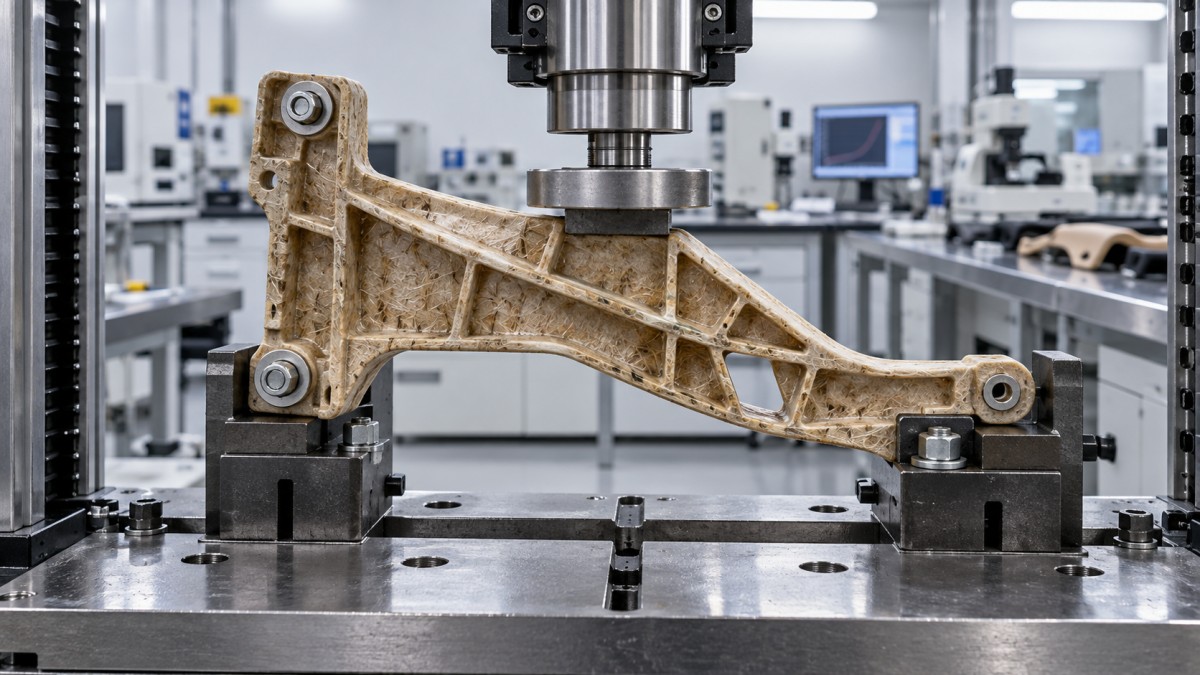
A composite panel can perform well in bending but fail locally around a fastener. Bearing stress, pull-through, edge distance, insert retention, and assembly torque all matter. Moisture-driven dimensional changes can further complicate joints between a natural-fiber composite and a metal support.
Adding ribs, thicker walls, metal inserts, or a protective coating may solve a local weakness. Those changes should be included in the comparison from the start. Otherwise, a lightweight material proposal can become a heavier assembly with more processing steps and a less straightforward recycling route.
Manufacturing also affects the result. Drying, melt residence time, fiber length retention, orientation, and weld-line location can change performance. A plaque molded under laboratory conditions is useful for screening, but production tooling may create a weak weld line exactly where an attachment needs strength. Qualification has to follow the manufacturing route intended for the vehicle.
What credible validation should include
For a serious material review, start with a component requirement rather than a resin brochure. Define the load cases, environmental exposure, allowable deformation, failure consequences, and expected service duration. Then build evidence from material specimens to joints, components, and relevant vehicle-level tests.
ISO 527 tensile testing and ISO 178 flexural testing can provide useful baseline properties when applicable. However, comparing results requires matching conditioning, specimen geometry, temperature, and test method. Neither standard, by itself, qualifies a material for a crash-critical component.
The most useful supplier questions are specific:
- Are the reported properties from the proposed reinforced compound, or only the base resin?
- How much stiffness, strength, and impact performance remain after representative heat-and-humidity exposure?
- Are creep, fatigue, and joint-retention data available for the intended loading conditions?
- How do production variability, reprocessed content, and permitted moisture levels affect the validated property range?
- Does the biodegradation evidence cover the finished formulation, and under which disposal conditions?
Chemical exposure and fire behavior also need application-specific review. Cabin parts, underbody components, and battery-adjacent assemblies face different demands. Flame retardants or barrier coatings may address one requirement while altering processing, mechanical properties, and end-of-life options. These interactions need testing, not assumptions.
Procurement teams should also require formulation traceability and change notification. Substituting a fiber treatment, stabilizer, or resin grade can invalidate part of the evidence package even if the commercial material name stays unchanged.
The environmental case needs its own evidence
Biodegradability is not automatically the most useful environmental feature for a long-lived vehicle component. During service, resistance to degradation is usually desirable. At end of life, the part must enter a collection and treatment route that can actually use its claimed properties.
A coated, bonded, mixed-material assembly may be difficult to separate and unsuitable for available composting facilities. Even where a material passes a compostability assessment, acceptance by a particular waste operator is a separate question. Automotive dismantling and shredding routes should not be assumed to deliver components to controlled biological treatment.
A meaningful comparison therefore considers the complete functional assembly: manufacturing energy, reinforcement and additives, service durability, repairability, mass, and realistic recovery options. If added thickness or premature replacement offsets a feedstock benefit, the material label is not enough to establish lower impact.
For Global Advanced Materials & Chemical Systems (AMCS), this is the useful connection between materials intelligence and supplier evaluation: chemistry, processing, retained performance, and supply consistency need to be assessed together. Renewable content and biodegradability belong in that assessment, but neither substitutes for engineering evidence.
Where development effort makes sense
The most credible starting points are components with modest loads, limited environmental exposure, inspectable failure modes, and no essential crash-management function. Even there, suitability remains formulation- and design-specific. Existing use of natural-fiber interior composites should not be presented as proof that fully biodegradable primary structures are ready.
For primary crash structures, the burden of proof remains much higher. A reinforced biodegradable material would need to demonstrate reliable aged performance, predictable dynamic failure, robust joints, and manufacturable consistency—not merely match a conventional material’s initial tensile strength.
Before funding tooling, request conditioned material data and test a representative joint under the intended load and environment. If those results are weak or unavailable, narrow the application. That is a more defensible development path than treating biodegradability as evidence of structural readiness.
Recommended News
- 2026.11.06Plasma Process Gases in Korea: Purity and Supply Criteria for ChipmakersIndustrial Gas Strategist
- 2026.11.06Battery Companies Highlight Energy Storage and Solid-State Batteries in Earnings CallsElectrochemistry Fellow
- 2026.11.05Engineering Plastics: Application Examples in Automotive and ElectronicsDr. Felix Sterling
The VitalSync Intelligence Brief
Receive daily deep-dives into MedTech innovations and regulatory shifts.