
PFAS-Free Materials Explained: Which Alternatives Meet Chemical Compliance Needs?
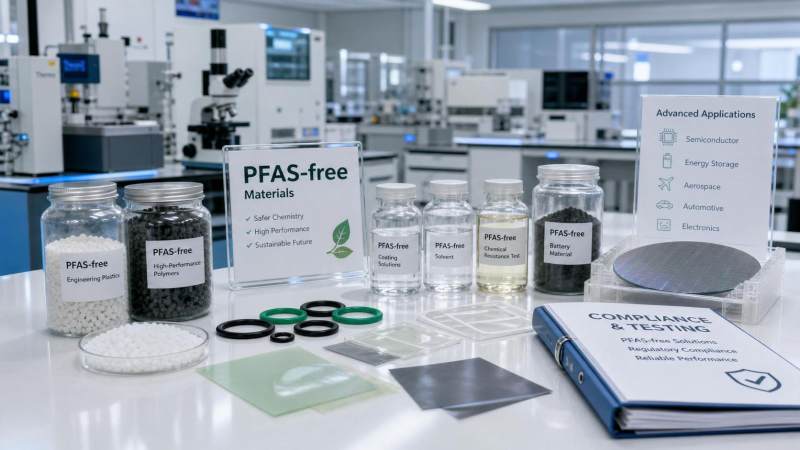
PFAS-free materials: what does the term really mean?
PFAS-free materials are materials intentionally designed without per- and polyfluoroalkyl substances in the finished formulation.
That sounds simple, but compliance review is rarely simple.
In industrial supply chains, the question is not only whether PFAS are absent.
It is also whether the substitute chemistry still meets thermal, chemical, electrical, and processing requirements.
This matters in electronics, battery materials, aerospace systems, medical devices, engineered plastics, and semiconductor chemical handling.
A useful starting point is to separate marketing language from technical evidence.
A PFAS-free claim should connect to composition data, supplier declarations, restricted substance screening, and application validation.
In practice, that is why advanced materials platforms such as AMCS track both chemistry trends and compliance signals together.
Which alternative material routes are getting the most attention?
There is no single replacement family for all PFAS-dependent applications.
The better question is which route fits the performance gap you need to close.
For coatings and surface protection, silicone, sol-gel, ceramic, hydrocarbon, and waterborne systems often appear first.
For high-temperature polymer parts, PEEK, PPS, PEI, polyimides, and modified polyolefins are commonly reviewed.
For sealing and process contact uses, engineers may compare EPDM, FKM alternatives, TPE, UHMWPE, or specialty non-fluorinated elastomers.
In semiconductor and battery-related environments, purity, extractables, and outgassing often matter more than a simple replacement matrix.
That is where PFAS-free materials need deeper review, especially when contamination can affect yield or electrochemical stability.
A quick comparison helps frame the trade-offs
How do you judge whether a PFAS-free option really meets chemical compliance needs?
A compliant substitute is not chosen by SDS review alone.
More common practice is to check four layers at the same time.
- Composition evidence, including full substance disclosure where possible.
- Regulatory mapping against EU, US, and customer-specific restricted lists.
- Performance fit under actual heat, pressure, media exposure, or purity conditions.
- Change-control readiness, including batch consistency and requalification burden.
For PFAS-free materials used near wafers, cells, or sensitive assemblies, impurity behavior can decide success faster than nominal chemistry.
That is why AMCS-style intelligence often links molecular composition with supply chain visibility and application-case interpretation.
The answer is usually found at the intersection of compliance, process stability, and contamination control.
Where do teams make the wrong call on PFAS-free materials?
One frequent mistake is treating all fluorine-free chemistries as equally safe or equally mature.
Another is assuming that a PFAS-free declaration automatically protects market access in every region.
Restrictions evolve by substance scope, article category, threshold logic, and reporting method.
A third problem is skipping long-cycle testing.
Some PFAS-free materials pass short screening, then fail during thermal cycling, chemical immersion, particle shedding, or electrical aging.
Needle-moving decisions usually come from controlled trials, not broad assumptions.
Useful checkpoints before approval
- Confirm whether the claim covers raw materials, additives, processing aids, and packaging contact.
- Ask whether the alternative changes corrosion, swelling, extractables, or particle generation.
- Review whether qualification data reflects your own temperature and media profile.
- Check supply continuity, because newer PFAS-free materials may still have narrow sourcing bases.
What about cost, timing, and implementation pressure?
The cheapest PFAS-free materials are not always the lowest-cost decision.
If a new polymer shortens tool life, increases scrap, or requires process redesign, apparent savings can disappear quickly.
Timing also matters.
High-spec sectors often need several validation rounds, especially where purity, dielectric behavior, or long-term stability is sensitive.
A practical selection path is to separate immediate restriction exposure from strategic redesign needs.
Some applications can switch to available PFAS-free materials quickly.
Others need a staged transition with pilot testing, customer approval, and updated compliance documentation.
So how should the next decision be made?
Start by defining the exact function the current chemistry performs.
Is it sealing, dielectric insulation, non-stick behavior, ultra-clean transport, corrosion resistance, or thermal endurance?
Then compare candidate PFAS-free materials against that function, not against a generic restricted-substance checklist.
Next, build a short decision file covering composition evidence, target regulations, process fit, validation data, and sourcing resilience.
That approach keeps compliance work tied to real operating risk.
For complex sectors such as semiconductor chemicals, battery materials, specialty polymers, and high-purity systems, the strongest decisions usually combine regulatory review with material intelligence.
If the path is still unclear, the next useful move is to rank alternatives by failure mode, qualification burden, and regional compliance exposure.
That turns the PFAS-free materials discussion from a label check into a defensible technical decision.
Recommended News
- 2026.09.18How to Evaluate a Polymer Compounding Manufacturer for High-Performance ApplicationsMr. Arthur Mercer
- 2026.09.17Chemical Manufacturing Compliance: Building a REACH-Ready Chemical Inventory SystemDr. Felix Sterling
- 2026.09.16Battery Material Purity Control: Critical Tests for Stable Cell PerformanceElectrochemistry Fellow
The VitalSync Intelligence Brief
Receive daily deep-dives into MedTech innovations and regulatory shifts.