
Materials Science Trends Reshaping Product Design in 2026
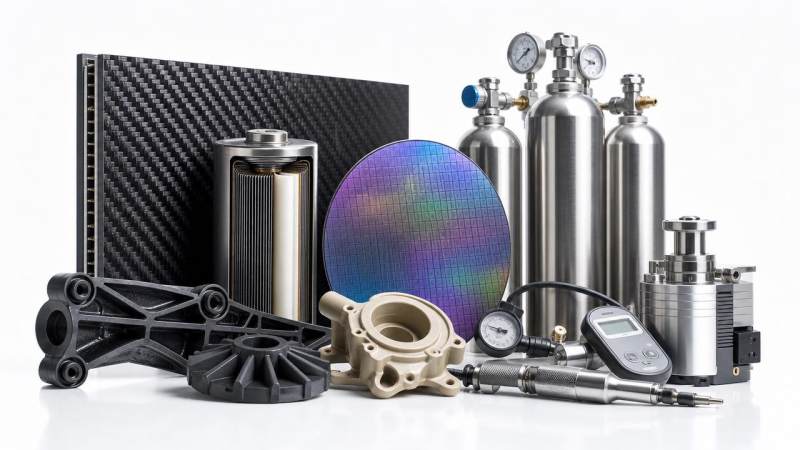
In 2026, materials science has moved from the lab to the center of product design decisions. It now defines how products meet stricter targets for weight, strength, purity, heat resistance, efficiency, and sustainability.
Across energy, aerospace, electronics, mobility, healthcare, and industrial equipment, design teams are no longer choosing shapes first. They are choosing molecular performance first, then building products around those limits and opportunities.
This shift is especially visible in carbon fiber composites, battery chemicals, semiconductor materials, specialty engineering plastics, and industrial specialty gases. Together, these fields show why materials science is reshaping product design in practical and measurable ways.
Why 2026 Feels Like a Turning Point for Materials Science
Several signals explain the acceleration. Performance ceilings are harder to break with traditional metals and legacy polymers. At the same time, regulatory pressure, supply chain risk, and energy efficiency targets are forcing deeper material innovation.
Modern product design now depends on advanced material behavior under extreme conditions. Engineers must consider ionic transport, impurity control, dielectric stability, fatigue resistance, and chemical compatibility much earlier in development.
This is where materials science becomes a strategic discipline. It reduces failure risk, improves manufacturability, and supports differentiation in markets where performance gains are increasingly microscopic but commercially decisive.
The Strongest Trend Signals Are Coming From Five Material Frontiers
The most important product design changes in 2026 can be traced to five advanced material categories. Each one is influencing how products are conceived, validated, and scaled.
- Carbon fiber composites are enabling lighter structures without sacrificing stiffness or fatigue performance.
- Battery cathodes, anodes, and electrolytes are redefining energy density, charging speed, and thermal safety.
- Electronic chemicals are pushing purity standards to levels where tiny contamination ruins entire device batches.
- Specialty engineering plastics are replacing metals in high-heat, corrosive, and radio-frequency environments.
- Industrial specialty gases are becoming precision tools for atomic-scale manufacturing consistency.
For organizations following AMCS intelligence areas, these frontiers are not isolated sectors. They are interconnected signals showing how materials science is setting the next rules of product competitiveness.
What Is Driving These Materials Science Trends
The rise of advanced materials in product design is not random. It is being driven by technical, commercial, and geopolitical forces that now interact more tightly than before.
These drivers explain why materials science now affects concept design, process development, and long-term product economics at the same time.
How Product Design Is Changing Across Key Industrial Applications
Aerospace and mobility are designing around lighter, stronger structures
Carbon fiber composites are changing structural logic. Instead of reinforcing heavy parts, teams are redesigning architectures to exploit directional strength, fatigue resistance, and lower inertia.
This means fewer components, better aerodynamic freedom, and improved energy efficiency. In these sectors, materials science directly influences performance, maintenance cycles, and certification pathways.
Energy storage products are being defined by electrochemical limits
Battery design in 2026 depends heavily on high-nickel cathodes, silicon-rich anodes, and new electrolyte systems. Small material shifts now decide charging speed, lifecycle, safety margins, and pack architecture.
Solid-state development also shows how materials science shapes future design. Interfacial impedance, crystal stability, and ion pathways are becoming core design constraints, not secondary research topics.
Semiconductor products rely on purity as a design parameter
In chip manufacturing, design success depends on process chemistry as much as layout. Photoresists, wet chemicals, and specialty gases must perform with extraordinary consistency at nanometer scales.
This creates a new design reality. Material purity, defect density, and reaction precision are now part of functional product performance, making materials science central to electronic innovation.
Medical, telecom, and industrial products are adopting specialty plastics faster
PEEK, PTFE, and related polymers are replacing metals where corrosion, weight, signal integrity, or biocompatibility matter. Their value comes from stability under heat, chemicals, and electromagnetic exposure.
As a result, product designers can reduce assembly complexity and improve durability. Here again, materials science expands design freedom while meeting harsher operating demands.
What These Shifts Mean for Business Decisions and Operating Models
The impact extends beyond engineering. Material selection now affects capital planning, supplier qualification, intellectual property strategy, compliance exposure, and time-to-market assumptions.
Organizations that treat advanced materials only as procurement items may react too late. In 2026, materials science is shaping the economics of product launches and the durability of competitive advantage.
- Qualification cycles are becoming longer for high-purity and safety-critical materials.
- Formula ownership and process know-how are creating stronger entry barriers.
- Regional compliance differences are changing product platform choices.
- Material data quality is becoming essential for simulation and faster iteration.
The Most Important Materials Science Priorities to Watch Now
Several focus areas deserve close monitoring because they will likely determine which designs succeed under 2026 conditions.
- Purity thresholds: Trace contamination is becoming a strategic risk in semiconductors and advanced batteries.
- Substitution readiness: Regulatory shifts require alternatives for restricted fluorinated materials and sensitive chemicals.
- Interface engineering: Battery and composite performance often depends on boundaries, not bulk material alone.
- Local supply resilience: Material availability increasingly depends on regional production ecosystems.
- Sustainability metrics: Low-carbon synthesis and recyclability are moving closer to purchasing and approval criteria.
These priorities show that materials science is no longer only about better performance. It is also about continuity, compliance, and strategic flexibility.
Practical Ways to Respond to the 2026 Materials Shift
A structured response matters because advanced materials can create both opportunity and hidden dependence. Strong insight reduces blind spots and improves decision quality across the full product lifecycle.
Why Deeper Intelligence Will Matter More Than General Market Noise
The next phase of competition will reward precise understanding, not broad headlines. Material behavior at molecular and impurity levels increasingly determines manufacturability, reliability, and commercial viability.
That is why specialized intelligence platforms such as AMCS have growing relevance. They connect materials science with carbon fiber, battery chemicals, electronic chemicals, specialty plastics, and industrial gases in one decision framework.
In 2026, the best next step is clear: monitor material signals earlier, connect chemistry with product strategy, and evaluate how advanced material shifts will alter design rules before markets fully react.
Recommended News
- 2026.09.18How to Evaluate a Polymer Compounding Manufacturer for High-Performance ApplicationsMr. Arthur Mercer
- 2026.09.17Chemical Manufacturing Compliance: Building a REACH-Ready Chemical Inventory SystemDr. Felix Sterling
- 2026.09.16Battery Material Purity Control: Critical Tests for Stable Cell PerformanceElectrochemistry Fellow
The VitalSync Intelligence Brief
Receive daily deep-dives into MedTech innovations and regulatory shifts.