
EU Lithium-Ion Battery Compliance: Chemical Limits and Safety Testing
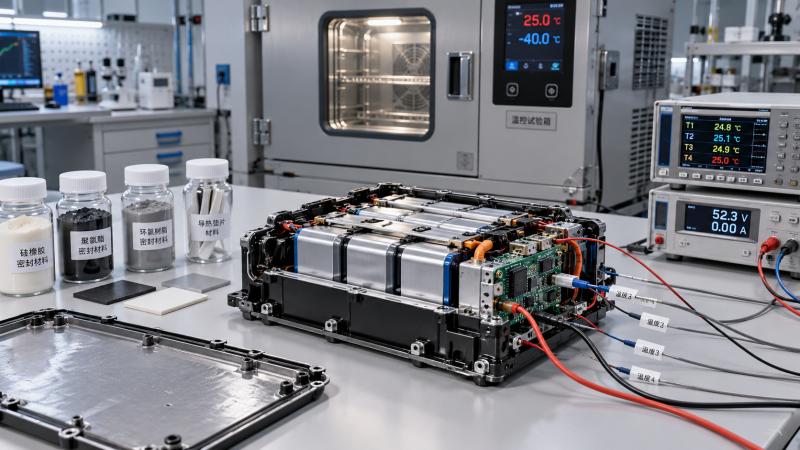
EU lithium-ion battery compliance requires separate evidence for chemical restrictions, product safety, and transport classification. A UN 38.3 test summary does not establish compliance with EU substance limits, and a chemical declaration does not demonstrate resistance to electrical or thermal abuse. The assessment begins with the battery category, intended application, and exact configuration placed on the market.
The EU Batteries Regulation, REACH, and application-specific safety requirements address different questions. A defensible compliance file connects each applicable requirement to the tested battery, its material composition, and its production controls. Unexplained gaps between cell documentation and the finished pack are a common reason that apparently complete submissions remain technically inadequate.
Chemical limits: identify the denominator before interpreting results
Under Regulation (EU) 2023/1542, Annex I restricts mercury in batteries and cadmium and lead in portable batteries, subject to the applicable provisions and exemptions. These restrictions also cover batteries incorporated into products. Classification therefore changes the assessment: a rechargeable lithium-ion battery is not automatically a portable battery simply because it can be carried.
These are battery-weight limits. A result measured in electrode powder, solder, or a metal component cannot be compared directly without accounting for that material’s contribution to total battery mass. Conversely, testing a diluted composite sample can conceal the location of contamination and weaken root-cause analysis.
A laboratory report should identify the sampled product, preparation method, analytical technique, reporting limit, and measurement units. “Not detected” is useful only when the reporting limit is sufficiently below the applicable restriction. X-ray fluorescence screening can locate suspect metallic components, but quantitative verification requires a suitable validated method and representative sample preparation.
REACH evidence follows a different assessment logic
REACH obligations require a separate assessment of substances, mixtures, and articles within the supplied product. Candidate List inclusion does not automatically prohibit a substance. It can trigger communication obligations when a substance of very high concern exceeds 0.1% by weight in an article. For complex objects, that assessment cannot simply use the mass of the complete battery pack as the denominator for every constituent article.
REACH Annex XVII restrictions are distinct from Candidate List duties. Their substance scope, concentration basis, application conditions, and exemptions must be read individually. A generic “REACH compliant” statement does not identify which restrictions were assessed or which Candidate List version informed the declaration.
Electrolyte safety data sheets support chemical handling and formulation review, but they do not establish compliance of the complete battery. Useful supporting evidence includes component declarations, substance identities where required, concentration information, and traceability to the supplied revision. Confidential formulations still need an evidence route that supports a documented compliance conclusion.
Chemistry changes the safety questions
Electrode chemistry affects thermal stability, but chemistry names alone cannot establish pack safety. Lithium iron phosphate generally offers greater cathode thermal stability than high-nickel layered oxides. Nevertheless, flammable electrolyte, internal short circuits, electrical interconnections, and accumulated pack energy remain relevant. A favorable cathode characteristic does not remove the need to evaluate the assembled system.
Electrolyte condition also matters. Moisture contamination can promote decomposition of lithium hexafluorophosphate-based electrolytes and formation of corrosive products, including hydrogen fluoride. Water-content specifications, drying controls, and sealing integrity therefore support both performance consistency and safety. A finished-battery heavy-metal test says little about these mechanisms.
Charging conditions introduce another distinction. Lithium plating becomes more likely when charging conditions exceed the cell’s validated operating envelope, particularly at low temperature. The relevant evidence connects cell limits to temperature sensing, charge-current control, and fault handling. Nominal capacity and room-temperature cycling results cannot establish safe charging across the declared operating range.
Select safety tests by application and assembly level
UN 38.3 addresses transport testing of lithium cells and batteries. Its prescribed tests include altitude simulation, thermal testing, vibration, shock, external short circuit, and other tests applicable to the cell or battery type. The test summary must correspond to the transported design. Transport evidence does not establish safety throughout the battery’s intended service life.
IEC 62133-2 addresses portable sealed secondary lithium cells and batteries for portable applications. IEC 62619 addresses secondary lithium cells and batteries for industrial applications. Their scope and assembly-level requirements differ. Neither standard number should be accepted without confirming that the product, intended use, and tested configuration fit its scope.
Road-vehicle batteries require assessment against the relevant vehicle approval framework, including UN Regulation No. 100 where applicable. Stationary battery energy storage systems also have specific safety requirements under the EU Batteries Regulation. A portable-battery test report cannot automatically support either application.
Standards become legally significant through the applicable regulatory framework. An IEC report does not by itself confer EU conformity, and an EN designation alone does not establish presumption of conformity. That effect depends on the relevant harmonised standard citation, its scope, and any limitations published in the Official Journal.
The tested configuration must match the supplied battery
A cell report leaves unresolved questions about pack interconnections, enclosure behavior, protective devices, and software. Series and parallel arrangements change fault currents and energy release. Thermal barriers, vent paths, and spacing influence whether a failing cell exposes adjacent cells to damaging heat.
Reports should identify cell models, pack drawings, protection settings, firmware revisions, and test conditions sufficiently to connect the results to production. State of charge, ambient temperature, aging condition, and cooling arrangements affect interpretation. Passing under one cooling configuration does not support an installation that blocks the specified airflow.
Changes require a documented assessment of continued validity. Substituting an electrolyte, separator, cell source, fuse, or protection firmware can alter the basis of earlier evidence. The necessary response ranges from justified document review to additional testing, according to the affected requirements and test scheme.
The technical documentation should link substance evidence, safety reports, design revisions, and the applicable conformity assessment. The EU declaration of conformity and CE marking follow the relevant legal obligations; they do not replace the underlying evidence. A release decision remains unresolved wherever a material declaration, tested specimen, or protection setting cannot be traced to the battery actually supplied.
Recommended News
- 2026.10.29Sourcing Wet Electronic Chemicals in Taiwan: Purity and Supply ReliabilitySemiconductor Chemistry Architect
- 2026.10.29China SAE Names 400 Wh/kg Solid-State Batteries Among Its Top 10 Trends for 2027Electrochemistry Fellow
- 2026.10.28Sourcing Battery Cathode Materials: How to Assess Supplier Quality and CapacityMr. Arthur Mercer
The VitalSync Intelligence Brief
Receive daily deep-dives into MedTech innovations and regulatory shifts.