
EU Adopts REACH Revision for PTFE and PEEK
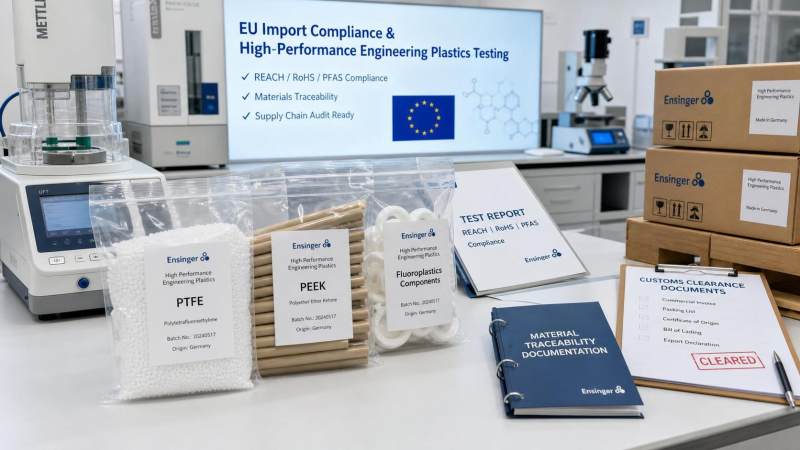
On July 18, 2026, the European Commission published Regulation (EU) 2026/1427 in the Official Journal of the European Union, formally revising REACH Annex XVII. The change introduces a new compliance requirement from January 1, 2027 for PTFE, PEEK, and other fluorinated engineering plastic products exported to the EU: shipments must be accompanied by a Life Cycle Compliance Dossier submitted by an EU authorized representative. For fluoropolymer exporters, processors, import-facing supply chains, and downstream buyers, this is worth close attention because the requirement is tied directly to customs clearance and customer access.
What the new filing requirement includes
According to the information provided, Regulation (EU) 2026/1427 was published by the European Commission in the OJEU on July 18, 2026 and formally revised REACH Annex XVII. The rule will apply from January 1, 2027 to all PTFE, PEEK, and fluorinated engineering plastic products exported to the EU.
The required Life Cycle Compliance Dossier, or LCA-Dossier, must be submitted by an EU authorized representative. The dossier must cover monomer source information, PFAS trace testing reports with a limit of detection of no more than 0.1 ppb, assessment of alternatives, and verification of recycling pathways.
The event summary also makes clear that the requirement directly affects customs clearance and customer admission for Chinese fluoropolymer export companies.
Where pressure is likely to appear first in the value chain
Export transactions may face a document-first threshold
From an industry perspective, direct exporters are likely to feel the impact first because the new requirement is attached to EU-bound shipments and customer access. The immediate pressure point is not only product movement, but whether the accompanying dossier can be prepared, submitted, and aligned with the EU authorized representative in time for delivery.
Upstream material traceability becomes more operationally relevant
Analysis shows that suppliers involved in resin sourcing and material preparation may come under closer scrutiny because the dossier must include monomer source information and PFAS trace testing results. In practical terms, that can shift attention toward the completeness and consistency of upstream supporting records rather than only final product declarations.
Manufacturers and converters may need to connect product data to recycling claims
For processing and manufacturing companies, the requirement matters because it extends beyond composition and testing to include alternative assessments and recycling pathway verification. What deserves closer attention is that compliance, in this case, appears linked to how production data, technical documentation, and end-of-life-related evidence are organized for EU-facing use.
EU customers and procurement teams may tighten pre-access checks
Observably, downstream buyers and procurement teams serving the EU market may treat the dossier as part of supplier onboarding or continued sourcing review. That means the effect may show up not only at customs, but earlier in quotation, approval, and contract execution stages where buyers ask whether the dossier can be supported through an EU authorized representative.
What companies should monitor before the 2027 start date
Track how the filing requirement is expressed in practice
Analysis shows that companies should pay close attention to how the formal rule language is reflected in actual documentation workflows. The summary confirms the mandatory dossier elements, but day-to-day execution will depend on whether internal product, sourcing, and testing records can be assembled in a form suitable for submission by an EU authorized representative.
Review which product lines fall within the immediate exposure zone
What deserves closer attention is the scope of PTFE, PEEK, and fluorinated engineering plastic products destined for the EU from January 1, 2027. For companies with mixed regional sales, the key practical issue is to identify which export streams, customer programs, and delivery schedules may require dossier readiness first.
Check whether existing supplier documents can support the required contents
From an industry perspective, companies should compare current material declarations and test files against the specific dossier elements already named in the event summary: monomer source information, PFAS trace testing at LOD less than or equal to 0.1 ppb, assessment of alternatives, and recycling pathway verification. The gap may not be whether documents exist, but whether they are complete enough for EU-facing review.
Prepare for longer coordination cycles with customers and representatives
Observably, the requirement that the dossier be submitted by an EU authorized representative adds a coordination layer that companies cannot treat as a last-minute paperwork item. Exporters, service providers, and customer-facing teams may need to align earlier on document ownership, submission timing, and communication responsibilities tied to customs clearance and customer qualification.
Why this should be read as more than a short-term filing update
Analysis shows that this development is better understood as an operational compliance signal rather than a routine documentation adjustment. The confirmed facts already indicate that access to the EU market for covered fluoropolymer products will depend on a dossier that links sourcing, testing, alternatives, and recycling verification in one package.
At the same time, it is more appropriate to understand this as a rule with immediate practical consequences and continued monitoring needs. The legal adoption has been confirmed, and the effective date has been stated, but the broader commercial effect will depend on how market participants adapt their documentation, customer review processes, and shipment preparation ahead of 2027.
How the industry can frame this development now
The clearest takeaway is that this is not merely a policy headline for the fluoropolymer sector. Based on the provided information, the REACH revision creates a defined compliance condition for PTFE, PEEK, and related fluorinated engineering plastic exports to the EU, with direct relevance to customs clearance and customer access.
A neutral reading is that the event already establishes a concrete near-term compliance obligation, while its wider commercial impact still needs to be observed through implementation. It is more appropriate to understand this as a confirmed regulatory change with both immediate preparation value and longer-running implications for EU-facing supply chain documentation.
Basis of this article and points for continued verification
This article is based on the user-provided news title, event date, and event summary concerning the European Commission's adoption of a REACH revision on July 18, 2026. In this type of industry update, commonly relevant source categories may include official regulatory notices, company disclosures, industry association updates, authoritative media reporting, and standard-setting or compliance-related documents.
No specific official source link was provided in the input, so the exact official link still needs continued verification. Follow-up attention should remain on any subsequent official wording, implementation clarifications, and how the stated dossier requirements are applied in actual EU-bound trade and customer access processes.
Recommended News
- 2026.09.14Gel Battery Electrolytes: How Ionic Conductivity and Stability Shape Cell DesignElectrochemistry Fellow
- 2026.09.13Fluoropolymer Extrusion Process: How Melt Control Affects Tube QualityPolymer Synthesis Expert
- 2026.09.12How German Implant Makers Select Medical Polymers for Long-Term BiocompatibilityPolymer Synthesis Expert
The VitalSync Intelligence Brief
Receive daily deep-dives into MedTech innovations and regulatory shifts.