
EU Adds 5 PFAS Restrictions Under REACH From July 1
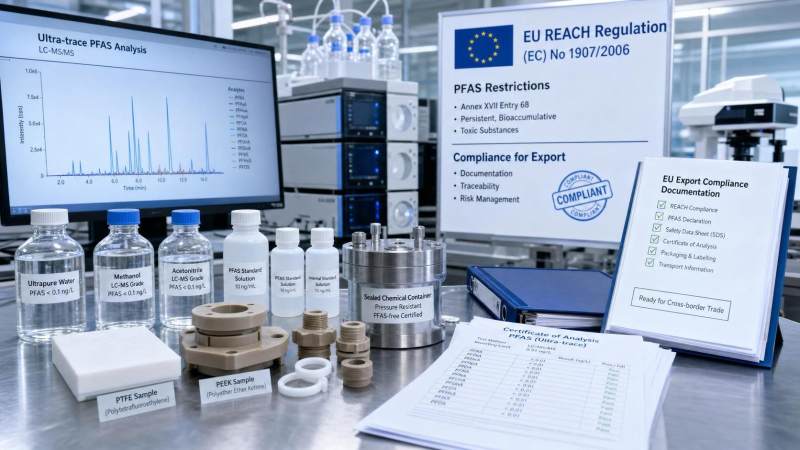
On June 26, 2026, the European Commission issued Regulation (EU) 2026/1389, adding five new perfluoroalkyl sulfonates under Entry 68 of REACH Annex XVII. The measure is especially relevant to fluoropolymer and specialty chemical trade involving PEEK, PTFE, fluorinated electronic gas precursors, and fluorinated wet electronic chemicals. From an industry perspective, this matters not only because the rule takes effect from July 1, 2026, but also because exports to the EU involving ultra-trace levels at or above 25 ppb will now face declaration requirements and customs sampling, bringing immediate compliance and cost implications for affected suppliers.
What the new REACH measure covers
According to the information provided, the European Commission on June 26, 2026 adopted Regulation (EU) 2026/1389 and included five new PFAS substances in Entry 68 of REACH Annex XVII. The restriction explicitly applies to polymers and specialty chemicals including PEEK, PTFE, fluorinated electronic specialty gas precursors, and fluorinated wet electronic chemicals.
The rule requires that, starting July 1, 2026, finished products or intermediates exported to the EU that contain the restricted PFAS at ultra-trace levels of 25 ppb or above must be accompanied by a compliance declaration. The information provided also states that customs authorities in EU member states may conduct sample testing.
The stated direct impact is on the export route to the EU for Chinese fluoropolymer suppliers, as well as on related testing and certification costs.
Where the pressure is likely to emerge in the supply chain
Export-facing fluoropolymer suppliers
Analysis shows that the most immediate effect falls on suppliers shipping fluoropolymer-related products into the EU market. The reason is straightforward: the new rule is tied directly to export declarations and customs sampling. The business impact is therefore likely to concentrate on pre-shipment review, product compliance documentation, and whether existing test evidence is sufficient for cross-border clearance.
Producers of specialty electronic chemicals
For manufacturers dealing with fluorinated electronic gas precursors and fluorinated wet electronic chemicals, the issue is not only whether a product is covered in principle, but whether the relevant restricted PFAS may be present at or above the stated threshold. What deserves closer attention is the connection between formulation control, supporting documents, and customs-facing compliance presentation for products moving into the EU.
Procurement and sourcing teams
From an industry perspective, procurement functions may also feel the impact where imported or exported intermediates are involved. If a business depends on upstream material declarations to support outbound compliance, any uncertainty in supplier data could affect order confirmation, shipment timing, and customer communication. The practical concern is less about broad policy interpretation and more about whether supply chain records can support the required declaration from July 1 onward.
Logistics and trade compliance service providers
Observably, customs sampling raises a direct operational issue for companies managing cross-border documentation, customs filing, and shipment scheduling. Service providers supporting EU-bound shipments may need to monitor whether product files, declarations, and testing records are aligned closely enough to withstand sampling checks without creating avoidable delays.
What companies should watch now
How the rule is applied in practice
Analysis shows that businesses should distinguish between the legal text itself and its day-to-day implementation. The regulation sets a clear compliance trigger and mentions customs sampling, but the operational burden will depend on how companies prepare declarations, how consistently product categories are reviewed, and how member-state enforcement is handled in practice.
Which product lines need immediate screening
The most relevant product focus, based on the information provided, includes PEEK, PTFE, fluorinated electronic gas precursors, and fluorinated wet electronic chemicals. Companies connected to these categories should pay close attention to whether finished goods or intermediates destined for the EU may contain the restricted substances at or above 25 ppb, because that threshold links directly to the declaration requirement.
Document readiness before shipment
What deserves closer attention is whether internal and supplier-side documentation is ready before goods move. In practical terms, the new requirement points to the importance of compliance declarations, traceability of material information, and a review of whether current testing and certification arrangements are adequate for EU-bound business.
Customer and supplier communication
Observably, this is also a communication issue across contracts and delivery schedules. Exporters, upstream suppliers, and EU customers may need a clearer alignment on declarations, supporting records, and shipment timing, especially where customs sampling could affect delivery certainty or add cost to the transaction.
Why this looks like more than a short-lived procedural change
Analysis shows that this development is better understood as an operational compliance signal with immediate effect rather than as a distant policy discussion. The timeline is short, the threshold is defined, and the rule is connected directly to export declarations and customs checks. At the same time, it would be premature to treat every commercial outcome as settled, because the practical effect on different product lines and shipment flows will still depend on implementation and ongoing verification.
It is more appropriate to understand this as a concrete near-term trade compliance change that also carries a longer-term regulatory signal for fluoropolymer and specialty chemical exporters serving the EU market.
How to read the development at this stage
From an industry perspective, the main significance of this update is that PFAS-related REACH control is moving into a more immediate export-management context for affected fluorinated materials and chemicals. The short-term issue is compliance execution from July 1, 2026. The broader signal is that companies selling into the EU may need tighter control over trace-level substance identification, declarations, and shipment documentation.
At the current stage, this is best understood neither as a routine paperwork adjustment nor as a fully settled long-term market outcome. It is a confirmed regulatory change with near-term operational consequences, while its broader commercial implications still require continued observation.
Basis of this article and points requiring follow-up
This article is based on the user-provided news title, event date, and event summary. The content has been written from the information that the European Commission issued Regulation (EU) 2026/1389 on June 26, 2026, added five new PFAS substances under REACH Annex XVII Entry 68, identified relevant product categories, and required compliance declarations and customs sampling from July 1, 2026 for EU exports meeting the stated threshold.
For this type of industry update, the source categories that are commonly relevant include official regulatory notices, company disclosures, industry association releases, authoritative media reporting, and standards-related documents. A specific official source link was not provided in the input, so further verification remains necessary. Follow-up attention should stay on any later official clarification, implementation details, and how the declaration and sampling requirements are applied in actual EU-bound trade flows.
Recommended News
- 2026.09.14Gel Battery Electrolytes: How Ionic Conductivity and Stability Shape Cell DesignElectrochemistry Fellow
- 2026.09.13Fluoropolymer Extrusion Process: How Melt Control Affects Tube QualityPolymer Synthesis Expert
- 2026.09.12How German Implant Makers Select Medical Polymers for Long-Term BiocompatibilityPolymer Synthesis Expert
The VitalSync Intelligence Brief
Receive daily deep-dives into MedTech innovations and regulatory shifts.