
Which Electrolyte Additive Most Improves Lithium Battery Cycle Life?
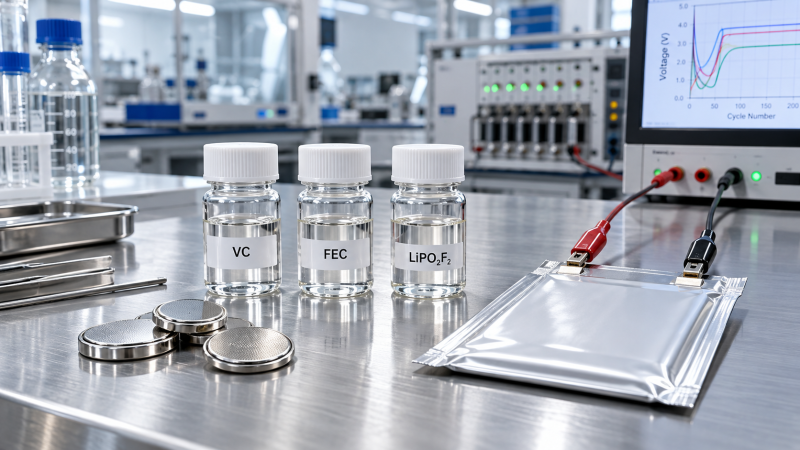
Which electrolyte additive improves lithium battery cycle life most? There is no universal winner, but there is a useful starting shortlist: vinylene carbonate (VC) for graphite-based cells, fluoroethylene carbonate (FEC) for silicon-containing anodes, and lithium difluorophosphate (LiPO₂F₂) when cathode-side degradation is a major concern. These are candidates for screening, not interchangeable solutions. Their ranking changes with electrode chemistry, charging voltage, temperature, concentration, and the rest of the electrolyte formulation.
The practical question is not which additive produces the longest cycle-life curve in a published experiment. It is which formulation slows the dominant failure mechanism in your cell without creating unacceptable resistance, gas, or manufacturing complications. That distinction matters when moving from laboratory coin cells to commercial pouch or cylindrical formats.
Start with the failure mechanism, not the additive name
Most electrolyte additives improve cycling by changing reactions at electrode surfaces. At the anode, the solid electrolyte interphase, or SEI, must limit continued electrolyte reduction while allowing lithium ions to pass. At the cathode, the cathode electrolyte interphase, or CEI, can help suppress electrolyte oxidation and other surface reactions. Neither layer is simply “better” because it is thicker or contains more inorganic material.
A protective layer that becomes too resistive may preserve capacity during gentle cycling but reduce usable energy under load. An additive that improves initial passivation may also generate gas during formation or storage. The trade-off often appears only after changing temperature, charging rate, or cell format.
Before choosing a candidate, ask what is actually limiting life. Is lithium inventory being consumed by repeated SEI repair? Is the positive electrode driving electrolyte oxidation? Is impedance increasing during high-state-of-charge storage? Or is fast charging causing lithium plating? Additives can influence these processes, but they cannot reliably compensate for poor electrode design, unsuitable charging protocols, or inadequate thermal control.
Where VC, FEC, and LiPO₂F₂ deserve a place
VC: a sensible graphite benchmark, not an automatic upgrade
Vinylene carbonate is widely studied as a film-forming additive in carbonate-based electrolytes. It can undergo preferential reduction and contribute to an SEI that limits further solvent decomposition on graphite. For conventional graphite cells, that makes VC a reasonable benchmark against which to compare newer additives.
The important qualification is dosage. Increasing VC does not necessarily produce a proportional improvement. Depending on the formulation and formation protocol, additional reaction products can raise interfacial resistance or alter gas evolution. A concentration that works at room temperature may not offer the best low-temperature power performance.
VC also cannot be judged independently of the positive electrode. If a graphite–high-nickel cell is losing capacity mainly through cathode-driven reactions, improving anode passivation alone may leave the principal failure mechanism largely untouched.
FEC: particularly relevant when silicon changes the interface
Silicon creates a different problem. Its volume changes during cycling can disrupt the interphase and expose fresh reactive surface. Continued electrolyte decomposition then consumes cyclable lithium and electrolyte. FEC can promote a fluorine-containing, often lithium-fluoride-rich interphase that helps stabilize silicon-containing electrodes.
That is why FEC belongs near the top of the screening list for silicon–graphite formulations. However, silicon content alone does not determine the required amount. Silicon particle structure, surface area, binder, electrode porosity, and electrolyte quantity all affect consumption and performance.
A useful warning sign is strong early cycling followed by accelerated fading. One possible explanation is depletion of a beneficial electrolyte component, including FEC, although electrode damage and other mechanisms must also be investigated. In some silicon systems, FEC is used at a substantial solvent fraction rather than a small additive dose. Comparisons should make that distinction explicit.
LiPO₂F₂: a candidate when cathode protection needs more attention
Lithium difluorophosphate can contribute fluorine- and phosphorus-containing interphase species. It is studied for stabilizing interfaces in demanding lithium-ion chemistries, including cells with high-nickel or higher-voltage cathodes. Its effects can involve both electrodes, so describing it solely as a cathode additive is too restrictive.
Its appeal is strongest when an anode-focused additive is not addressing the whole problem. Even then, compatibility matters: salt chemistry, solvents, moisture, concentration, and co-additives can change the outcome. Solubility and storage stability also need checking before a promising laboratory formulation becomes a production candidate.
Do not confuse LiPO₂F₂ with lithium difluoro(oxalato)borate, commonly called LiDFOB. Both appear in electrolyte research, but they have different compositions and reaction pathways. An abbreviated supplier description is not enough to establish chemical identity.
Why an additive package can outperform a single molecule
A full cell has two reactive electrodes sharing one electrolyte. It is therefore reasonable to combine an additive that supports anode passivation with another that addresses cathode-side reactions. Borate-based compounds, sulfur-containing film formers, and selected scavengers may also enter the screening process when the failure analysis supports them.
But beneficial ingredients do not necessarily add up to a beneficial mixture. They can compete for reaction sites, change one another’s decomposition pathways, or generate a more resistive interphase. A package may also increase formation gas even when its cycling results improve.
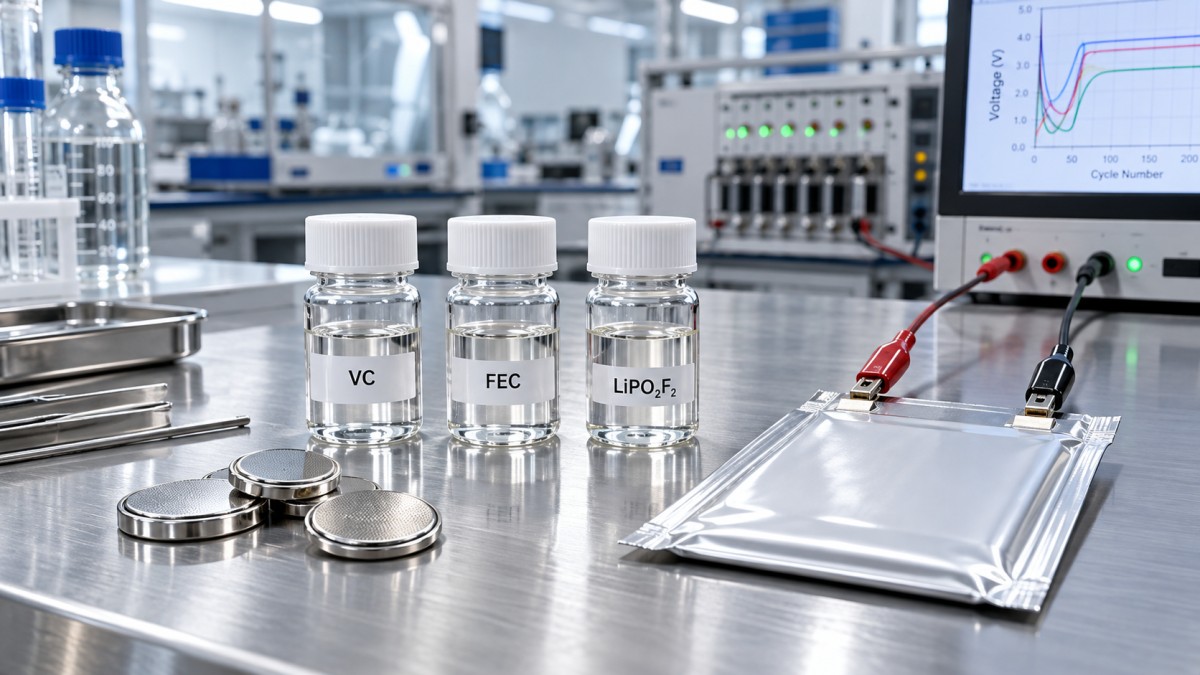
A manageable experiment compares the base electrolyte, each candidate individually, and selected combinations. Keep the base salt and solvent system unchanged unless changing them is an explicit experimental variable. Otherwise, the apparent “additive effect” may actually come from a different solvent balance or salt concentration.
Read cycle-life claims as test conditions, not rankings
A cycle count without operating conditions is not a meaningful purchasing specification. A cell cycled over a restricted state-of-charge window faces different stresses from one repeatedly charged to its upper voltage limit. Likewise, a gentle laboratory discharge can conceal resistance growth that matters in an EV acceleration pulse or a power-tool load.
For a credible comparison, request the following information:
- Cell construction: electrode chemistry, active-material loading, negative-to-positive capacity ratio, and electrolyte quantity relative to capacity.
- Operating protocol: voltage limits, charge and discharge rates, constant-voltage termination, temperature, and rest periods.
- Formation history: initial charging procedure, temperature, aging, and any degassing steps.
- Performance definition: capacity-retention reference, end-of-life threshold, resistance method, and energy-efficiency results.
- Repeatability: replicate count, cell-to-cell variation, and treatment of failed cells.
Lithium-metal half-cell results need particular care. They can help identify electrode behavior, but excess lithium changes the lithium-inventory constraint. A silicon electrode that performs well against lithium metal may still lose unacceptable capacity in a practical full cell. Excess electrolyte can similarly delay depletion that becomes important under lean-electrolyte conditions.
Track absolute delivered capacity alongside percentage retention. A formulation that sacrifices substantial initial capacity can look attractive when subsequent performance is normalized to its own starting point. Also measure impedance and gas: a cell that retains capacity but swells excessively or cannot deliver required power has not met the application requirement.
Concentration and formation belong in the same development plan
There is no defensible universal “best percentage” for VC, FEC, or LiPO₂F₂. Published concentrations are starting points only when the underlying chemistry is comparable. Even the reporting basis matters: weight percent of the final electrolyte is not interchangeable with volume percent of the solvent mixture.
Screen a justified concentration range rather than selecting one level and declaring the molecule ineffective. Then revisit formation. Because many additives work through controlled decomposition, formation current, temperature, and voltage holds can influence the interphase they produce.
Qualification should also include storage. A formulation that improves continuous cycling may behave differently during prolonged high-state-of-charge storage, especially at elevated temperature. For applications with long idle periods, calendar-aging behavior can be as important as cycling performance.
The supplier specification is part of the electrochemistry
Once a formulation works, procurement has to preserve it. “Battery grade” is not a complete specification. Buyers should establish agreed limits and test methods for water, relevant acidic species, metals, and synthesis-related impurities. Packaging, transport conditions, shelf life, and sampling procedures also affect whether material arrives fit for use.
For moisture-sensitive LiPF₆-based systems, water control is especially important because hydrolysis-related chemistry can produce harmful acidic species. A nominally identical additive from another source should therefore undergo analytical and cell-level qualification, not just a certificate-of-analysis comparison.
This connection between molecular performance, purity control, and supply reliability is central to the battery-materials coverage of Global Advanced Materials & Chemical Systems (AMCS). An additive is not commercially qualified merely because one laboratory batch performs well; consistency and change control must support that result.
The practical verdict: start with VC for graphite interphase screening, give FEC serious consideration for silicon-containing anodes, and investigate LiPO₂F₂ when cathode-side instability warrants it. Select the winner only after matched full-cell testing shows better useful life without unacceptable impedance, swelling, storage degradation, or supply variability. The best additive is the one that resolves your cell’s limiting mechanism—not the one attached to the largest published cycle count.
Recommended News
- 2026.11.05Japan's JIC Plans to Sell JSR to Mitsui Chemicals for Over 1.3 Trillion YenMr. Arthur Mercer
- 2026.11.04ECHA PFAS Restriction Proposal: Scope and What Manufacturers Should KnowDr. Felix Sterling
- 2026.11.04Dongguk University Develops Ultrathin Anode-Free Solid-State Battery PlatformElectrochemistry Fellow
The VitalSync Intelligence Brief
Receive daily deep-dives into MedTech innovations and regulatory shifts.